

When it comes to cleaning up live drums, few tools divide opinion quite like a gate.
Ask ten mixers what their favourite drum gate is and you will get ten passionate answers, usually followed by a story about hi-hat bleed, unusable tom mics, or that one snare track that almost ruined a mix.
A few months ago, we asked exactly that question across YouTube, Facebook, Instagram, email, the academy, and the students page. What is your favourite plugin for gating drums? The result was clear. Sonnox Oxford Drum Gate came out on top. However, there were so many strong suggestions for other favourites that it felt only fair to put the top contenders head to head and see what really happens in a proper mix situation.
So that is exactly what we did.
Rather than testing these plugins on a beautifully recorded, surgically isolated modern drum kit, I wanted to make life difficult. The track we used, by our good friends The Last Internationale, is a far more realistic challenge for many of us. This kit was recorded with just five microphones, mono kick, mono snare, mono overhead, mono room, and a trash mic. No stereo imaging, no close tom mics, plenty of bleed, and lots of hi-hat pouring into the snare mic.
In other words, exactly the kind of session where a drum gate actually has to earn its keep.
The Five Drum Gates in the Shootout
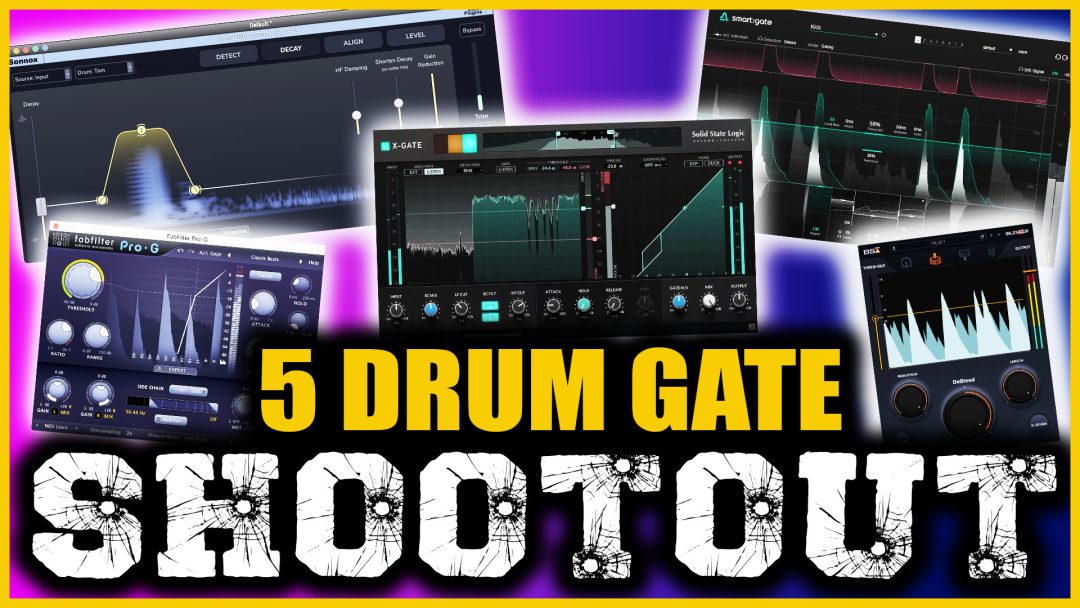
The five plugins we tested were:
Sonnox Oxford Drum Gate A drum-specific gate with intelligent transient detection, ghost note preservation, natural decay handling, and built in time alignment.
FabFilter Pro-G Not specifically designed for drums, however extremely flexible, very clean, and packed with detailed visual feedback and sidechain control.
SSL X-Gate A simple, punchy, SSL-style gate with a classic workflow and a very affordable price tag.
Sonible smart:gate An AI-assisted gate designed to separate hits from bleed in messier recordings where traditional gating can struggle.
Black Salt Audio Silencer A stripped back, ultra-fast drum cleanup tool with a modern workflow and minimal setup.
Each one had something going for it. The real question was which one handled this difficult five mic drum recording the best without destroying the feel of the kit.
Why This Test Actually Matters
A lot of drum gate demos use pristine recordings. There is nothing wrong with that, however it does not always tell you much about how a plugin will behave when the session gets messy.
Most of us are not always mixing perfectly isolated kick and snare tracks with dedicated tom mics and beautifully controlled cymbals. Sometimes you are dealing with a mono overhead carrying the toms, room mic splash, and enough hi-hat bleed to start its own band.
That is where a drum gate either becomes a lifesaver or a source of new problems.
The goal here was not simply to make the drums tighter. It was to preserve body, attack, and decay, while reducing unwanted bleed enough that compression, EQ, and ambience could be applied without the whole kit turning into a fizzy, phasey mess.


1. Sonnox Oxford Drum Gate, Still the One to Beat
It did not take long to hear why Oxford Drum Gate won the audience poll.
On kick and snare, it immediately felt natural. It was fast to set up, it let me choose the source type, detect the instrument properly, and dial in decay without losing the weight of the drum. Most importantly, it got rid of bleed while still preserving the body of the sound.
That body turned out to be a huge part of this whole shootout.
A lot of gates can reduce bleed. The real trick is doing it without making the drum feel smaller, thinner, or overly processed. Oxford kept the snare sounding like the original snare. The kick still had boom and attack. Ghost notes and natural sustain felt intact.
However, what really pushed it ahead was not just the gating.
Oxford Drum Gate also allowed me to use alignment only on the overhead, room, and trash mic. That meant I could phase align the whole kit while cleaning up the close mics. Once everything was working together, the low end got bigger, the snare had more body, and the whole kit felt more powerful and more cohesive.
That extra functionality is what made it very difficult for the others to beat. On gating alone, some of the competition got impressively close. Once time alignment entered the picture, Oxford pulled ahead.


2. FabFilter Pro-G, Incredibly Close
If Oxford had the edge overall, FabFilter Pro-G was the closest challenger.
This was particularly interesting because Pro-G is not marketed as a drum-specific tool in the same way. However, it performed extremely well, especially on kick and snare. It was clean, precise, and flexible. With careful tweaking, it got very close to the Oxford on pure gating duties.
On the kick, Pro-G did a great job controlling bleed while preserving enough weight to remain musical. On the snare, it also got close, especially once the settings were adjusted beyond the presets.
Where it fell slightly behind was in the way some upper mids and high-end bleed came through once compression and EQ were added back in. It was subtle, very subtle, however noticeable enough in context. Compared to Oxford, Pro-G felt a touch brighter and a little less controlled in the suppressed bleed. Oxford seemed to keep things slightly darker and more subdued in a way that felt more natural once the rest of the processing chain was active.
Still, this was splitting hairs.
Pro-G was excellent, and if somebody told me they were using it as their go-to drum gate, I would completely understand why.


3. sonible smart:gate, Clever and Very Capable
Sonible smart:gate was one of the most interesting plugins in the test because of its AI-assisted approach.
It absolutely worked. In fact, at times it got remarkably close to Oxford. On the kick, it did a strong job and felt musical once the release and attack were dialled in properly. On the snare, it was also capable of reducing bleed significantly, especially with some careful tweaking of the suppression controls.
The challenge with smart:gate was that while it cleaned things up well, I felt it lost a little of the snare’s body compared to Oxford. It also allowed a small amount of high-end bleed through in a way that could feel a little brittle once the compression and EQ were brought back in.
That said, it was still really good. Very good, in fact.
This was not a case of one plugin succeeding and another failing. This was a case of multiple very capable tools all doing the job, with subtle differences in feel, tone, and workflow. smart:gate absolutely belongs in that conversation.


4. SSL X-Gate, Affordable and Full of Character
SSL X-Gate was the cheapest plugin in the test, and for the money it was genuinely impressive.
This is not the most feature-rich option. It is simple, direct, and extremely easy to get up and running. There is something refreshing about that. My brain likes a layout like this. No fuss, no overthinking, just threshold, attack, hold, release, and go.
On the kick, it was surprisingly tasty. It brought in a punchy, assertive attack and gave a result that felt lively and musical. On the snare, it was less natural than the top contenders, however it did something interesting. It changed the sound in a way that was actually quite appealing, particularly if you are after that classic gated SSL-style rock sound.
That became the main story with the SSL. It was not the most transparent plugin in the shootout. It did not preserve the original snare body as well as Oxford, Pro-G, or even smart:gate. However, it had character. It reshaped the sound in a way that felt deliberate and useful.
If I were chasing a more 80s-inspired drum sound, especially on rock tracks, I would absolutely reach for it.
So no, it was not the most natural. However, it may well be the most vibey.


Silencer may have entered this test with the lowest expectations, however it ended up being one of the biggest surprises.
It is unbelievably simple. Possibly the simplest gate plugin I have ever used. That alone will make it attractive to a lot of mixers. You do not have to spend ages fiddling about. You get in, make a few decisions, and get a result quickly.
On the kick, it was extremely competitive. In fact, it ended up vying for second place on kick alone. It controlled bleed well, avoided some of the harsher high-end artefacts that showed up elsewhere, and got very close to the Oxford in overall feel.
Its main limitation was sustain. I kept wanting just a tiny bit more length on the kick. Not a lot, just a fraction more. On the snare, it was also very impressive, although it became a little trickier when the part moved beyond a straightforward backbeat into more detailed fills or ghosted material. When I adjusted it to handle the more complex bits, it was not always quite as flattering on the main snare sound.
Still, I came away much more impressed than I expected.
For fast, effective drum cleanup, especially in heavier styles, Silencer could be a very strong choice.
What Actually Separated Them?
The fascinating part of this shootout was just how close these plugins really were.
None of them were bad. None of them embarrassed themselves. Quite the opposite. The biggest takeaway was how good drum gating tools have become.
The differences came down to a few key things:
Naturalness Oxford consistently preserved the original tone and body of the drums better than the rest.
Bleed suppression Pro-G, smart:gate, and Silencer all got close, however Oxford still had the edge in how smoothly it dealt with the remaining bleed.
Character SSL changed the sound more noticeably, however in a way that could be creatively useful.
Workflow Silencer was by far the quickest and simplest. SSL was also wonderfully straightforward.
Extra features Oxford’s time alignment function was a huge advantage in a multi-mic scenario like this.
That last point really mattered. Once the overhead, room, and trash mic were aligned with the kick and snare, the entire drum sound became bigger and more solid. That is not just convenience. That is a meaningful sonic benefit.
Final Ranking
In this particular shootout, using this particular five mic drum recording, my ranking came out like this:
1. Sonnox Oxford Drum Gate Best overall combination of natural gating, body preservation, flexibility, and time alignment.
2. FabFilter Pro-G Exceptionally close, especially on pure gating, with great control and flexibility.
3. Black Salt Audio Silencer / sonible smart:gate Very competitive, each with different strengths. Silencer for simplicity and speed, smart:gate for intelligent cleanup.
5. SSL X-Gate Still very good, especially for the price, and full of character, however less natural than the others.
That said, ranking them almost feels unfair because they are all genuinely strong tools. This was less about exposing weaknesses and more about understanding where each one shines.
So Which One Should You Buy?
That depends on what you need.
If you want the most complete drum cleanup tool, especially for difficult multi-mic recordings, Oxford Drum Gate is the clear winner here. The gating is excellent, and the time alignment pushes it into a different category.
If you already own Pro-G, you may be closer to the top result than you think. It is extremely capable.
If speed and simplicity matter most, Silencer is a serious contender.
If you like clever AI-assisted workflows, smart:gate is very impressive.
If you want character, punch, and affordability, SSL X-Gate is a lot of fun.
In other words, there is no bad option here. There is simply the right option for your workflow, your budget, and your music.
The Real Takeaway
What I loved most about doing this shootout was that it reinforced the audience poll while also revealing how competitive this space has become.
Yes, Oxford came out on top. However, the bigger story is that drum gating in 2026 is in a really good place. These tools are smart, musical, and genuinely useful. Even in a messy analogue-style drum recording with just five mics and loads of bleed, they all delivered something valuable.
That should be encouraging to anyone mixing real drums in the real world.
Because most of us are not dealing with perfect recordings.
We are dealing with songs, performances, bleed, phase, odd mic setups, and all the glorious chaos that comes with making records.
And thankfully, these plugins are more than up to the job.