


Hi everybody, I hope you’re doing marvellously well.
We recently had the great pleasure of being back at Abbey Road Studios with Mirek Stiles, this time in the Curve Bender Room, talking about something wonderfully creative, wonderfully strange and, best of all, completely free: The Big Nessie Free Sampler.
You can download Big Nessie for free here: https://www.abbeyroad.com/bignessie
Big Nessie is Abbey Road’s first in-house built sampled instrument, and it is exactly the kind of thing that makes you want to stop what you are doing, open a session and start making music.
What makes it so special is that it does not come from the usual world of perfectly recorded pianos, strings or drum kits. Instead, it was born from a collaboration between Abbey Road and Scottish fashion designer Charles Jeffrey LOVERBOY, founder of the brand Loverboy. Charles had created a clothing line inspired by Abbey Road, and that sparked the idea: what would happen if Abbey Road went into his creative world, captured the sounds of his workshop, then brought those sounds back into the studios and transformed them into an instrument?


The result is Big Nessie.
This is where it gets really fun. Mirek and the Abbey Road team went to Charles Jeffrey’s workshop at Somerset House in London with portable recorders and started gathering sounds in a very hands-on, experimental way. They captured sewing machines, shoe boxes used as percussion, reels of fabric wrapped around cardboard tubes, room sounds and all sorts of unexpected textures from Charles’ creative environment.
Then Charles and his music director Tom came to Abbey Road Studio Two, where the team set up drums, guitars, bass and piano. But instead of just playing them normally, they brought the fashion world into the process. Fabrics were draped over drums, knitting needles became drumsticks, scissors were used to pluck piano strings, and anything that could merge fashion and music became fair game.
That is the beauty of Big Nessie. It is not just a sample library. It is a creative collision between two worlds.
Mirek describes this as part of Abbey Road’s “Curve Bender philosophy,” inspired by the legendary RS56 Curve Bender EQ. The original Curve Bender gave engineers the ability to dig into specific frequencies and really shape, bend and mangle sounds. Abbey Road has taken that spirit and applied it to sampling: harvest interesting sounds, process them through remarkable equipment, reamp them through legendary rooms, then turn them into playable instruments.

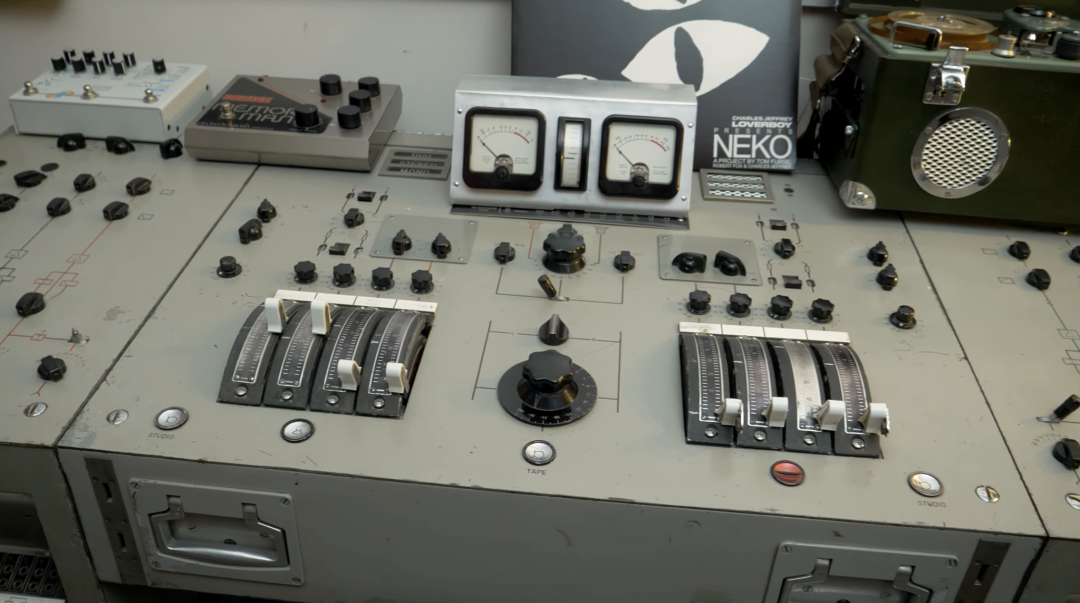
And of course, because this is Abbey Road, the processing chain is rather extraordinary.
The sounds were run through pieces of Abbey Road history, including the Redd. 17 valve desk from 1958, the J37 four-track valve tape machine, old EMI tape, Chandler Abbey Road gear, classic outboard, vintage harmonizers and even the restored BTR3 EMI tape machine. The team also reamped sounds through the studios themselves, using spaces like Studio One, Studio Two and Studio Three as part of the instrument’s sonic fingerprint.
That is something you cannot really recreate anywhere else. It is not just the samples. It is the samples plus Abbey Road’s rooms, microphones, tape machines, desks and history.
Big Nessie is designed as a Kontakt instrument, but it is not laid out like a traditional piano or guitar library. Sarah Mace, who helped build the instrument, explained that the idea was to give people enough variety to start making a whole piece of music from one instrument.
The keyboard is split into different sound zones. There are loops, drum sounds, basses, melodic synth-like textures and sound effects. Some of the sounds are deeply musical, some are percussive, some are atmospheric and some are just wonderfully odd.
There are bass sounds created from real bass and processed into something stranger and more textural. There are synth-like sounds made from guitars, pads and even voices resonating underneath a piano with the sustain pedal held down. There are sound effects from Charles’ workshop, including random bits of speech, sewing machines and other moments that were captured during the process.
That is what makes it such a great creative tool. You are not just loading up a clean, predictable sound. You are loading up a world.
The sampler also includes a set of creative controls with names that fit the character of the instrument: Scowl, Chomp, Scale, Curl, Lure, Spit, Pulse and Fang.
Scowl is the reverb, created from the incredible acoustic of the stairwell at Somerset House. Chomp adds warmth and lo-fi character. Scale works as a stereo spreader. Curl is a filter. Lure adds a vibrato-style movement. Spit brings in high-frequency fizz. Pulse adds distortion. Fang adds another layer of saturation.

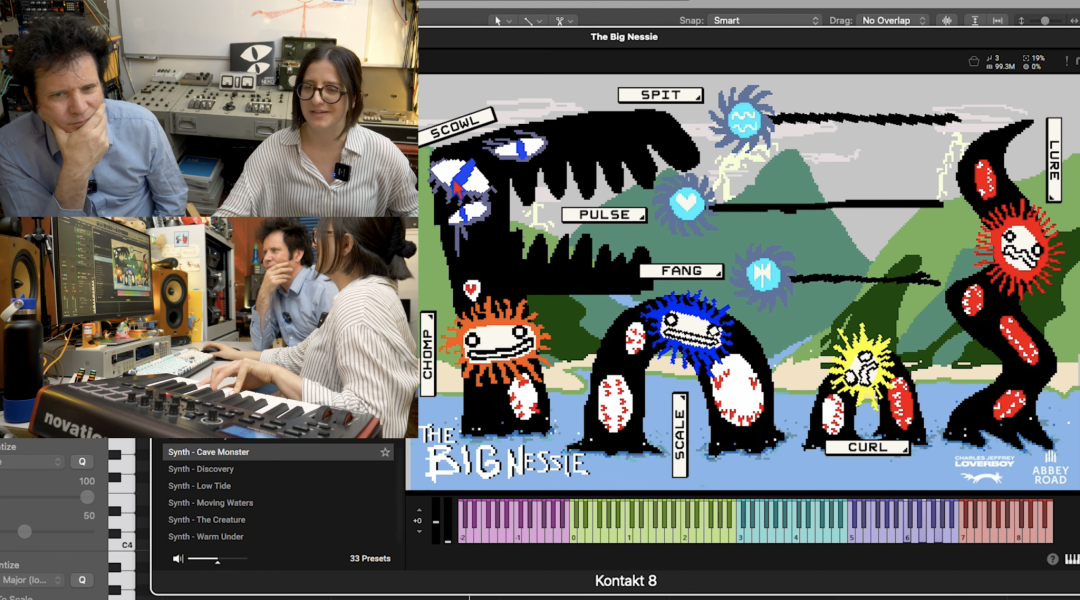
In other words, Big Nessie is not just a collection of samples. It is a vibe box.
You can open it, grab a loop, add a bass, find a strange percussion sound, throw on some reverb or distortion and immediately start building something. Sarah even demonstrated a track she had built using mostly Big Nessie, with only a little extra guitar added. The beat, bass, textures and much of the atmosphere all came from the sampler.
That is exactly the kind of thing I love. Tools that make you want to create. Tools that make you play. Tools that give you ideas before you have had time to overthink them.
And the best part?
Big Nessie is free.
Abbey Road wanted this first instrument to be something the community could download, explore and enjoy. It is the beginning of what sounds like a much bigger journey, with more Abbey Road sample libraries and instruments to come.
Download Big Nessie for free here: https://www.abbeyroad.com/bignessie
Mirek also hinted at the wealth of sounds Abbey Road has access to, from old Akai S1000 sample libraries found in cupboards, to vintage drum machines, synths, Omnichords, Jupiter 4s, Prophet-5s, classic Abbey Road gear and the studios themselves. Big Nessie is the first step, but it sounds like there is a lot more coming.
For me, this is exactly what modern music-making should be about. Yes, the history is incredible. Yes, the gear is incredible. Yes, the rooms are legendary. But at the heart of it all is playfulness.
Big Nessie takes sewing machines, fabrics, drums, pianos, tape machines, stairwells, voices, valves, distortion, reverb and imagination, then turns them into something anyone can use to start making music.
So download it, make something weird, make something beautiful, make something that surprises you.
Download Big Nessie for free here: https://www.abbeyroad.com/bignessie
And when you do, Abbey Road wants to hear it.
You can send your compositions to: thebignessie@abbeyroad.com
Have a marvellous time recording and mixing,
Warren