
Download The Multitracks: https://producelikeapro.lpages.co/kyros-rumour-form/
Artist: Kyros https://www.youtube.com/c/KYROSuk
Track: Rumour https://open.spotify.com/track/5edGsJ3JpCKNGh1riNZjxT?si=MV_VDK1AS-GbnKynZlAhWQ
Drummer Ray Hearne: https://www.instagram.com/rayhaken
Recording Drums with Multiple Audient Interfaces: One Song, Five Setups, Endless Lessons
Hi everybody. Hope you are doing marvellously well.
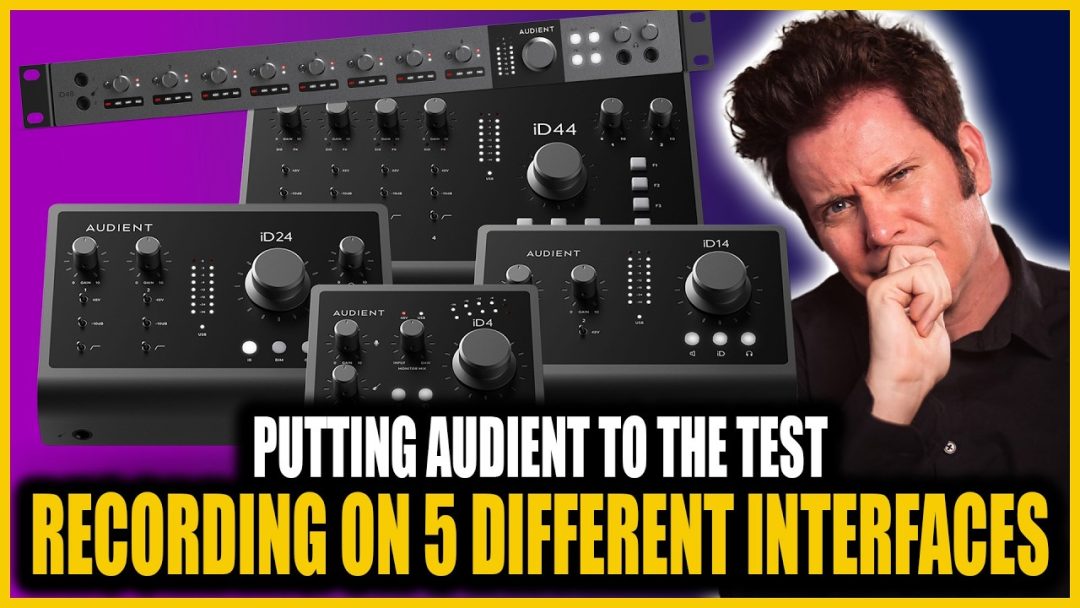
We headed into Sensible Music with a simple idea and a slightly mad plan. Audient say the mic preamp quality is consistent across their range, from the most affordable boxes right up to the top end. So rather than argue about spec sheets, we decided to do the only test that matters, record a real song, with a real drummer, in a real room, and track drums through the whole line.
Here is the twist. We did not just swap interfaces and keep everything else identical. We deliberately used each interface the way most people actually would, based on the available inputs and features. That meant the drum setup changed each time, going from eight mics, to four, to two, to one. You get to hear the difference between a full multi mic capture and a stripped back, placement driven capture, while also getting a feel for how each interface fits into a practical workflow.
This is not about “can you record drums at home”, you already can. This is about how to make smart choices with the gear you actually have.


The Core Idea: The Same Preamp DNA, Different Real World Constraints
Across the range, the experience is familiar. Solid build, low latency over USB C, straightforward gain structure, and an honest, clean capture that takes processing well. Where things start to separate is not “sound quality” in a dramatic night and day way, it is workflow.
How many mics can you plug in.
Whether you can expand via optical.
Whether you can insert outboard on the way in.
How you handle monitoring and headphone mixes.
How quickly you can move from a solo session to tracking other musicians.
When you are recording drums, those differences become very obvious, very quickly.


The Interfaces and How We Used Each One on Drums
iD48: Eight mics, full control, outboard inserts, proper studio workflow
This was the biggest drum capture and the most flexible front end.
Why it matters for drums
You have eight mic pres on tap, and you also have proper insert routing via DB25. That means you can commit to outboard compression or EQ on the way in, and you can also use that same outboard for mixing later.
How we tracked the kit
We went for a full eight channel approach. Kick, snare, toms, hats, overheads, plus a mono “glue” mic to capture the kit as a whole.
Outboard on the way in
We leaned into inserts where it made sense.
Kick got a touch of DBX style control for punch.
Snare got an 1176 style bite, fast, assertive, exciting.
Overheads got valve colour from a Chiswik Reach, which added warmth and smoothed the cymbals in a very musical way.
This is the most “console like” experience of the whole lineup, not because it is trying to look vintage, but because it behaves like a serious studio hub. Interface, monitoring, talkback, headphone sends, outboard access, the lot.
What you learn
When you have channels, you can be generous with detail. You can mic the hats, give the toms their own space, and build the kit like a record from the start.
Audient ID48: https://sweetwater.sjv.io/VOyNKa


This setup was about proving something important. You do not need the flagship interface to get a full drum capture, if you build sensibly.
Why it matters for drums
The iD24 gives you core inputs plus insert points on the analogue channels, and ADAT expansion lets you add an eight channel preamp like the Audient SP8. Suddenly you are in full band territory.
How we used it
We matched the same eight mic approach as the iD48 session, and kept the same plugin workflow later. The point was not to chase microscopic differences, it was to show that you can achieve the same practical capability, eight inputs for drums, with a modular rig.
What you learn
Expandability is not just a feature, it is a long term plan. It lets you avoid sideways steps. You start small, then add inputs when you actually need them.
Audient ID24: https://sweetwater.sjv.io/jraDb6
Audient Evo SP8: https://sweetwater.sjv.io/3kPE2r


Four channels still feels luxurious once you start taking mics away.
Why it matters for drums
Four mic drum recording is a sweet spot for a lot of home setups. You still get stereo overheads, and you can keep kick and snare as dedicated close mics.
How we tracked the kit
Kick.
Snare.
Overhead left.
Overhead right.
No hat mic, no tom close mics, no dedicated mono kit mic. So you have to make the overheads do more work, and you have to place them with intent so the toms speak and the kit sounds complete.
What you learn
With four mics, the overheads become the kit. The kick and snare become the focus. The better the drummer, the easier this gets, and Ray absolutely delivered.
Audient ID44 MKII: https://sweetwater.sjv.io/5gB5vD


Two channels is where you stop thinking like an engineer with infinite options and start thinking like a producer with a deadline.
Why it matters for drums
Two channel interfaces are incredibly common. If you are working at home, this is often the reality.
How we tracked the kit
Kick mic for punch.
A single mic capturing the whole kit for the picture.
The logic was simple, preserve the “engine” of the track with the kick, and let one well placed mic provide everything else, snare, cymbals, toms, vibe.
What you learn
You can absolutely track drums with two inputs. The sound is more mono, more direct, and it forces you to make arrangement decisions and mix decisions with far less clutter.
Audient ID14 MKII: https://sweetwater.sjv.io/xLnmoR


This is the one people least expect to work, and it is the one that teaches you the most.
Why it matters for drums
The iD4 is designed for solo creators, vocals, guitars, quick demos, and travel. However, one great preamp plus one well placed mic can still make a record, if you treat the limitation as a creative brief rather than a problem.
How we tracked the kit
One mono mic on the kit, capturing everything.
We ended up being genuinely blown away by how much information came through, especially once we made sure we were not accidentally high passing the life out of it. The big surprise was how much low end a single mic could capture when placed properly and when the kit and the drummer are consistent.
The reality check
With one mic, cymbals can take over if placement is wrong. If you need more kick and snare, you move the mic, you change the height, you change the angle, you aim away from the harsh stuff, you chase balance.
What you learn
One mic drum recording is not a gimmick. It is a skill. It is mic placement, tuning, performance, and judgement. If you can make one mic sound good, every multi mic session you do afterwards gets better.
Audient ID4 MKII: https://sweetwater.sjv.io/nLnKbX


The Mic Approach That Made the Whole Experiment Work
A big part of why this test was useful is that we did not change everything every time. The microphones stayed familiar and purposeful.
Overheads were handled by a pair of Austrian Audio OC818s.
Kick was captured with an Austrian Audio OC7.
Toms were on MD421s, the classic for a reason.
Hi hat was the surprise, an Electro Voice PL9, originally a lectern mic, found in the studio and still doing an incredible job.
The “whole kit” mono mic was the Coles 4038, which turned out to be the star of the show, smooth top, huge mids, and far more low end than most people expect.
The biggest takeaway is not “which mic is best”. It is that a coherent mic choice plus a consistent drummer gives you a stable foundation, then the interface and channel count simply decide how much detail you can capture.


Inserts and Outboard: When It Helps, and When You Can Ignore It
One of the most practical differences across the range is insert capability.
On interfaces like the iD24, iD44, and especially the iD48, inserts let you commit to compression on the way in, which can be brilliant for kick and snare. It is not mandatory, and you can make great records without it, however it can speed up decision making and help a drum sound arrive already feeling like a record.
On the smaller interfaces, you skip all of that and focus on capture. Clean, stable gain, good placement, and you process later.
Both approaches are valid. The only wrong move is trying to do everything at once and doing none of it well.
The Big Takeaway: Channel Count Changes the Drum Sound More Than the Interface
If you listen across the versions, the most dramatic differences come from the mic setup, not from some mysterious “cheap pre vs expensive pre” moment. Eight mics gives you detail and options. Four mics gives you punch and clarity. Two mics gives you vibe and focus. One mic gives you honesty, and forces you to earn the sound.
This is why the experiment is so useful. It meets people where they are.
If you have an iD4 or iD14, you can still record drums, and you can still make it exciting.
If you have an iD24 or iD44, you have a very serious home studio front end, and you can expand when you are ready.
If you have an iD48, you have a studio hub, built for outboard, full sessions, and proper tracking workflow.
And whichever one you are using, the same principle applies.
Limitations force creativity, and creativity forces you to get better.
Practical Setups You Can Copy Today
One input
One mic on the kit, move it until the snare speaks and the kick exists, then adjust height and angle to control cymbals.
Two inputs
Kick mic plus one kit mic, treat the second mic like your entire drum sound and place it accordingly.
Four inputs
Kick, snare, stereo overheads, aim overheads to capture toms and the kit picture, not just cymbals.
Eight inputs
Kick, snare, toms, hats, overheads, plus one “whole kit” mic for glue, then choose what to feature in the mix.