
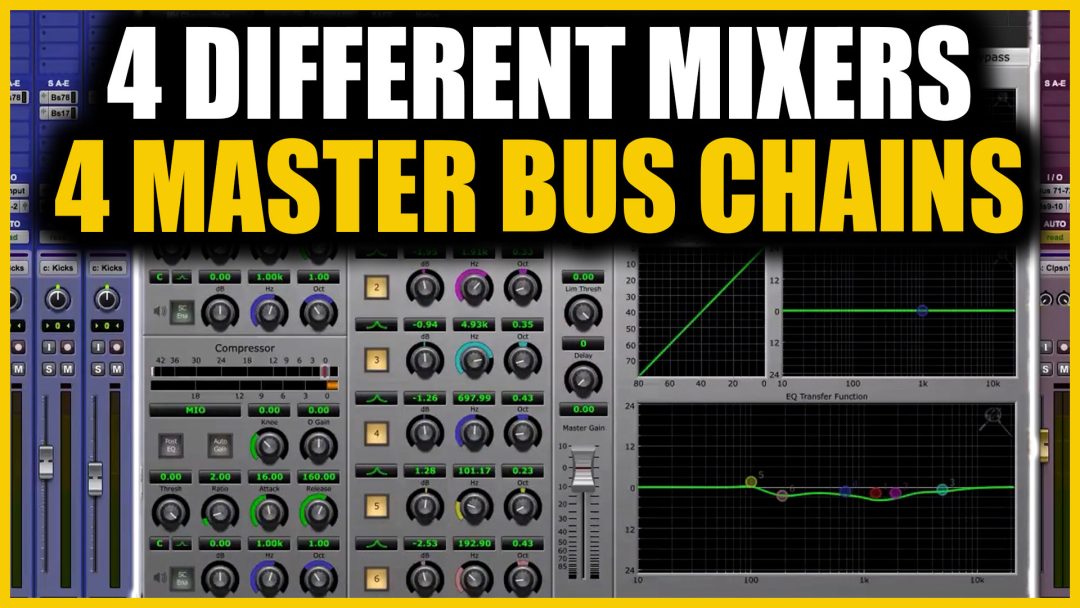

One of the fascinating things about mixing is how every engineer treats the master bus differently. Some rely on subtle, cumulative colour; others use heavier compression, tape, or saturation to bring a mix to life. There isn’t one “right” chain — it’s about what each song needs. Here are four world-class mixers showing just how varied the solutions can be.


F. Reid Shippen (Mixing Nashville Singer / Songwriter – $37 Special) https://promixacademy.com/course/mixing-nashville-singer-songwriter/ Reid takes a refined, analogue-heavy approach. His chain is all about tiny increments that add up. He starts with a Mäag EQ for a hint of top and bottom lift, a touch of transformer colour from CAPI modules, and a Dangerous BAX EQ for subtle tilt and filtering. A custom stereo widener, built by Digital Audio Visual in the UK, adds just a click of width.
For compression and tone, he uses a Dangerous Compressor that barely moves, and a Fairchild (Drip build with vintage tubes) to add unique colour rather than heavy gain control. Western Electric 111C transformers sit at the very end for extra character, and he’ll sometimes blend in a parallel path through a vintage Ampex mixer to introduce grit. The overall philosophy? Cumulative subtlety — character comes from transformers, saturation, and delicate EQ, not aggressive processing.


Darrell Thorp (All Fired Up – Mixing in the Box – $37 Special) https://promixacademy.com/course/all-fired-up-mixing-modern-rock-with-darrell-thorp/ Darrell is a master at creating excitement using plugins and tape-style colour. His chain often begins with the Metric Halo Mix Head, which emulates the harmonic lift of driving into a tape machine, followed by Slate’s Virtual Tape Machine for additional tone-shaping.
He frequently uses the classic Andrew Scheps Pultec trick — lifting around 10 kHz and adding low end at 60–100 Hz — and follows it with a Millennia EQ (Brainworx) for mud control around 220–250 Hz and silky top-end air. The SAC EQ then reinforces kick fundamentals, mids, and sheen.
For compression, Darrell mixes into a Glue Compressor (1–2 dB of reduction), blends in a parallel compressor for RMS lift (25–30% of heavy squashing), and finally uses an API 2500 as both a glue compressor and a final “volume knob” with its hidden soft clipping. To finish, Brainworx Masterdesk Pro adds subtle mid/side dynamics, and an L2 Limiter helps him preview how mastering will hit the mix. It’s a plugin-driven, hybrid philosophy, combining colour, subtle width, and controlled loudness.


Richard Furch (Mixing Pop – $37 Special) https://promixacademy.com/course/mixing-pop-with-richard-furch/ Richard leans on parallel processing and energy to create a modern pop punch. His drum bus contouring starts with SSL-style EQ, then parallel drums get slammed through an SSL compressor, Decapitator distortion, and an L2 limiter. He blends about 30–35% of this crushed signal back into the clean bus, instantly lifting energy and excitement. He even uses a dedicated “Kick Add” bus with an Invisible Limiter to keep the kick cutting through dense arrangements.
For percussion, the Kush Clariphonic adds airy sheen, with ProQ2 restoring mids and taming harshness. Guitars and keys are grouped through Clariphonic and Metric Halo EQ for brightness and balance without affecting vocals or drums. Vocals are glued with a light SSL Comp, plus de-essing and dynamic EQ to tame peaks.
On the stereo bus, Richard uses FabFilter for surgical EQ (cutting mud at 200 Hz, taming 2–3 kHz harshness, and adding a touch of air), Softube Saturator in “Keep Low” mode for harmonic lift without muddying the bass, a parallel comp for density, the SAC EQ for sweetening, and finally an API 2500 for subtle glue and soft clipping. His mixes are big, modern, and aggressive — every part of the chain is designed to keep the music loud and exciting.


Bob Horn (Producing & Mixing at Echo Bar Studios – $48 Special) https://promixacademy.com/course/producing-mixing-at-echo-bar-studios/ Bob approaches the master bus with a mastering mindset. For him, it’s about controlling levels and leaving space for the mastering engineer, while still sculpting the record into shape. He aligns his mixes around –15 dBFS, a touch hotter than the traditional –18, giving him headroom while keeping closer to record loudness.
EQ moves are small but effective: gentle high-pass filtering around 28–32 Hz, subtle boosts around 20 kHz for air, and a touch of warmth around 300 Hz. He often uses the Curve Bender, Massenburg EQ, or even EQ3, depending on the song.
Compression is light: Waves R-Comp in warm mode shaving 0.5–2 dB, sometimes swapping in Slate Gray, API 2500, or Avid’s Impact. A Waves L2 is applied carefully, never crushing, usually around –1 to –2 dB of limiting. Bob’s philosophy is restraint — his chain is about balance, musicality, and leaving the mastering engineer plenty of room to finish the job.
Four Different Chains, Four Different Philosophies
What’s striking is how differently these top mixers treat the stereo bus. Reid Shippen favours subtle analogue colour, Darrell Thorp mixes into a hybrid plugin/tape-style chain for excitement, Richard Furch builds power through aggressive parallel processing, and Bob Horn opts for minimalist shaping with a mastering mindset.
The takeaway? There is no single master bus recipe. Each chain is shaped by the song, the mixer’s taste, and the emotional goal. Some tracks need transformer colour and subtle glue, others demand parallel slam and sheen. The best mixers aren’t locked into one formula — they adapt, combining philosophy with instinct, always serving the song.