
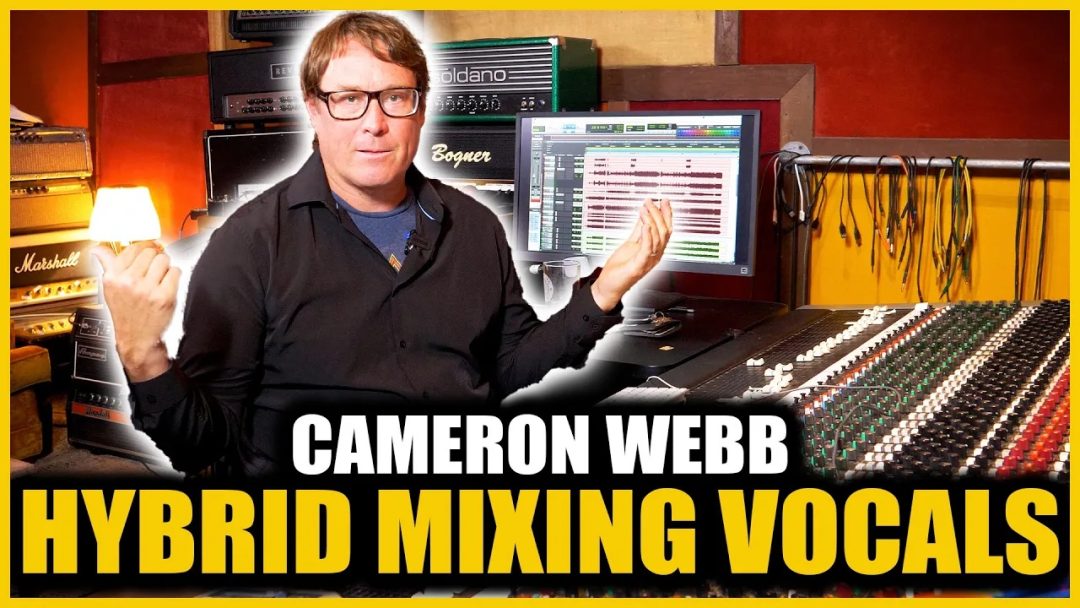

If you want vocals that leap out of the speakers, grab you by the collar, and refuse to let go, you listen to someone who has built a career doing exactly that.
Cameron Webb is not just another mix engineer talking theory. He is a Grammy Award-winning producer and mixer whose credits include punk and rock heavyweights such as Green Day, Motörhead, Alkaline Trio, NOFX and Social Distortion. His work across modern punk and rock has cemented his reputation for delivering raw, aggressive, emotionally charged records that still translate on radio and streaming platforms.
And when it comes to punk rock vocals, Cameron does not hold back.


Slam It, Control It, Make It Exciting
At the heart of Cameron’s vocal chain sits a piece of hardware he openly calls his favourite compressor, the Altec 322C.
He describes it like this:
“It’s like my Fairchild, however I like it even better. It slams the vocal and puts it right in your face.”
That is the goal. Punk vocals are not meant to sit politely in a mix. They need urgency, attitude, breath, grit.
Cameron runs the Altec as a hardware insert in Pro Tools, sending the vocal out and back in through dedicated I/O. It is a hybrid workflow, partly in the box, partly through analogue hardware, and it is intentional. He wants the aggression and density that box delivers.
When you hear it engage, something happens. The breaths lift. The consonants push forward. The vocal becomes alive.
It is not polite. It is exciting.
Start Simple, Then Build
Before any fancy tricks, Cameron strips everything back.
No effects. No EQ. No compression.
He listens.
Immediately he knows whether low end needs rolling off. His first move is often a simple stock Digi EQ, nothing exotic, just musical and practical. A gentle high-pass. A touch of top end.
Then he hits an 1176.
The first stage of compression grabs the performance without flattening it. Even when pushed, it does not suck the life out of it. That matters in punk. You need control, however you cannot lose attitude.
After that, the Altec comes in and adds the attitude.
Then comes another stage, SSL-style compression at around 3:1, shaping and tightening the vocal in context.
EQ. Compression. Compression. EQ.
Layered intention.


Don’t Worship Numbers
One of the most refreshing things Cameron says is this:
“Just because people tell you something doesn’t mean it’s right.”
He boosts around 6k on this vocal, even though he has always been told 5k is the magic number. He listens instead of obeying rules.
He boosts the nasties to find them, then cuts. He shapes high-mid presence by ear. He re-rolls low end after adding the tube compressor, because the tonal balance has changed.
This is not preset mixing.
This is judgement.
Control the S’s Before the Mastering Engineer Calls
Punk vocals are bright and aggressive. That means sibilance can get out of hand quickly.
Cameron places a de-esser after his compression and EQ stages, often working around 5k to 7k depending on the microphone and preamp combination.
He does not blame the singer. He listens to the mic and the chain.
The vocal is shaped to sit in the mix, not to impress in solo.


Depth Without Clutter
A quiet quarter-note delay sits underneath the lead. Almost invisible.
It is not there to be heard. It is there to create dimension.
Then he brings in one of his secret weapons, an AMS DMX harmoniser. Output 13 and 14 in Pro Tools feed the hardware. He prints the return back into the session.
Why print it?
Because hardware fails. Because recalls matter. Because committing forces decisions.
The harmoniser spreads the vocal wider, giving it that glossy width and movement without drowning it in reverb.
This is mixing as production.
Creative Production Inside the Mix
Cameron treats mixing as part of the production.
When remote vocals arrived from England, he did not simply drop them into the session. He reprocessed them, re-compressed them, filtered them, delayed them and built layers. He treated them like they had just been tracked in his room.
Reverbs, delays, filters and distortions are his instrument.
The mix engineer is not just balancing levels. He is creating impact.
Go Deeper: Full Course Access
When you are ready to dive all the way in, explore the complete course here:
Mixing Modern Rock with Cameron Webb https://promixacademy.com/course/mixing-modern-rock-with-cameron-webb/
Inside the full programme, Cameron takes you inside Maple Studios and walks you through complete mixes, showcasing:
• Hybrid analogue and in-the-box workflow • Real hardware inserts and routing • Layered vocal compression techniques • Creative effects printing and recall strategies • Production decisions made during mixing • How to balance aggression with clarity
This is not theory. This is real-world workflow applied in real time.
If you want your punk rock vocals to sound urgent, wide, controlled and unapologetically in your face, this course shows you exactly how it is done.
Dive in, study the process, and then go make something loud.