
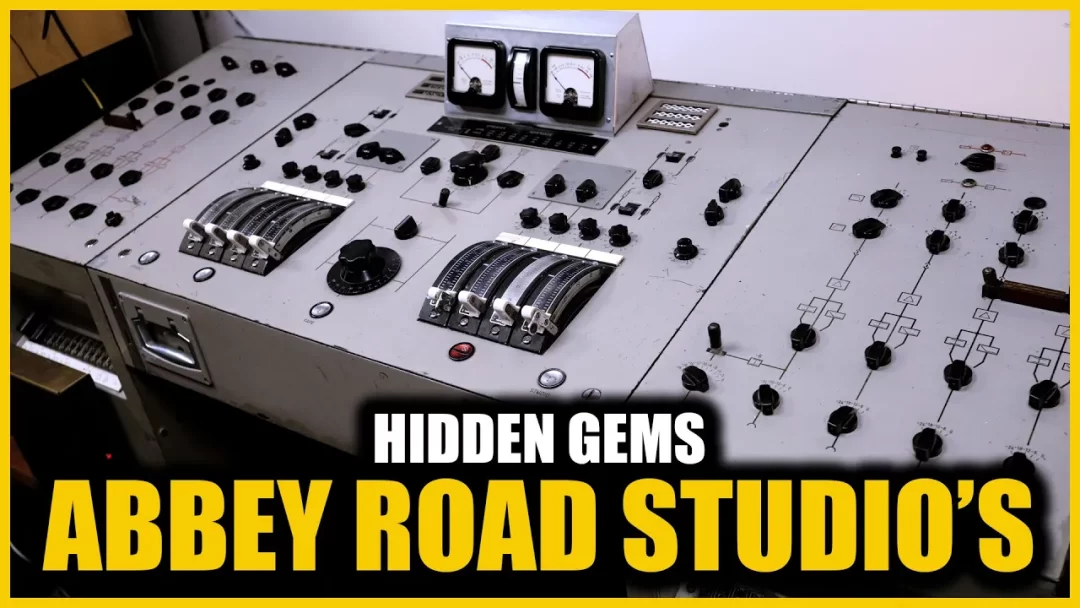

Mirek Stiles, REDD Desks, TG Legends and a New Chapter of Sound
There are studio tours, and then there are moments where you realise you are standing in the middle of recorded history.
Walking into Mirek Stiles’ room at Abbey Road Studios feels exactly like that. It is not simply a collection of rare equipment. It is a working archive of sound, and more importantly, a laboratory for what comes next.
This is where EMI’s past meets Abbey Road’s future.


The REDD Desks: Myth, Mystery and Musical DNA
We began with the question everyone asks. The original console that kept being sold and resold.
That was the REDD 37.
It was installed in Studio One and is officially the only REDD desk used by The Beatles that ever left Abbey Road. Mirek mentioned that sessions like All You Need Is Love may well have passed through it. In other words, literal Beatles air travelled through those transformers.
The REDD 51, the desk most associated with the majority of Beatles recordings, survives as well. One of only four ever built, it now lives at British Grove Studios. Three REDD 51s originally resided at EMI. One was shipped to EMI Italy. That Italian unit is the one that survived.
The others?
Romantically, they are waiting to be rediscovered.
Unromantically, they may be in landfill.
The REDD 17: Where Stereo Became Real
What Abbey Road does have is arguably even more significant.
The REDD 17.
Built in 1958, it was EMI’s first stereo console that truly resembled what we think of as a modern desk. Before this, EMI desks were upright rotary panels. Functional, yes. However hardly the inspiring centrepiece we associate with classic studios.
The REDD 17 changed that.
Eight channels of mic pres, powered by Siemens V72s. The classic EMI EQ, that 10k shelf and 100 Hz lift that simply sings when both are pushed. Each signal path moves through three V72 gain stages, one on the channel, one driving the EQ inter-amp, and one on the output stage. It is beautifully gain staged, which is why it sounds musical rather than overwhelming.
Mirek uses it constantly.
Drums. Strings. Synths. Samples.
Run through the REDD 17, then into the J37 tape machine, and suddenly a modern sound acquires weight, glue and dimension.


The J37 and Original EMI Tape
However Mirek has taken it further.
He sourced original EMI tape from the 1960s. Not reissue tape. Not approximations. The real thing.
EMI tape from that era never needs baking. It simply plays. No shedding. No residue. Possibly highly toxic by today’s standards, however sonically remarkable.
He even went into the archives, identified partially used reels, obtained permission, and salvaged unused sections. Fifteen minutes of 1962 EMI tape is not just a novelty. It is a time capsule.
He also has access to the original EMI sound effects library. Abbey Road engineers in the 1950s and 60s went out with portable EMI L2 recorders capturing crowds, cars, babies crying, bonfires, engaged telephone tones.
All of that material is now being chopped, processed through REDD desks and J37s, reamped in Studio One and Studio Two, close and distant miked, and turned into new sampled instruments.


TG Mark I: The Abbey Road Album Era
Hidden behind a rack of Focusrite units are three original TG Mark I channel strips. These would have been part of the TG console installed in Studio Two in 1969 for the recording of Abbey Road.
Unlike later TG versions built around silicon transistors, these early units used germanium devices. Germanium transistors have a character all of their own, slightly softer, harmonically rich, almost chewy in the way they respond.
The plan is to rack these as floating outboard units. Not museum pieces. Working tools.
That philosophy runs through everything in Mirek’s room.


Super Vintage: The New REDD 47 Special Edition
The special edition REDD 47 units, built with 53 vintage components in each unit. Mullard mustard capacitors. Iskra resistors. French PY resistors. WIMA capacitors. Old Siemens parts. Even vintage BC transistors stockpiled decades ago.
They light up red when powered on, a nod to the illuminated EMI logos on the original desks.
It is not nostalgia.
It is commitment.
While much of the industry moves towards streamlined modern manufacturing, this approach goes deliberately the other way. If vintage sound matters, why not use vintage parts?
Funky, Quirky, Future
Abbey Road has long collaborated with companies like Native Instruments and Spitfire Audio, and those partnerships continue.
However what Mirek is building now feels different.
Original EMI tape. REDD desks. J37 saturation. Reamping in Studio One and Studio Two. Stacked impulse responses. Old Quant reverbs. Marshall Time Modulators. Eventide 910 harmonisers. Chandler RS660 units in THD mode, even stacked back to back for pure harmonic texture.
These are not sterile sample libraries.
They are living, breathing instruments built from the DNA of recorded music history.
This Is Where It Happens
At the end of the tour I said, “I never knew you were hiding up here.”
Mirek smiled.
“This is my lair.”
And that is exactly what it is.
Not a museum.
Not a shrine.
A place where REDD desks, TG channel strips, original EMI tape and modern imagination collide.
History is not being preserved behind glass.
It is being recorded through.