
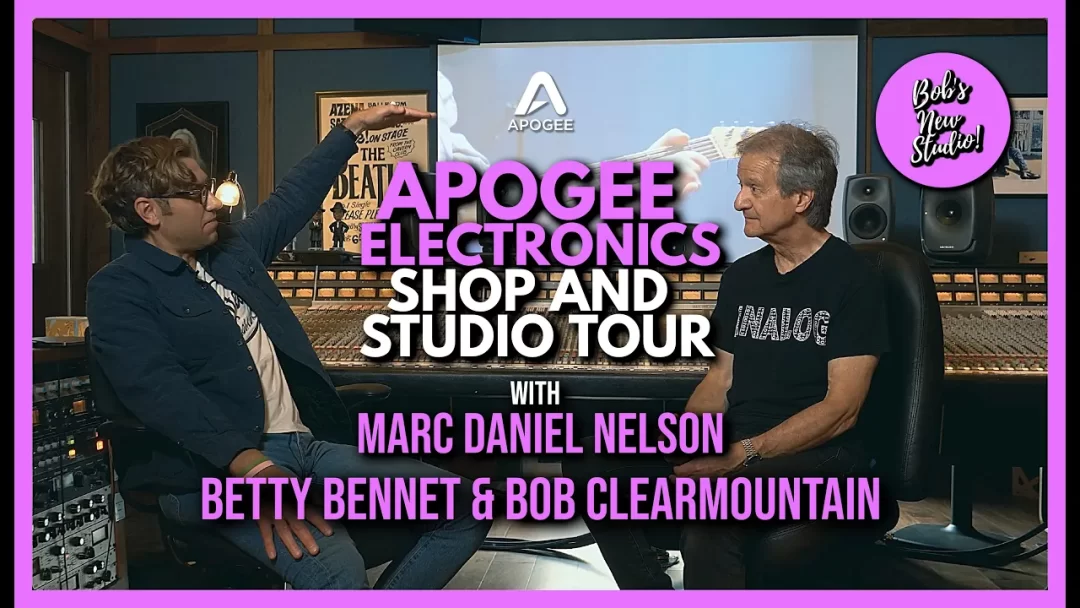
My wife Kasia and I have been lucky enough to call Betty Bennett and Bob Clearmountain our friends for many years. As a couple who also work side by side in the music world, we have always found their partnership inspiring. They have built a company, a studio and a life together while continuing to shape the sound of modern music, and that is something we deeply admire. To be able to host this video with some of our favourite people, Marc Daniel Nelson, Betty and Bob, feels like a real blessing.
Let’s join Marc Daniel Nelson on his visit to Apogee Electronics in Santa Monica, where he gets a behind-the-scenes look at how the company operates and sits down with Betty and Bob to hear the full story. From a modest filter that changed digital audio forever, to Apple Stores around the world, to Bob’s rebuilt mix room after the Palisades fire, this is a journey through four decades of Apogee innovation.


A small team with a big impact
Walking through Apogee HQ it is clear this is not a faceless corporation. Sales, marketing, QA, assembly and repair are all just steps apart, and most of the staff are musicians or engineers themselves. Units are hand assembled, burned in to ensure reliability, and overseen by repair techs with decades of soldering experience. It feels hands on and personal, and everything is proudly American made.
How it began
Back in 1985 Apogee’s first product was the 944 filter for early Sony and Mitsubishi digital recorders. Bob Clearmountain, fresh from mixing Born in the U.S.A., was frustrated with the harshness of early digital. Once the filters were available, engineers insisted on “Apogee enhanced” machines, and rental houses had to bring them in or risk losing sessions. That first step showed how much difference good digital design could make.


Making digital sound musical
Throughout the 1990s Apogee kept digital moving forward:
-
AD8000 and collaboration with Digidesign brought professional conversion to Pro Tools
-
UV22 noise shaping allowed engineers to work at higher bit rates while delivering a polished 16 bit CD
-
Soft Limit gave sterile digital a more analogue like character, adding headroom and warmth
-
Products like the Rosetta and Symphony set the benchmark for converters in major studios
A big part of Apogee’s success was the partnership of Betty and Bob. Betty knew the technical side inside out, Bob wanted digital that felt as alive as analogue. Together they made digital recording not just possible, but desirable.


The breakthrough moment: Duet
In 2006 Apogee released the Duet. Moving from high end systems to an affordable portable interface was a bold move, however it lined up perfectly with Apple’s push around Logic and GarageBand. The Duet landed in Apple Stores, sounded fantastic, and became the go to home recording interface. It carried Apogee’s sonic signature into bedrooms and laptops all over the world.


From “garage” to world class venue
What began as Bob’s dream of a $5,000 demo studio quickly became the Apogee Studio, complete with a stage, control room, iso booths and a legendary Neve 8068 console (the very one from Power Station Studio A). The room hosted KCRW sessions with Alabama Shakes, Tom Jones, Billie Eilish and many more. It is a rare space where live energy meets studio precision, and it sounds like a record the moment the band hits.


Mix This: Rebuilding after loss
Tragedy struck when Betty and Bob’s house was destroyed in the Palisades fire, taking with it Bob’s long time mix room. Rather than rebuild at home, Bob relocated his studio into the main Apogee building in Santa Monica. The centrepiece is an SSL console, rebuilt to replace the one he lost in the fire. This was a major project led by SSL tech legend John Ellisand spearheaded by SSL veteran Phil Wagner, combining two boards, one provided by Chris Lord Alge, the other by his brother Tom Lord Alge, to recreate Bob’s heavily modified desk in every detail. The result is now fully restored and installed, serving as the beating heart of his new mix room.
Apogee staff and Bob’s team have wired the room for both stereo and Atmos, with Apogee Symphonies, vintage compressors, trusted reverbs and a beautiful courtyard outside. The new Mix This carries on Bob’s legacy with even more flexibility, right in the heart of the company he and Betty have built together.


Bob’s approach: keep it simple, trust your ears
Clearmountain’s philosophy has never changed:
-
Mic into console into LA 2A if needed
-
Do not over process, just listen
-
Strip away unnecessary plugins or hardware and focus on the performance
Even his SSL automation is old school, VCA fader moves saved on floppy disks, because it is faster, more musical, and lets him listen to the song instead of juggling mechanics.


Forty years of Apogee
Today Apogee is marking its 40th anniversary with a refreshed Symphony interface, now on Thunderbolt 3 with USB C. The company remains small and musician driven, still focused on sound and reliability. With Betty steering the brand and Bob chasing the magic of a live band through a console, Apogee continues to bridge engineering precision and musical feel.
Betty and Apogee continue to innovate, and Bob continues to be the greatest mixer of our time. As a couple in the music industry, Kasia and I admire them more than anyone.