
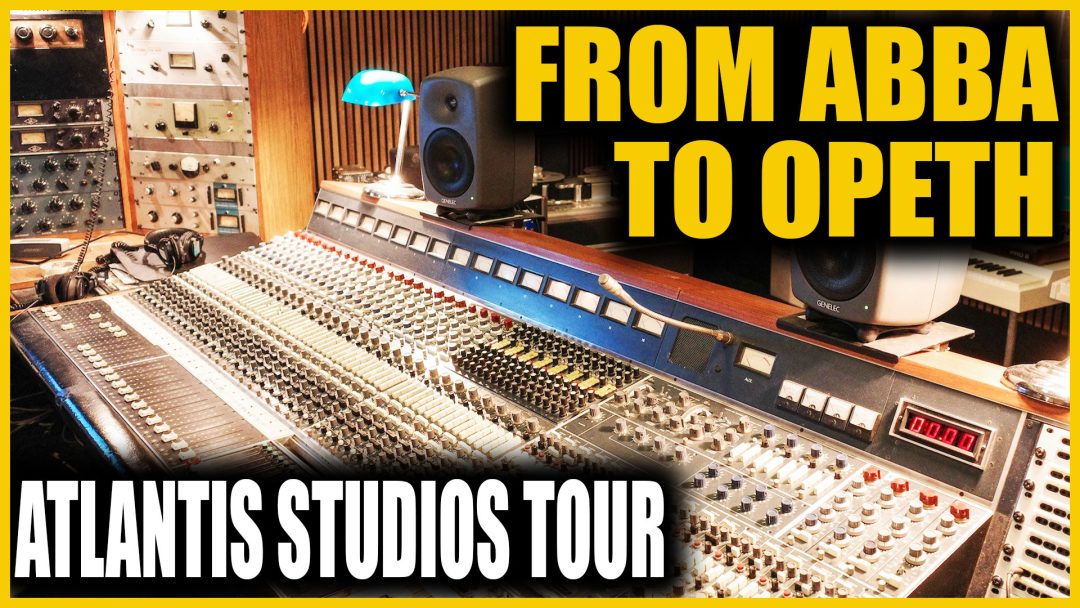

Walk through the doors of Atlantis in central Stockholm and you feel history under your feet. The studio stands at Karlbergsvägen 57 in Vasastan. Long before it became a recording landmark the building was a neighbourhood cinema, opening in 1941 as the 330-seat Kadetten and renamed Terry in 1943. The theatre closed in 1959 and that same year the Metronome record label converted the premises into a recording studio. From that point Stockholm had a new creative engine.


From cinema to Metronome to Atlantis
Metronome Studios opened in 1959 and was run by Anders Burman and Börje Ekberg with sound engineers Gösta Wiholm and Rune Persson. Early sessions featured Siw Malmkvist and Owe Thörnqvist, and the rooms were soon busy with projects for other labels including Povel Ramel’s Knäppupp and AB Svenska Ord. In January 1968 Michael B. Tretow joined as an engineer, a pivotal addition to the studio’s story.
The Hootenanny Singers recorded at Metronome and when band member Björn Ulvaeus began writing with Benny Andersson, their songs were largely tracked here. Ulvaeus’ girlfriend Agnetha Fältskog also recorded at the studio, and she and Andersson’s girlfriend Anni-Frid Lyngstad contributed backing vocals to Ulvaeus and Andersson’s 1970 album Lycka. The four soon began recording together as ABBA. The majority of ABBA’s early and biggest hit singles, including Waterloo, Mamma Mia, and Knowing Me, Knowing You, were cut at Metronome. In 1978 Ulvaeus and Andersson, together with Polar Music co-founder Stig Anderson, established Polar Studios which became ABBA’s home base. Tretow left Metronome for Polar and later became its studio manager.
In 1983 Metronome was purchased by Janne Hansson, an in-house engineer for a decade, who renamed the facility Atlantis Grammofon AB. Hansson ran Atlantis until May 2020 when a new ownership group took over. The team includes Polar Studios veteran Stefan Boman, former Kent guitarist Sami Sirviö, Martin Terefe, Jörgen Ringstrand, Lars-Johan Jarnheimer, and Jonas Kamprad. Today the studio is known simply as Atlantis Studios and remains a magnet for artists across genres. Historic clients include ABBA while later eras brought The Cardigans, Roxette, Opeth, The Hives and many others.


A control room that breathes music
The main control room centres on a Neve 8026 loaded with 1084 preamps across 24 channels. The outboard is a who’s who of character and control, with stereo and mono Fairchilds, LA-2As, 1176s and Pultec-style EQ alongside carefully chosen modern pieces. There is even a compact EMI desk with four mic amps and onboard limiting, a tangible nod to classic British console design. Engineers will happily mix through the desk when a project calls for it, printing decisions in the moment. Many sessions adopt a hybrid approach that uses the Neve, select outboard and an in-the-box master session for final tweaks.
Rooms with character
The live area is modular and musical. A large main room flatters drums, strings and horns, with two adjoining booths that offer contrasting acoustics, one super dry for control and one a touch livelier with removable gobos. Recent bookings range from intimate drum-less jazz quartets to full-on rock and metal. Ghost spent seven weeks here on their last record which underlines Atlantis’ relevance to modern production.
The mic lockers are glorious. U47s, M49s, U67s, a 251, KM54s and stereo treasures such as the SM69 and SM23 sit beside a ribbon corner stocked with RCA and Coles. The inventory enables elegant multi-mic arrays, from classic acoustic guitar setups to robust ensembles recorded live with separation across the booths and the red room upstairs.


The famous Atlantis echo chambers
Purpose-built concrete echo chambers remain one of Atlantis’ great assets. Designed after early research trips to American facilities, the chambers avoid parallel walls which increases decay, and a vintage Ampex speaker feeds the space. Push it and you get a musical saturation that blends with the long tail in a way plates and plugins rarely capture. Softube’s Atlantis Dual Chambers brings a convincing digital version to the wider world, complete with the ability to drive the virtual amp.
Softube Atlantis Dual Chambers: https://www.softube.com/plug-ins/atlantis-dual-chambers
Stefan Boman’s vision, from console to Atmos
Producer and mixer Stefan Boman is both co-owner and a creative anchor at Atlantis. Under his stewardship the facility has benefited from a full rewire and a thoughtful refresh that includes a welcoming bar and communal area which encourages bands and producers to live with their records while they work. Stefan’s personal mix room houses a full Genelec immersive array and a large Avid controller, the environment where he mixed Opeth’s latest album The Last Will and Testament. The room translates precisely, whether you are building a dense progressive metal arrangement or sculpting intimate vocals.


Learn with Stefan at Kohle Audio Kult
You can now sit over Stefan’s shoulder. His course at Kohle Audio Kult takes you inside his original mix session for “Paragraph 1” from Opeth’s The Last Will and Testament. He opens every layer, from plugins and outboard choices to automation, effects chains, bus architecture and the thinking behind tone capture at the tracking stage. The course is hands-on. You can download the original multitracks, craft your own mix, upload it, and receive a personal review from Christian Kohlmannslehner. Standout mixes will be selected for prizes from Softube which feels fitting given the studio’s link to the Atlantis chambers.
Get the course here: https://www.kohleaudiokult.com/courses/opeth
Why Atlantis endures
Atlantis Studios at Karlbergsvägen 57 is a rare blend of provenance and practicality. The Neve, the Fairchilds, the EMI sidecar and those echo chambers provide undeniable character. The rooms are flexible, the mic collection is second to none, and the people who run it value music above mythology. Whether you are chasing the shimmer of seventies pop or the precision of modern metal, Atlantis delivers. It is living proof that classic tools and contemporary thinking make records that last.
If you are ready to deepen your craft, start with Stefan Boman’s Kohle Audio Kult course and work through the Opeth multitracks. Then take those lessons back to your room, or better yet, bring a project to Karlbergsvägen 57 and hear your songs bloom in a space that helped define the sound of popular music.
Have a marvellous time recording and mixing
Warren
Get the course here: https://www.kohleaudiokult.com/courses/opeth
Watch the video here: https://www.youtube.com/watch?v=EyT3Bq5a314
Softube Atlantis Dual Chambers: https://www.softube.com/plug-ins/atlantis-dual-chambers