


SXSW came to London, and it was fantastic to be part of it.
The whole event brought together musicians, producers, engineers, artists, technology companies and some of the most creative people working in music today. I was there taking part in panels, having conversations about where our industry is heading and, of course, spending plenty of time with our friends from Abbey Road Studios.
There was a tremendous energy throughout the event. You could walk from a discussion about the future of music and artificial intelligence straight into a demonstration of a new instrument, recording console or immersive audio technology.
That is what made SXSW London so exciting. It was not simply about looking back at the history of music. It was about understanding how that history can help shape what comes next.
Bringing Abbey Road to SXSW London
Abbey Road had a significant presence at SXSW London, with its own area showcasing new technology, historic equipment and some fascinating collaborations.
It felt as though we had been transported directly into Abbey Road itself.
There were pieces of equipment derived from the original REDD and TG consoles, historic limiters and EQs, microphones inspired by classic EMI designs and a range of new Abbey Road products that bring the studio’s heritage into modern production environments.
One of the recurring themes throughout my time at SXSW was the idea that history should not become a museum piece.
The equipment, techniques and ideas developed by Abbey Road and EMI remain incredibly relevant. The challenge is finding ways to make those ideas accessible to a new generation of producers, engineers, musicians and listeners.
That was clearly reflected in everything Abbey Road was presenting.


Turning a Car into an Abbey Road Listening Environment
One of the most interesting demonstrations came from my friend Mirek Stiles, who has been deeply involved in developing the Abbey Road Sound Mode for Polestar vehicles.
Mirek worked alongside Bowers & Wilkins and Harman to explore a fascinating question:
What would it mean for a car to sound like Abbey Road?
A car is a very different environment from a recording studio. It is comparatively dry, tightly controlled and has fixed listening positions. You know exactly where the listeners are sitting, where the speakers are positioned and how the acoustic space behaves.
Rather than simply adding an exaggerated reverb effect, the team approached the car as a blank canvas.
Mirek began experimenting with tools inspired by Abbey Road’s historic equipment, including EQ, stereo widening, saturation and impulse responses captured from the studio’s rooms.
Some of the ideas he expected to work did not. Other ideas that initially appeared unusual became central to the finished sound.
One particularly successful element was inspired by EMI’s original Compander noise reduction system.
The Compander was designed by EMI in the early 1960s to reduce tape hiss. However, Abbey Road engineers discovered that using only the encoding stage could create an exciting, bright and energetic character.
It became one of the studio’s secret weapons.
Mirek incorporated that idea into the car audio processing, alongside Studio Two-inspired acoustics, EMI-style EQ and stereo spreading.
When the processing was bypassed, the sound appeared to collapse. When it was re-engaged, the entire car seemed to come to life.
The difference was not gimmicky. It was subtle, musical and engaging.
That was extremely important.
Many attempts to create simulated listening spaces can quickly sound artificial. The Abbey Road approach was not about making the music sound as though it had been played through a speaker at the far end of a large room.
It was about changing the listening environment itself.
The user can move between smaller and larger acoustic spaces, add more of a vintage high-frequency character, introduce a more modern low-mid punch or widen the stereo image.
It is almost like creative calibration.
Instead of approaching playback solely from a technical or analytical perspective, Abbey Road has applied the mindset of a recording and mixing engineer.
The question is not merely whether the system is technically accurate.
The question is whether the music feels more exciting, open, wide, clear and emotionally engaging.
That is a very different way of thinking about consumer audio.
Abbey Road is now exploring how this technology might translate into televisions, laptops, mobile devices, soundbars and other listening systems.
It also represents a return to Abbey Road and EMI’s roots. EMI was not only involved in recording studios and record production. It manufactured radios, televisions and consumer audio equipment.
In many ways, this project brings everything full circle.


The Big Nessie: Turning Fashion into a Musical Instrument
Another highlight was seeing the Big Nessie, Abbey Road’s first sample instrument.
This project began when the Abbey Road team started searching through its archives and discovered a collection of floppy disks created for the Akai S1000 sampler.
During the 1980s and 1990s, Abbey Road engineers created huge numbers of samples using the equipment and rooms around the studios.
The team began recovering those sounds and thinking about how they could be reimagined.
Rather than simply releasing the original samples, the idea was to run them back through Abbey Road’s rooms, tape machines, consoles and outboard equipment.
That same experimental approach led to the Big Nessie.
Abbey Road collaborated with Scottish fashion designer Charles Jeffrey and his LOVERBOY brand. Charles had already been exploring Abbey Road’s visual archives as inspiration for his fashion work, but he was also deeply interested in music and sound.
The team visited his workshop at Somerset House with portable recorders and began capturing anything that produced an interesting noise.
They recorded sewing machines, knitting needles, rolls of fabric, shoeboxes and other objects from the fashion studio.
Anything capable of producing a sound became a potential instrument.
They also captured impulse responses from the enormous stairwells inside Somerset House, creating a unique reverb that became part of the finished instrument.
Charles and his musical collaborators later came into Abbey Road Studio Two, where they experimented with triggering drums using fabric and other materials from the fashion collection.
The result is a wonderful combination of fashion, sound design, recording history and modern sample programming.
The sounds were chopped, processed, stretched and distributed across the keyboard inside Kontakt.
Big Nessie includes drums, loops, basses, pads, guitars, sound effects and other unusual textures. It also includes distortion, tremolo, reverb, an arpeggiator and several creative processing controls.
Most importantly, it feels like an instrument rather than simply a folder containing samples.
You can sit down, play it and immediately begin creating music.
It is also completely free, which makes it an incredible opportunity for musicians and producers to explore some of these ideas themselves.

The World’s First Parametric EQ
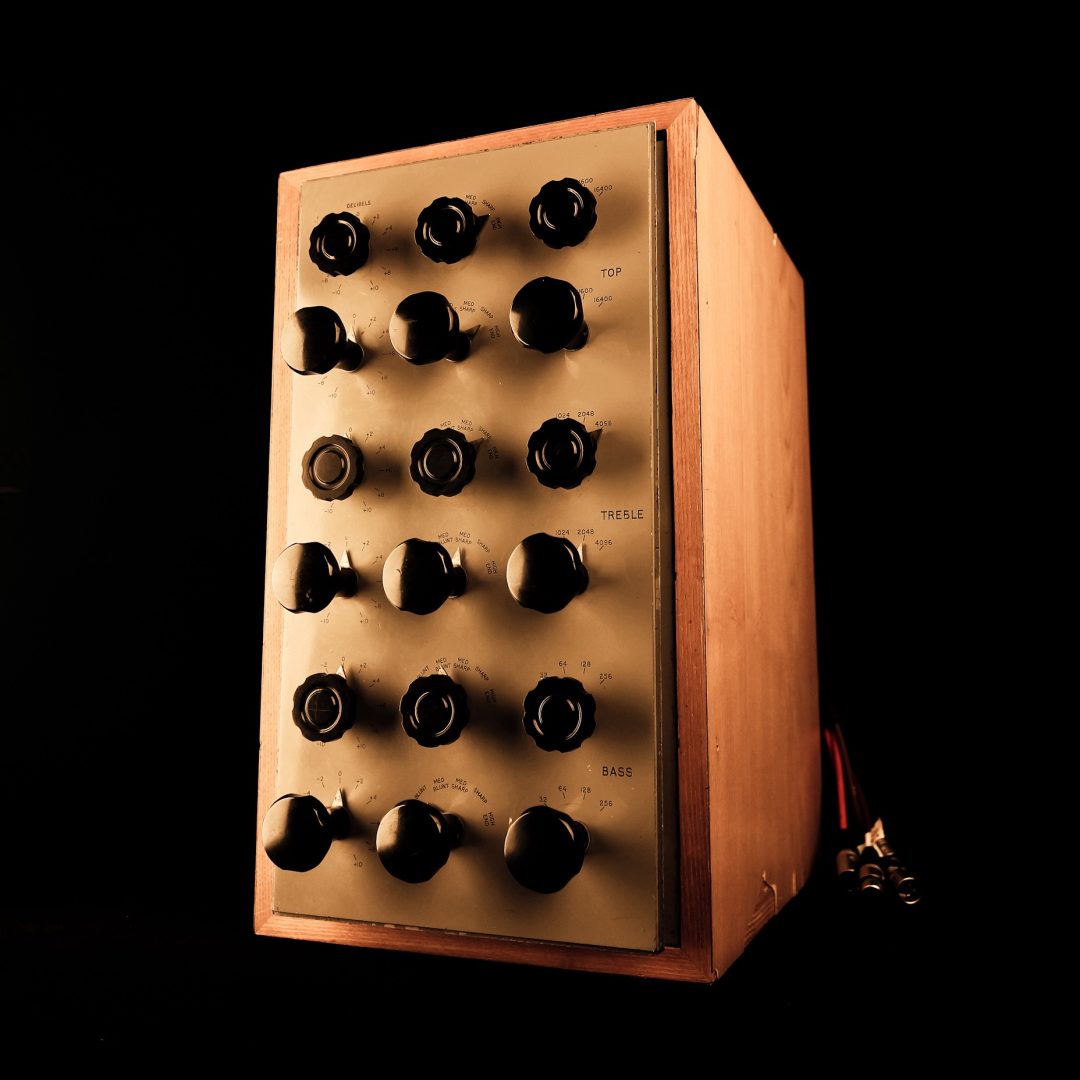
One of the most extraordinary pieces of equipment on display was the original EMI RS56 Universal Tone Control, better known as the Curve Bender.
Designed in 1954, the RS56 is widely recognised as the world’s first parametric equaliser.
It was originally designed for Abbey Road’s disc-cutting rooms, but engineers soon realised that it offered far more control than the EQs built into the studio’s recording consoles.
The original REDD console EQs were extremely limited. Engineers generally had high and low-frequency controls, but they could not precisely select frequencies or alter the shape of the filter.
The RS56 changed that.
It allowed engineers to choose frequencies, adjust gain and select different curve shapes.
Even the terminology feels wonderfully musical.
Instead of using purely technical descriptions, the EQ offered settings such as blunt, medium blunt and sharp.
The frequencies were also organised around the key of C, reinforcing the musical thinking behind the design.
The unit is completely passive and enormously heavy, filled with mechanical components and complex switching systems.
One particularly ingenious feature allows the left and right channels to be linked or controlled independently simply by pulling or pushing the control.
It is a beautifully simple solution created through extraordinarily complex engineering.
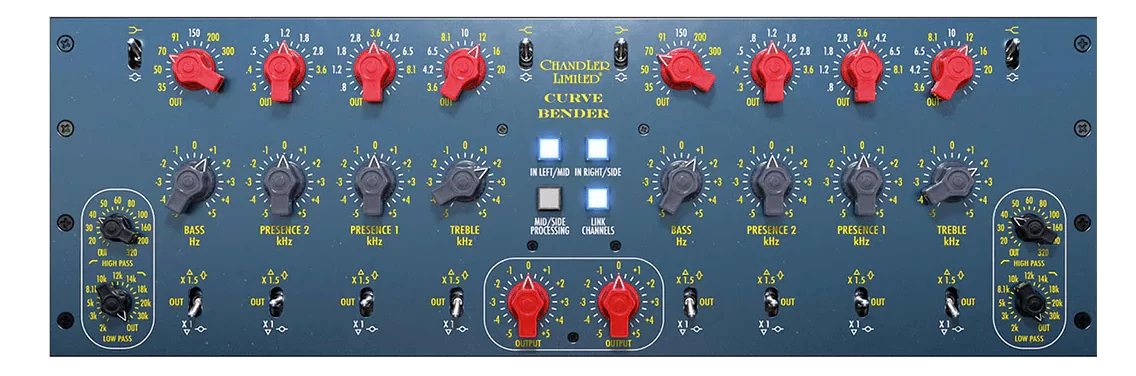
The design philosophy behind the RS56 continued through Abbey Road’s later TG consoles, mastering desks and modern products such as the Chandler Limited TG12345 Curve Bender Mastering Equalizer.
For producers working in the 500 Series format, Chandler also offers the TG12345 MKIV 500 Series Curve Bender EQ.
There is also a software recreation available in the form of the Softube Chandler Limited Curve Bender Plug-in.
It is remarkable to see how many ideas we consider modern were already being explored by EMI and Abbey Road engineers more than 70 years ago.

We also spent time exploring the original TG compressor and limiter modules.
The TG console was one of the first recording consoles to include a compressor and limiter on every channel.
These circuits were not subtle.
They could be extremely aggressive, particularly when used on drums, room microphones and other sources that benefited from additional energy and excitement.
Later versions were installed in Abbey Road’s mastering consoles during the 1970s.
Although they can be too forceful for some modern mastering applications, they remain incredibly effective creative tools in the studio.
Put one across a pair of drum room microphones and the entire kit seems to explode into life.
The attack, density and attitude these units create are immediately recognisable.
The Chandler Limited TG 1 Limiter, Abbey Road Special Edition brings that classic EMI-style compression and limiting character into a modern studio unit.
For engineers who need additional flexibility, particularly when working across a mix bus or mastering chain, the Chandler Limited TG12413 Zener Limiter expands on the original design with a wider range of controls.
The important thing is that these modern versions maintain the personality of the original equipment while offering additional control for current workflows.

The Abbey Road REDD Microphone
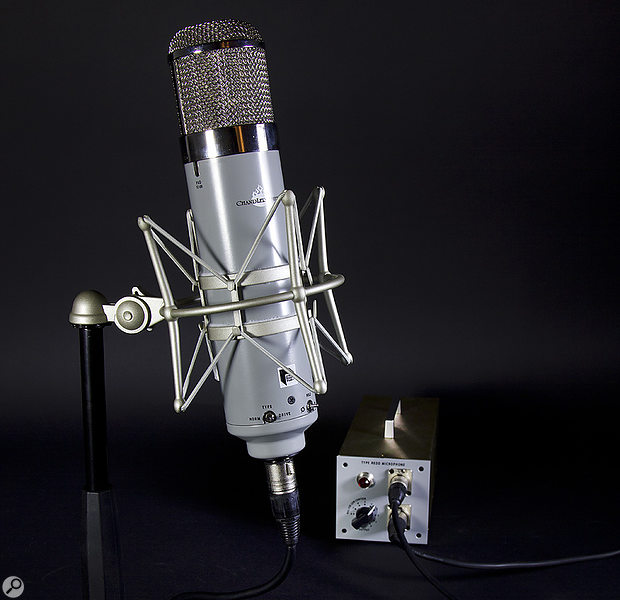
Another fascinating product was the Chandler Limited REDD Microphone, developed from Abbey Road and EMI heritage.
The microphone combines a classic large-diaphragm capsule design with a preamplifier based on the original REDD.47 valve circuit.
Instead of sending the microphone signal through a separate external preamp, the capsule feeds directly into the built-in REDD-style preamplifier.
The microphone includes gain control, polarity reversal and a drive mode that allows the preamp to be pushed into a more colourful and harmonically rich sound.
It is capable of producing an enormous vocal sound, but it is far more versatile than simply being a character microphone.
Abbey Road engineers have used it on orchestras, strings, guitars, drum overheads and film scoring sessions.
That is one of the most impressive things about well-designed equipment.
It can have a distinctive personality while still being useful across a huge range of applications.
For those who want the REDD.47 circuit as a standalone studio preamp, Chandler also makes the REDD.47 Tube Microphone Preamp.

A Modern Console Built from Abbey Road History
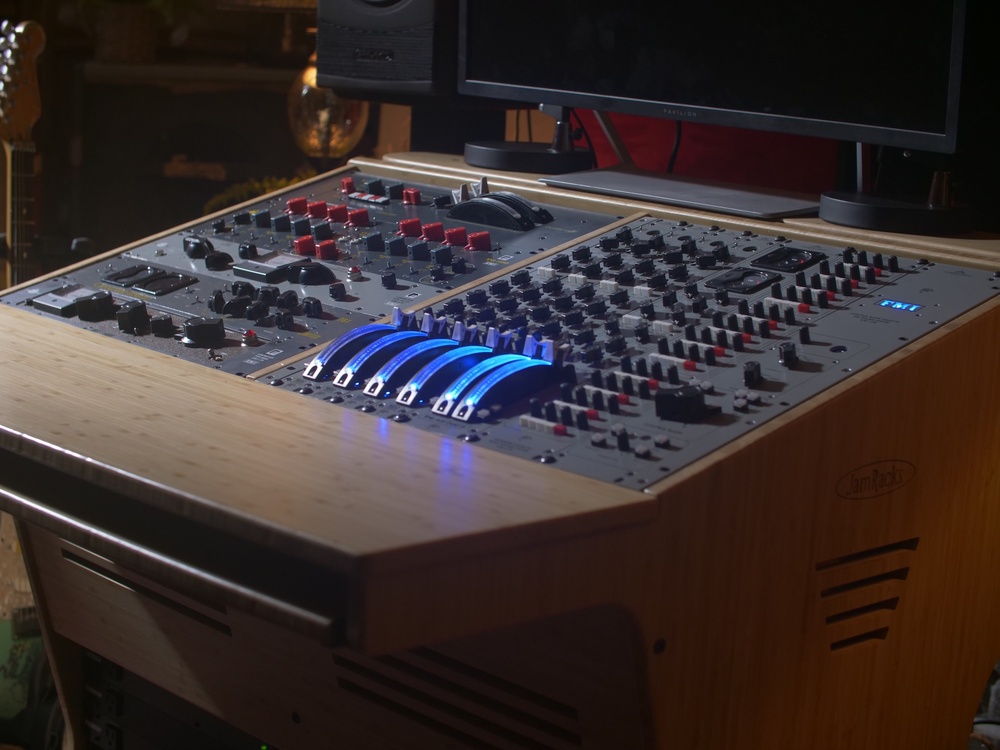
One of the largest pieces of equipment at the event was Chandler Limited’s Abbey Road console.
The console draws inspiration from Abbey Road’s historic REDD and TG desks, which were used on recordings ranging from The Beatles and Pink Floyd to film scores including Raiders of the Lost Ark and Return of the Jedi.
Chandler Limited founder Wade Goeke worked closely with Abbey Road to develop a console that captured the sound and workflow of the originals while providing the flexibility required by modern studios.
The console is hand-wired and uses components based closely on those found in the historic desks.
Where original components were no longer available, the closest modern alternatives were carefully selected.
The result is not simply a reproduction of one particular console.
It is a modular system that allows studios to combine different Abbey Road circuit designs.
A studio might choose valve-based REDD channels for some sources, transistor-based TG channels for others and configure the console around its own workflow.
That modularity is particularly exciting because every producer and engineer has different preferences.
Some people naturally gravitate towards the depth and harmonic character of valve equipment. Others prefer the speed, punch and clarity of transistor designs.
This console allows those personalities to coexist within a single system.
The same TG preamp heritage can be found in the Chandler Limited TG2 Abbey Road Microphone Preamp.
There is also a compact Chandler Limited TG2-500 Microphone Preamp for studios built around the 500 Series format.
For engineers looking for a more complete front-end recording channel, the Chandler Limited TG Microphone Cassette Channel Strip combines TG-style preamplification, equalisation and dynamics in a single unit.
The console itself is also remarkably expandable.
Some installations have been configured with as many as 48 channels, although powering that many valve circuits requires a substantial collection of power supplies.
The illuminated faders provide a small modern visual touch while maintaining the classic feel of the original consoles.
It is serious equipment, but it is also designed to be inspiring and enjoyable to use.
That sense of fun is important.
Studios are creative environments. The equipment should make you want to experiment.
Abbey Road and Chandler Gear Featured in the Video
Here are the modern products connected to the Abbey Road equipment and designs featured during my time at SXSW London:
Chandler Limited REDD Microphone https://sweetwater.sjv.io/oqGPk9
Chandler Limited TG12345 Curve Bender Mastering Equalizer https://sweetwater.sjv.io/yZWz6y
Chandler Limited TG 1 Limiter, Abbey Road Special Edition https://sweetwater.sjv.io/7Xd40O
Chandler Limited TG12413 Zener Limiter https://sweetwater.sjv.io/rERVNB
Chandler Limited TG12345 MKIV 500 Series Curve Bender EQ https://sweetwater.sjv.io/xJOB63
Chandler Limited REDD.47 Tube Microphone Preamp https://sweetwater.sjv.io/aNr27M
Chandler Limited TG2 Abbey Road Microphone Preamp https://sweetwater.sjv.io/DKA0vy
Chandler Limited TG2-500 Microphone Preamp https://sweetwater.sjv.io/1G26Q6
Chandler Limited TG Microphone Cassette Channel Strip https://sweetwater.sjv.io/zzRWkx
Softube Chandler Limited Curve Bender Plug-in https://sweetwater.sjv.io/PzBoZM
Conversations About the Future of Music
Alongside all the equipment demonstrations, SXSW London provided an opportunity to take part in panels and conversations about the future of the music industry.
We are living through a period of enormous change.
Artificial intelligence, immersive audio, streaming, new production tools and changing consumer habits are all reshaping the way music is created, distributed and experienced.
However, one thing became very clear throughout the event.
Technology is most exciting when it supports creativity rather than replacing it.
The most compelling products I saw were not trying to remove musicians, producers or engineers from the process.
They were giving creative people new ways to express themselves.
Whether it was transforming the interior of a car into a more musical listening environment, turning a fashion workshop into a playable instrument or rebuilding the sound of a 1950s console for modern studios, the common thread was human creativity.
That is what gives these technologies meaning.
History as a Starting Point
Spending time with the Abbey Road team is always inspiring because they understand the value of their history without being trapped by it.
The original EMI engineers were constantly experimenting.
They used equipment in ways its designers had never intended. They modified circuits, misused noise-reduction systems, pushed compressors beyond their normal operating range and invented tools whenever the existing technology was not enough.
That is the real Abbey Road tradition.
It is not simply a collection of famous rooms or historic equipment.
It is a culture of curiosity.
The Big Nessie, the Abbey Road Sound Mode, the modern Chandler console and all of these new projects continue that tradition.
They take something from the past, place it into a new context and ask what else it might become.
An Incredible First SXSW London
SXSW London was a wonderful opportunity to reconnect with friends, discover new technology, participate in some important conversations and celebrate the relationship between music, creativity and innovation.
There was a great sense that the different parts of our industry were coming together.
Artists were speaking with engineers. Producers were speaking with software developers. Fashion designers were creating instruments. Recording studios were helping shape consumer audio systems.
Those connections are where genuinely new ideas begin.
I left the event feeling inspired, encouraged and excited about what comes next.
The tools will continue to change. The formats will continue to change. The way people discover and consume music will continue to evolve.
However, the fundamental goal remains the same.
We are trying to make music that moves people.
SXSW London was a fantastic reminder that, when technology, history and human creativity come together, the possibilities are almost endless.
Watch the full video and join me at SXSW London here: