

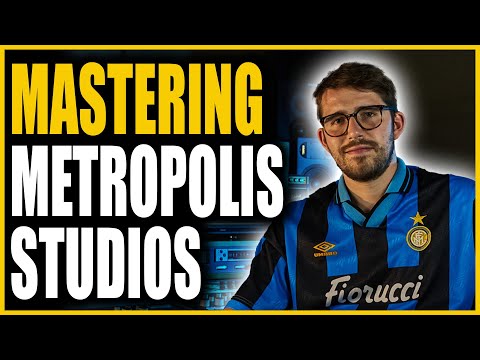
Where world-class expertise meets musical intent
Tucked inside Metropolis Studios, which is housed within the Grade II listed Power House, a beautifully restored Victorian power station in Chiswick, West London, Metropolis Mastering is widely recognised as one of Europe’s premier mastering facilities.
For more than three decades, its engineers have shaped the sound of countless landmark records. With pristine acoustic environments, state-of-the-art technology and a team that includes Tony Cousins, Stuart Hawkes, Matt Colton, Mike Hillier, Andy “Hippy” Baldwin and Felix Davis, the facility continues to set the benchmark for modern mastering.
From traditional stereo mastering to Dolby Atmos, Metropolis offers an exceptional range of services across all modern formats including vinyl, CD and streaming, ensuring every project translates perfectly across listening systems. The studio’s history of Grammy and Mercury Prize-winning work stands as testament to the consistency and quality of its output.


Inside the Room with Felix Davis
A conversation about taste, tools and translating intent
During my visit to Metropolis, I sat down with mastering engineer Felix Davis in Mastering Room 5, affectionately nicknamed “Dylan”. Felix joined Metropolis in 2016, the same year his father John Davis was remastering Led Zeppelin’s entire catalogue with Jimmy Page, a project that would become a defining moment for both.
“One of my first paid jobs in music,” Felix recalls, “was literally QC-ing all the Led Zeppelin CDs, listening from start to finish and noting any clicks, pops or squeaky pedals.”
Felix later assisted his father on various projects before stepping into the role himself. When John became ill, Felix took over recutting certain Led Zeppelin lacquers, consulting with his father throughout the process.
“Dad told me, ‘Make it loud, Jimmy wants it loud. Don’t hide width with elliptical tricks, he’ll hear it if something’s been monoed.’ No pressure at all,” he laughs.
Hybrid workflow and philosophy
Felix describes his approach as a blend of analogue character and digital precision.
His setup centres around a Mac mini running Pro Tools, feeding through a Prism DA into an analogue chain before being captured in Sequoia. The chain includes Maselec EQs, Avalon compression and EQ, and a Summit EQ for subtle tube warmth. Digital refinement follows with iZotope Ozone and FabFilter Pro-L2, while monitoring is handled through PMC speakers and Audeze LCD-X headphones.
“Analogue sets the tone, digital lets me fine-tune. If someone asks for half a dB less, I can instantly open the session and adjust. That’s the beauty of recall.”
He is pragmatic about loudness.
“Some mixes handle level beautifully, others fall apart. I do what feels right for the music. Platforms change their targets all the time, so I trust my ears first.”


Sibilance, sparkle and the low-mid balance
Felix is meticulous about high-end texture.
“The Avalon EQ gives you top end that feels expensive, never brittle. Between 9 and 12 kHz you get that zone where cymbals and sibilance overlap, so it’s about bringing life without harshness.”
He’s equally conscious of context.
“On Spanish or Turkish vocals, you can’t over-de-ess. It changes the meaning of the words. I’ve literally had clients say, ‘You’ve given me a lisp.’ You learn respect for the language.”
As for the low-mid range around 250 Hz:
“That area gives a track its push. A lot of people scoop it too heavily in choruses after stacking guitars, and the song loses weight. I’ll often add a touch back in the chorus so it still feels powerful.”
Width, mono and vinyl sense
“Sometimes monoing the bass just works. If you keep everything under about 40 Hz centred, the bottom end stays punchy and the stereo width above it actually feels wider.”
Format and delivery
Metropolis increasingly handles high-resolution projects, with many mixes arriving at 96 kHz. Masters are captured at native resolution, then carefully converted for streaming, vinyl or CD.
“You can’t control how people listen, whether it’s lossless Apple Digital Masters or default Spotify quality, so the goal is to make something that survives every context.”
While Room 5 is primarily a stereo suite, Felix also masters Dolby Atmos projects downstairs in the Metropolis Dolby-certified studio.
“Atmos has really overtaken legacy 5.1 for music. Most of my work is still stereo, but when clients attend in person, I love it. I like to talk, share what I’m hearing and make decisions together.”


Advice for artists and mixers
Felix’s guidance for those sending mixes is refreshingly straightforward.
“Don’t clip your mix unless you love the sound of the clip. Leave a little headroom so we can go analogue without it slamming. Send the highest resolution you have. And if something’s unworkable, we’ll tell you. Otherwise we’ll meet you where you are.”
He credits his father for instilling that sense of openness.
“Dad never treated mastering like a dark art. He wanted me to understand everything. That transparency helps everyone make better records.”
Learn more or book a session
Metropolis Mastering operates as part of Metropolis Studios, located in the Power House, 70 Chiswick High Road, London, one of the most architecturally striking studio complexes in the world.
If you’d like to learn more about their work, hear samples or book a mastering session, contact Mastering Engineer Manager Ellie at (+44) 0208 742 1111 or send a booking enquiry via the Metropolis Studios website.
Metropolis Mastering inside the Victorian heart of Chiswick, where craft, taste and technology combine to help your music sound its very best.