
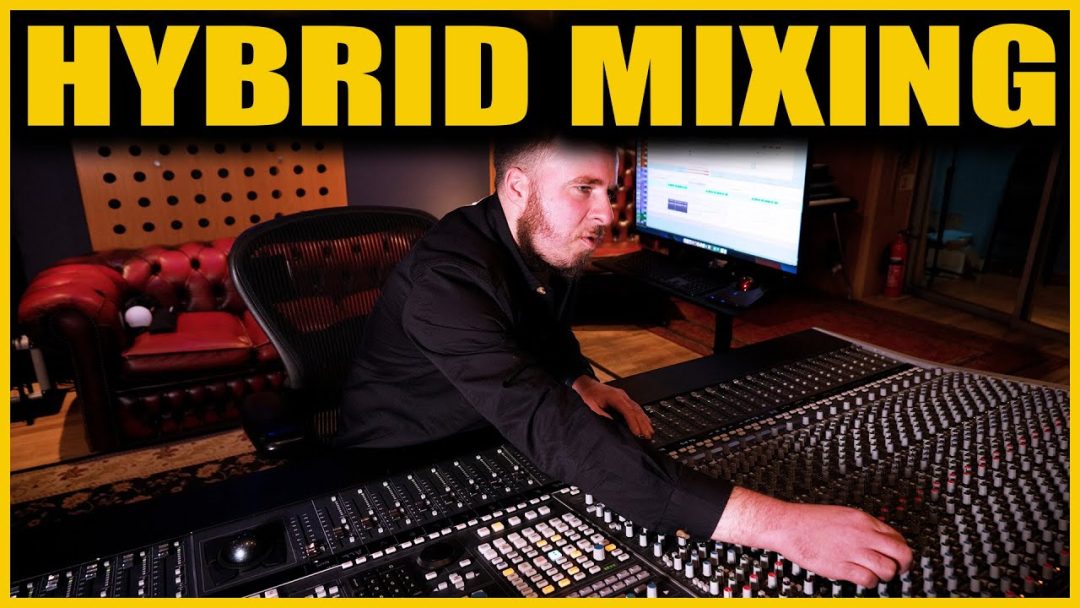

At The Motor Museum in Liverpool, producer and mixer Al Groves has developed a deeply musical approach to mixing that draws the best from both analogue and digital realms. In a recent walkthrough, he gives us a detailed look at how hybrid mixing, the integration of a DAW with an analogue console and outboard gear, can not only enhance sonic control, but also serve the emotional storytelling of a song.
Al mixes from Pro Tools through his SSL console, using faders, EQ, and compression on the desk to sculpt sounds with immediacy, while leaning on in-the-box tools for detailed creative shaping. It is a flexible, instinctive approach that allows him to chase inspiration without friction.


Shaping Space: Using Room Mics for Drama, Not Distance
The mix begins with the drum room mics, captured not in the Motor Museum’s iconic stone room, but in the wooden live room, which imparts a tight, midrange-heavy resonance. Rather than use the room mics for ambience or width, Al processes them for emotional weight.
By filtering the low end, taming cymbal harshness, and applying gentle compression, he transforms the room into a source of tension and excitement.
“I’m not looking to make the drums sound further away, I’m trying to create depth. Depth is drama, shimmer, energy, the sense that something is about to explode.”
EQ with Intent: Toms, Not Just Tuning
Moving to the toms, Al treats them like extensions of the kick, sculpting the low mids and emphasising their attack. He sweeps for that low-mid woof that stresses speakers and filters it just enough to tighten the sound without losing body. Each tom is panned and placed in a way that balances the stereo image, making space for the rest of the kit and mix elements to breathe.
Even when EQing in solo, he stresses the importance of returning to context, because what matters is how the parts function together.


When the DAW Becomes an Instrument
The hybrid workflow really shines when Al turns to creative sound design. In the box, he processes a tremolo guitar part using ShaperBox 3 by CableGuys, a plugin that allows complex modulation, glitching, and tonal shaping. See how Al uses ShaperBox creatively.
“I love that plugins like this let me make something unique. I want the records I work on to feel like a cultural identity. A timestamp, not just in when it was made, but how it was made.”
Through experimentation with drive, bit-crushing, and time-based manipulation, he injects subtle movement and character into the sound, something that would be difficult or time-consuming to achieve solely through hardware.
Panning with Purpose
When bringing in additional guitar layers, Al focuses not just on tonal balance, but on stereo interplay. Instead of defaulting to centre or hard panning, he listens for where the energy feels needed. One guitar lands slightly left to balance the hi-hat, another tucks right to allow a processed synth shimmer to cut through.
“It’s these small decisions, like where you place a bend guitar, that help a mix go from sounding good to feeling emotionally alive.”


Building the Vocal World
For Al, the vocal is sacred. He builds a world around the singer using a combination of subtle tools, the Roland Dimension D for widening, plate reverb for a sense of space and solitude, and carefully timed delays from the SDE-2500 to create emotional pull without blurring the centre image.
He tests different reverb types not for technical perfection, but for emotional tone. One makes the singer sound vulnerable, another gives the impression of isolation in a vast empty space. All of it contributes to the story.
“A plate reverb can make a singer sound lonely. And that might be exactly what the moment needs.”
Harmonies and Restraint
With the harmony stack, Al keeps things simple. A high-pass filter removes any unnecessary low end, and a touch of H3000 widening adds flavour, but only if it enhances the emotional glue of the vocal.
This restraint defines his approach. Whether using plugins or analogue gear, he avoids processing for its own sake. Instead, he makes deliberate choices based on what each moment in the song demands.


This mix session is a perfect illustration of what hybrid mixing can offer. With faders under his fingers, Al can react instinctively, shaping EQ and compression in real time. Meanwhile, his DAW allows surgical edits, automation, and bold creative choices using plugins that push boundaries.
The real benefit, though, is not technical. It is emotional. Hybrid mixing gives Al the tools to clear away distraction and focus on the heart of the song.
“It’s not about having every option, it’s about having the right options, to create a feeling, to follow an instinct, to chase down a moment.”
In Al Groves’ hands, hybrid mixing is not a compromise between two worlds. It is a synergy, where feel meets fidelity, and where the console and the computer work together in service of something far greater than the sum of their parts. Watch Al break it all down here.