

Download The Multitracks: https://producelikeapro.lpages.co/majora-kursk-form/
Post rock lives and dies on mood, movement, and dynamics.
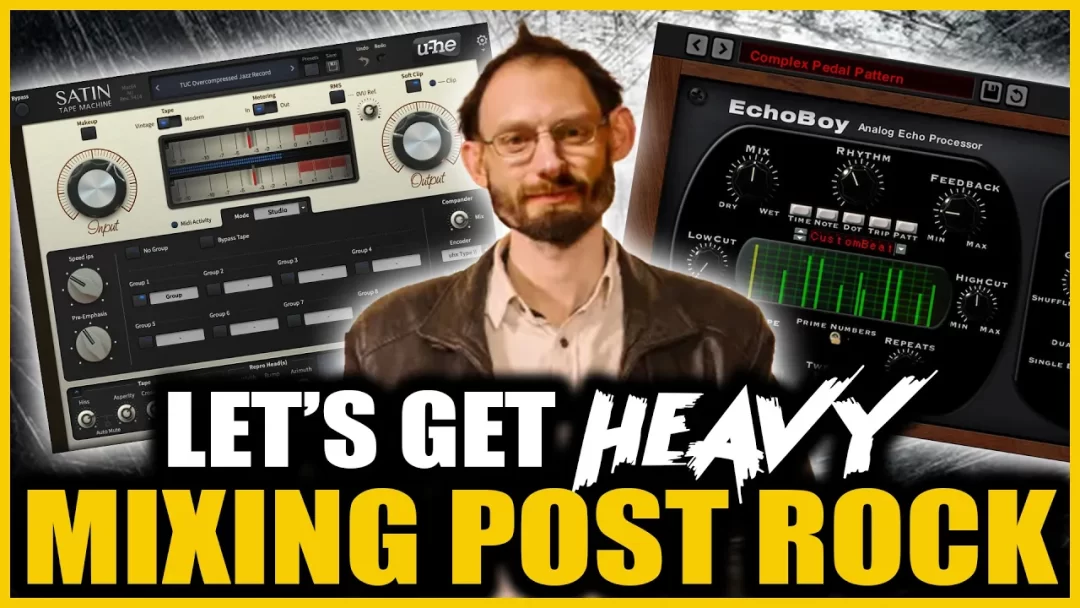
When it works, it does not just sound big. It feels like a journey. It pulls you into a world, sets a scene, and keeps unfolding in ways that are often more cinematic than conventional song based. That is exactly what makes Dax Liniere’s breakdown of his mix for Kursk by Majora so compelling.
This is not simply a walkthrough of plugins on a session. It is a detailed look at how to shape a record so that every section feels intentional, every transition has weight, and every sound serves the story.
Kursk was inspired by the tragic events surrounding the Russian nuclear submarine disaster, and that sense of tension, dread, atmosphere, and eventual chaos is woven into the arrangement from the very first sound. Dax approaches the mix with that narrative in mind, treating the track almost like a short film rather than a conventional rock production.
If you want to hear how all of this comes together in context, watch the full video. It is packed with ideas on depth, routing, tone shaping, automation, and creative decision making that go far beyond a simple mix breakdown.

A mix built around story

One of the most striking things about this session is that Dax is not just balancing instruments. He is building an environment.
The intro is eerie and unsettling, with film samples, filtered reverbs, guitar swells, strange synth textures, and soft ambient layers all combining to create a sense of unease. Rather than throwing one reverb across everything and calling it done, he uses multiple spaces, each with its own tone, decay, pre delay, and character, to create depth and complexity.
That is a recurring theme throughout the mix. Different reverbs from different manufacturers are used not because more is automatically better, but because different designers build tools with different sonic personalities. By layering them carefully, Dax creates spaces that feel more textured and more lifelike than a single reverb algorithm usually can on its own.
It is a brilliant reminder that atmosphere is rarely built from one thing. It is usually the result of many small choices, all pulling in the same direction.

The master bus is about control, not brute force

Dax begins by walking through the master bus, and what immediately stands out is how measured the processing is.
There is EQ reshaping to help him adapt to working in a new studio, some gentle SSL bus compression, multiple stages of tape style saturation, subtle harmonic enhancement, and final limiting that is doing surprisingly little. Most of the loudness is coming from the individual tracks and subgroups, not from smashing the mix at the end.
That matters.
A lot of mixers try to force impact out of the stereo bus. Dax takes the opposite approach. He builds weight, density, and aggression from the ground up, then uses the master bus to glue, shape, and refine. It gives the mix a sense of scale without flattening the life out of it.
He also does something particularly smart with the sub bass synth and sub drops, routing them so they bypass most of the master bus chain and hit the final limiter directly. That keeps the sub information clean and controlled, and stops it from overdriving the bus compressor or dragging the whole mix around in unhelpful ways.


Why this mix feels so deep
One of the reasons Kursk feels so immersive is the way depth is treated as part of the arrangement.
There are room reverbs, chambers, plates, early reflections, long halls, shimmer verbs, and heavily processed ambience effects all used with intent. Some are short and splatty. Some are dark and distant. Some are huge and floaty. Some are there purely to add attack or width. Others create the sensation of a space opening up around the instruments.
Dax also uses send EQ in a really intelligent way. Instead of just EQing tracks before they hit the reverb, he sometimes filters only the signal being sent to the reverb, leaving the dry sound untouched. That means he can keep brightness, mud, harshness, or low end under control in the ambience without sacrificing the direct tone.
It is one of those details that can make a massive difference in a dense arrangement.
Dynamics are protected at every stage
This session has 149 tracks, which tells you straight away this is not a sparse production. However, it never feels cluttered in the way you might expect from a number like that.
A big part of that comes down to Dax’s obsession with preserving movement and dynamic range.
He talks about removing narrow resonances because constant tones reduce perceived movement. That is such an important point. If something unpleasant is ringing constantly, it is not just annoying. It can also flatten the emotional contour of a section. Remove that resonance, and suddenly the arrangement breathes more naturally.
That philosophy shows up everywhere. Dynamic EQ is used to control harshness only when it appears. Parallel compression is used to lift detail without destroying transients. Gates are tuned for musical tightness rather than just aggressive cleanup. Automation brings effects in and out so sections evolve rather than stay static.
The result is a mix that feels alive. It swells, contracts, builds tension, and releases it.

Creative use of plugin variety

One of the most useful ideas in the video is Dax’s commitment to using different tools from different developers for similar jobs.
Two delay plugins may technically be doing the same thing. Two tape emulations may both be adding saturation. However, they do not sound identical, and that difference matters. Dax uses that to his advantage, often choosing contrasting plugins on parallel layers or duplicate tracks so that the final blend has more texture, more complexity, and more individuality.
It is the in the box equivalent of working in a studio full of mismatched outboard, where each compressor, EQ, and reverb has its own quirks and sonic fingerprint.
That is a big part of why this mix does not feel sterile. It feels assembled from colours rather than presets.
Guitars that move from atmosphere to violence
The guitar work in Kursk covers an enormous emotional range, and the mix supports every part of that arc.
At the start, guitars are treated almost like environmental sound design. Swells are softened with auto swell processing, sent to long reverbs and delays, filtered for space, and widened carefully so they hover rather than dominate.
As the song develops, the guitars become more defined, then more insistent, then eventually crushing. Amp sims, EQ, compression, saturation, delay, shimmer, pitch shifting, and layered ambience are all used to help the guitars occupy different emotional roles at different moments.
What is especially impressive is how often Dax reshapes these tones not just for size, but for placement. Mid range carving, side boosts, stereo manipulation, and selective filtering all help the guitars feel wide and dramatic without trampling over the bass, drums, or synth layers.

A bass sound with weight and intention

The bass in this mix is doing a lot of heavy lifting.
Dax blends DI, overdrive, amp driven layers, Darkglass distortion, sub synth support, and stereo effected distortion parts depending on the section. However, none of it is random. Each layer has a job.
The low end is protected by removing unnecessary lows from distortion layers. String noise is controlled where needed. Sidechain compression from the kick keeps the relationship between kick and bass moving naturally. Stereo width is introduced selectively, and only in the right moments.
There is also a great example of using Waves RBass not just to add low end, but to generate harmonics that help a sub part be heard more clearly. That is a classic move, and in a track like this it makes perfect sense because the bass needs to be felt and understood.
Drum mixing with both realism and impact
The drums were recorded by the band, and Dax had to do some serious shaping to bring them all the way to the finish line.
Kick drums are reinforced with EQ, gates, saturation, samples, and even a sine wave triggered by the kick to add low frequency extension. Snare top and bottom are treated differently, with careful gating on the under mic to avoid false triggering from spill. Parallel snare compression adds punch and urgency without replacing the original character.
The toms are a particularly nice example of problem solving. Sample tracks are used not as a lazy replacement, but as a precise way to trigger spill gates and tighten the original recordings while keeping the natural body and decay of the drums intact. That says a lot about Dax’s mindset. The aim is not to throw away what is there. The aim is to make what is there work harder.
Room mics, overheads, parallel drum buses, saturation, stereo control, and selective compression all help the kit expand as the song intensifies. By the end, the drums feel huge, chaotic, and exciting, however still connected to the emotional narrative of the track.

Sound design inside the mix

Another thing this breakdown makes clear is that modern mixing often overlaps with sound design.
Pitch shifting, octave effects, organ style processing, stereo widening, reverse delays, shimmer verbs, filtered ambience, transient shaping, and even automation tricks that mute sounds for impact all play a role here. None of it feels tacked on. It all supports the mood and the arrangement.
That is especially true of the stranger elements, like eerie voice pads, siren like textures, glockenspiel style parts, samples of ocean waves, and manipulated vocal fragments. These details help the track feel haunted, submerged, and unstable, which is exactly the emotional territory Kursk needs.
Why you should watch the full video
Reading about this mix is one thing. Hearing Dax solo elements, explain the routing, and show how each choice affects the emotion of the song is where the real value is.
The video is full of useful takeaways for anyone mixing rock, prog, post rock, cinematic music, or anything arrangement heavy. It is also a reminder that great mixing is not about stacking plugins for the sake of it. It is about understanding what the song is trying to say, then using every available tool to help it say that more powerfully.
If you want to see how a dense, atmospheric, highly layered production can still feel clear, dynamic, and emotionally coherent, this is well worth your time.
Watch the full video and hear Dax Liniere break down his mix of Kursk by Majora in detail. It is a deep dive into creative routing, ambience, dynamics, saturation, layering, and storytelling through sound, and there is a lot here to inspire your own mixes.
Download The Multitracks: https://producelikeapro.lpages.co/majora-kursk-form/