
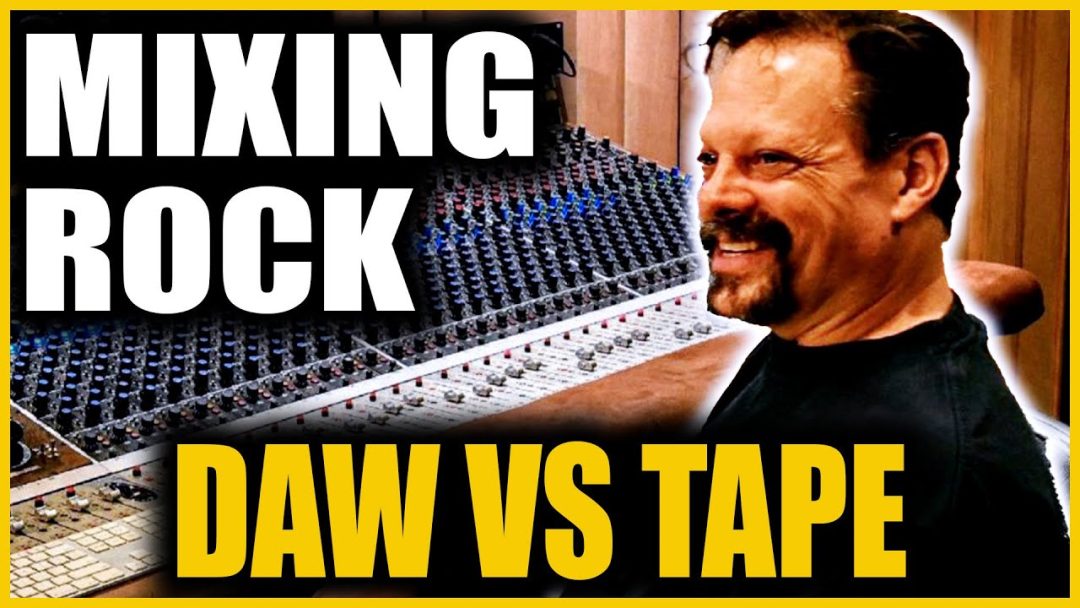
There is something very special about sitting in a room while someone like Bradley Cook builds a mix from the ground up. In this DAW vs Tape session we are in front of a console, Pro Tools running in the background, tape machines spinning, and a loud, scrappy rock track called “Let’s All Have A Blast” blasting out of the speakers.
The whole point of this experiment is to live right where those worlds meet. Pro Tools for capture and recall, tape and transformers for tone and attitude. What follows is a walk through Bradley’s process, how he shapes the sound at the console, how he uses compression and chambers, and how tape changes the feel of the finished mix.


Drums first: carving the kit at the console
Brad starts where most great mixes start, with the drums. Not with wild moves, just focused, musical decisions that let the drums feel exciting without taking over the whole record.
Kick drum: smack without splash
On the kick he is very deliberate about what not to let in. There is a low pass around 14 kHz to keep cymbal wash out of the kick channel. The idea is to keep the kick focused in its own lane instead of turning it into another cymbal mic.
From there he adds a big boost at 5 kHz, about +6 dB, to get that front, the click and “smack” that lets the drum poke through when the track gets loud. The mud lives around 400 Hz, so he dials a very narrow notch there just to pull out the cardboard and leave the punch.
Nothing fancy, just three decisions that say “this is a rock kick, not a room mic.”
Snare: split personality across tape and console
The snare is where you really start to see the hybrid thinking. The snare mic is split. One path goes straight to the console channel. The other goes to the Scully tape machine so Bradley can push it into saturation and then bring that back.
On the first snare path he uses the low mid EQ, adding about +2 dB at 200 Hz to get some shell, the body of the drum. The second snare path, the one coming back from tape, is shaped more aggressively. He engages the low frequency band, adds around 1.5 dB at roughly 150 Hz for extra weight, then carves out a big scoop around 480 Hz to remove the boxy midrange. Up top he boosts 3 kHz and high passes around 100 Hz so the snare has front and bite without rumbling around in the kick space.
You end up with a combination of body, transient and tape grit. One path is relatively clean and controlled. The other is dirtier and more midrange forward. Together they feel like a snare that has been hit hard in a small loud room.
Toms and overheads: let the kit be a kit
The toms are straightforward because the source is great, which is a recurring theme. Rack and floor are miked with 414s from drummer’s perspective. On the rack tom he boosts at 100 Hz and around 160 Hz for weight, then 3 kHz for attack. On the floor tom he adds a lot of 90 Hz, enough to feel it in your chest, and leaves it at that. The floor tom “just sounded amazing” so it does not need surgery, only support.
Overheads are C12As and Bradley does the best possible thing when the overheads sound right. He does nothing. No EQ at all. The kit mic, an M49, gets a small notch at 400 Hz and a bit of 3 kHz for presence, then a 15 kHz low pass to keep the very top under control.
The drums are now punchy, forward and a little gnarly, and all that has happened before a single fader ride.
Bass: glue from tube compression and tape
The bass setup shows very clearly how Bradley is thinking about tape vs DAW.
The DI is printed straight to Pro Tools, clean, no EQ, purely for safety and later options. That does not touch tape. The amps, a B15 and a Magnatone, are what he commits to tape. Those are the character paths.
On both amp channels he inserts an UnFairchild. First he sets the input so the VU needle is bouncing around zero, then he switches to gain reduction and dials in how hard he is hitting it, typically around 3 to 5 dB of reduction. He starts with the attack super slow and the recovery super fast in variable mode, so the compressor just catches the tops of the notes instead of flattening the whole performance.
The result is a bass that stays in place, feels solid under the track and has that thickness you get from tubes and transformers working a little.


Guitars: phase, midrange and attitude
For guitars Bradley is obsessed with two things, phase and midrange.
Phase alignment first
Both guitarists are recorded with two mics on the cab. Typically a 57 and a Royer. He lines the capsules up physically in as close to the same plane as possible, then flips the polarity on one mic while listening. He moves things until the sound almost disappears, which means the mics are cancelling each other, then flips it back so they are in phase and the sound “pops” into focus.
That little ritual avoids the hollow, washy sound you get when mics are fighting each other. Once phase is right, EQ choices actually work.
Ryan’s guitar: fixing a thin amp
Ryan’s main guitar tone from the amp is quite bright and “penny” sounding. To fix that he leans on midrange rather than just turning down the top. He dials a wide boost around 480 Hz and somewhere in the 3 hundred region, big broad mid bumps that give the sound some chest and wood. Later Ryan adds more low end at the amp and pulls some highs, which works together with the console EQ so the tone becomes big and exciting instead of thin and annoying.
For the solo tone he adds just a touch of bright EQ around 3 kHz, maybe +1 dB, again with a wide bell. He wants the solo to be just a little too loud and a little too forward, very Stooges, so it leaps out of the speakers without taking your head off.
Craig’s guitar: bright 57, supportive ribbon
Craig’s Bronson amp gets the 57 and Royer combo too. In this case the 57 already sounds awesome and bright, so Bradley leaves it flat. On the Royer he adds a little 3 kHz with a wide curve, and high passes around 75 to 80 Hz. The ribbon gives weight and smoothness, the 57 provides the bite. Together they make a full picture that sits easily in the mix.


Vocals: control, grit and old school de-essing
The vocal chain is another nice example of hybrid thinking.
On the main vocal track there is a high pass at 70 Hz to remove rumble, then a Fairchild style compressor in variable mode. Bradley sets the level into the compressor first, then dials in gain reduction until the vocal is controlled but still alive. Again he favours slow attack and fast release so consonants and transients keep their edge.
Later on he adds a second vocal flavour. There is a “razor blade” Scully vocal that is super crispy and distorted, and a cleaner MPDI preamp vocal. At the end of the process he blends them, adding more of the clean path until the vocal feels warm enough without losing the punk aggression.
For sibilance he goes very old school, patching in an FS900 style manual de-esser on the Scully vocal. It takes a lot of de-essing because that path is so gnarly, however the end result is a vocal that is bright and exciting without tearing your ears off.
Building the static mix: balance before automation
One of the most important things Bradley talks about is “blocking everything out”. Before he worries about rides or effects, he wants the mix to sound good with all the faders basically parked.
He spends time editing. Cleaning up crossfades, trimming extra guitar noise, sorting out odd bits of feedback and end noise. He assigns outputs sensibly, although he does not obsess over perfect track order. In fact he often just throws messy routing down to the bottom of the session and starts again rather than rearranging everything. The point is to get decision making out of the way of listening.
He listens quietly for the majority of the time. When you monitor loud it is very easy to fool yourself into thinking the balance works. At low volume you hear the truth. He wants the vocals to feel a little on top when quiet, and not too loud when cranked. If it passes both tests, the level is right.
He even gives the mix the “hallway test”. Walking out of the sweet spot, listening from across the room, letting the song hit you as a whole. If the vocal is still present and the groove still feels right when you are not staring at the meters, you are on the right track.
Only once that static balance feels solid does he start to think about different tones in different sections. For instance, a boomier kick in the verses and a spikier kick in the choruses.


Mix bus compression: UnFairchild and Deca flavour
Halfway through the mix Bradley starts experimenting with bus compression to see what it does to the energy of the track.
He first patches in the UnFairchild across the stereo bus. He hits the input a little harder so the transformers and tubes are working, then dials in a small amount of gain reduction with a slow attack and fast release. He wants it to just kiss the mix, not clamp it.
You can hear the tone change. Louder is always better of course, however there is also a genuine tonal difference. The mix comes forward, the top end feels more exciting, and everything starts to sound more finished.
Later he tries a Deca or BBC style compressor instead. There are arguments about the original design, however in practical terms this unit adds a very appealing top end sheen and a sense of “goo” to the mix. Bradley sets the make up gain around minus four for unity, then edges it up to minus two to give the mix a little push into the stereo bus. Again he avoids the very heavy auto time constant modes that just sit on the mix and prefers settings that feel open and punchy.
Tape vs DAW: printing to the ATR
The DAW vs Tape part of the session really comes into focus when Bradley prints the mix to the ATR tape machine and brings it back.
There is even a small ritual to it. Put tension on the tape, hit stop, flip the machine into input or repro, align the levels, then roll. He has aligned the machine the day before, so once it is ready they print the mix straight to tape, then monitor off repro.
The change is not subtle. The tape makes the whole track feel warmer and more “finished”. The top end does not disappear. If anything the tape adds a kind of high end that feels like air rather than harsh brightness. The vocal seems to sit more naturally against the band, and Bradley comments that he does not feel like he needs to keep moving it up and down through the song. The track wrestles him less.
It is a perfect example of why people still love tape in a digital world. Pro Tools gives you the flexibility, the edits, the recall. Tape gives you the way the transients soften, the way the low end rounds out, the way instruments glue together when they hit real electronics at the right level.
Chambers, ambience and the big ending
Space is another place where the analogue side of the room really shines.
Bradley sends guitar feedback into a real chamber, then claps in the room to hear how it reacts. The treatment on that feedback gets printed, not left as a live send, so the effect becomes part of the performance. It is subtle, however it adds a sense that the guitar is living in a physical space rather than stuck to the speaker.
He then runs Ryan’s lead guitar through the chamber as well so it has some dimension throughout the song. The result is slightly surfy, a little retro, exactly the sort of character you want on a raw rock track.
For the big ending he goes even further. The drums already have chamber on them, and for the final “whoosh” he also sends Craig’s rhythm guitars and the bass through the same chamber. It feels like a cement rehearsal room, like those classic punk or AC/DC endings where the band is bashing away in a live space while the reverb tails off forever.
Once he is happy with the print he turns off all the aux sends, a bit of good housekeeping, and cleans up the end of the multitrack. Snare rattles, tape hiss, odd breaths. He keeps the cool bits, the scream in the room at the very end, the human moments that remind you this is a band, not a loop.


Final balances: loud, quiet and everything in between
The last stage is all about detail. Bradley spot checks different sections, nudges the solo level up or down, makes sure the rhythm guitars match in volume left and right, and checks that doubles and reverbs are doing what they should.
He listens very loud for a moment to feel the excitement, then very quiet to confirm the vocal is still leading the song. If something feels off, he makes tiny moves, half a dB here, a small EQ tweak there. No huge drama, just refinement.
One useful detail is his view on doubles. He is perfectly happy with doubled guitars being at equal volume on each side when it serves the part. The point is consistency and impact. If the rhythm guitars surge and sink randomly, the groove collapses. If they hit evenly, the chorus slams.
By the time he is ready to “wax it” and print the final mix, there are still no crazy fader rides. The mix sits “really nicely without any fader moves whatsoever”. The movement comes from the performance, the arrangement and the tone shaping, with only minimal automation to polish transitions.
Takeaways for your own DAW vs Tape workflow
Even if you are working entirely in the box there is a lot you can steal from this session.
- Get the static balance right first Do your edits, clean up noise, then sit and make the mix feel great with no automation. Listen quietly and from outside the sweet spot.
- Use EQ to define roles Carve out 400–500 Hz on kicks and snares when they are boxy. Use 3–5 kHz to add front and attack. Do not be afraid of broad mid boosts on guitars to make them feel big.
- Think in paths, not plugins The snare exists as a clean path and a tape path. The vocal exists as a gritty Scully path and a clean MPDI path. You can do the same with duplicate tracks and different saturation plugins in a DAW.
- Compress for feel, not for volume Slow attack, fast release, just catching the tops. Whether it is a Fairchild emulator or another compressor, let the transients live.
- Experiment with mix bus processing Try a compressor that is barely working, simply pushing its transformers or modelled electronics. Do not clamp the mix. Let it breathe.
- Use ambience as part of the arrangement Print special effects like feedback through a chamber. Think of reverbs and rooms as instruments that come and go, especially in intros and endings.
- If you have access to tape, use it intentionally Print a finished mix to tape and compare to your in the box version. Listen for how the vocal sits, how the low end feels, how the high end changes. Even if you end up using a tape plugin instead, you will know what you are really chasing.
This DAW vs Tape session with Bradley is a beautiful reminder that the tools are only half the story. The rest is careful listening, confident decisions and a willingness to let the song tell you what it needs.
Check Out Bradley Cook’s Full Here: https://promixacademy.com/course/recording-mixing-punk-rock/
Have a marvellous time recording and mixing.
Warren Huart