
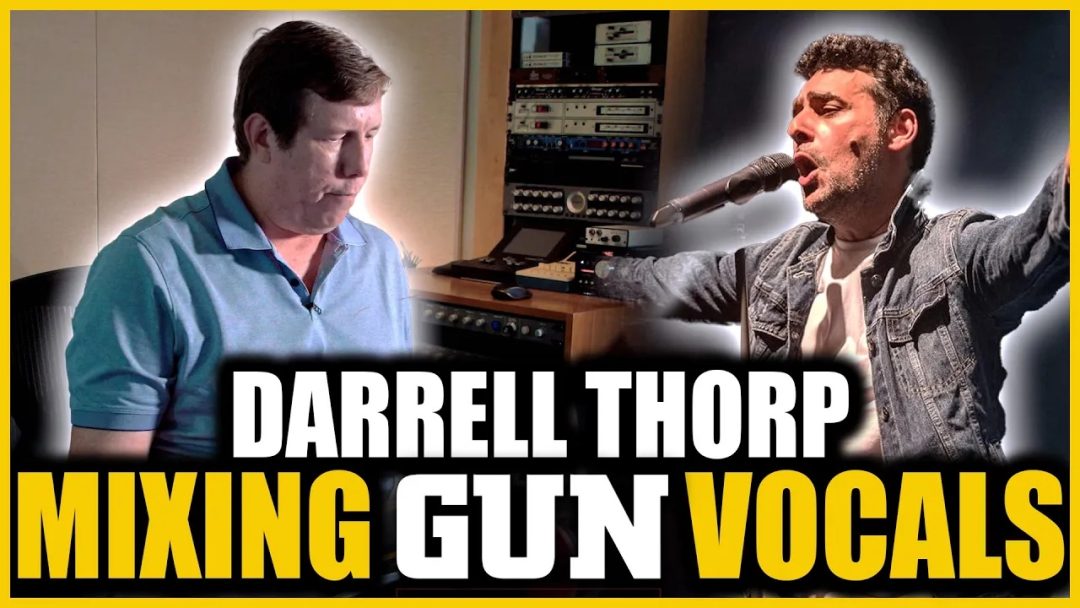

“Alright… what are they doing here?”
We jump into the pre-chorus and straight away Darrell hears it:
“Okay… that’s compressed… and there’s some grit going on.”
There’s already saturation happening from Soundtoys Decapitator.
Now here’s the moment most people miss.
He doesn’t go:
“Cool, delete that, here’s my chain.”
Instead it’s more like:
“Alright… they’re going for attitude… let’s work with that.”


Saturation, Back It Off… Then Make It Better
He keeps the Decapitator… however immediately adjusts it:
“I’m just going to back off the distortion… a lot… and bring the brightness up.”
That’s such a key move.
Instead of obvious distortion, it becomes:
- Energy
- Presence
- Aggression without harshness
And you can almost hear him thinking:
“It’s cool… just not that much of it.”


“Good Old 1176… sounds good already”
He drops in a Urei 1176 and within seconds:
“Sounds good already… can’t go wrong.”
No overthinking.
That’s decades of experience right there.
- Fast
- Aggressive
- Musical
It just moves the vocal forward.
“Is that… out of polarity?”
This is one of those subtle pro moments.
He flips back and forth and goes:
“Yeah… I hear a slight difference.”
Fixing polarity:
- Adds weight
- Makes the vocal feel like it’s pushing air
- Gives it physicality
And I love how he frames it:
“You want the speaker working in your favour… pushing air.”
That’s not theory, that’s feel.


De-Essing & Surgical Fixes
He starts broad with FabFilter Pro-DS, then gets surgical with FabFilter Pro-Q 3.
You can almost hear the moment:
“Oof… there it is… that frequency right there.”
Instead of carving the whole vocal up:
- Narrow band
- Dynamic control
- Just tame the problem
“Every singer has that one spot that’ll rip your head off.”
So true.
“I don’t know why I love R-Vox… it just works”
He brings in Waves R-Vox and explains it perfectly:
“It doesn’t sound like compression… it just levels things out.”
That’s the magic.
- Quiet words come up
- Loud words stay controlled
- No obvious pumping
It’s more like:
“Oh, now I can hear every word.”
EQ, Keep It Musical
He grabs a Pultec-style EQ and just starts lifting the top:
“Let’s just start with the top…”
Nothing drastic.
Then:
- High-pass around 50–75 Hz
- Clean the low end
It’s all about:
- Clarity
- Air
- Musical moves, not surgical ones
Parallel Compression, “Oh… now that works”
This is a big moment.
He adds a parallel chain using a Empirical Labs Distressor.
Before:
- The distortion felt a bit weird
After:
- Everything clicks
“When I bring in the parallel… oh… that sounds pretty cool.”
That’s such a real mixing moment.
Parallel compression:
- Adds density
- Smooths aggression
- Glues the tone together


“I’m a huge slap guy”
This made me laugh because it’s so true:
“Can never have enough slap.”
Using delays like:
- Soundtoys EchoBoy
- Tape-style echoes
He adds:
- Thickness
- Groove
- Attitude
Not long delays, just enough to feel it.
Reverb, The 80ms Trick
Using something like LiquidSonics Seventh Heaven:
He adds a plate… then:
“Let’s put about 80 milliseconds of pre-delay on it.”
This is huge.
Same reverb level, however suddenly:
- Vocal stays upfront
- Reverb sits behind
- Feels bigger without getting washed out
“It feels like it’s in front of the tunnel… not inside it.”
Perfect description.
The Real Lesson, It’s Not the Chain
This is the biggest takeaway.
Darrell isn’t doing:
- Fixed plugin order
- Preset chains
- One-size-fits-all
He’s doing:
“Alright… what does this song need?”
Sometimes he keeps things. Sometimes he deletes them. Sometimes he completely pivots halfway through.
“There’s a thousand ways to do this.”
Final Thoughts
If you boil it down, the process is:
- Listen to the rough
- Respect the intention
- Control saturation
- Use fast compression for energy
- Fix problems surgically
- Add parallel for impact
- Create space with delay and pre-delay
- Stay flexible
And honestly, that’s the difference between:
- Following a tutorial
- And actually mixing a record
Want To Go Deeper?
If you want to really get inside Darrell’s workflow, his full course bundle is here:
👉 https://promixacademy.com/course/darrell-thorp-everything-bundle-2025-edition/
It goes way beyond just this vocal chain and gets into how he approaches entire mixes, decisions, and workflow in a real-world context.