
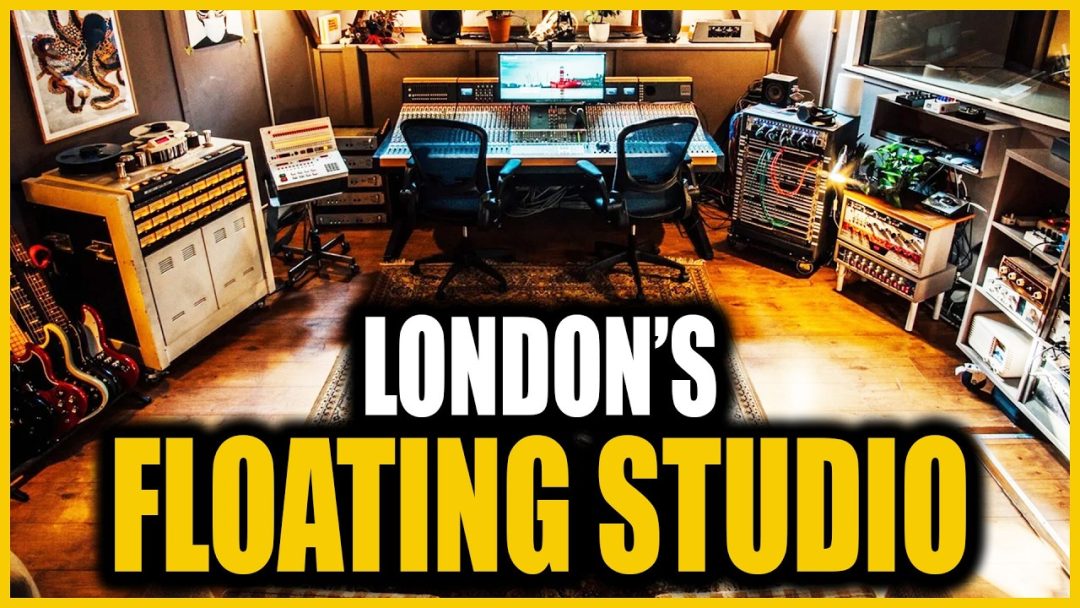

Check Out Lightship 95 Studio: https://www.lightship95.com/?gad_source=1&gbraid=0AAAAAqwS1EaR7jW8oX446A5zw8P7Ef-Yr
Hi everybody, hope you’re doing marvellously well.
I’m quite excited about this one.


We’re at Trinity Buoy Wharf in East London and sitting in front of something pretty extraordinary, a real lightship called Lighthouse 95. Now, quick clarification, for my American friends, that’s buoy as in something floating in the water, not a “boy” wandering around!
This ship was built in 1939 and originally towed out to sea to act as a floating lighthouse. That alone is amazing. However what’s even more incredible is what it has become today, a fully functioning recording studio.
So naturally, I had to go and check it out.
Stepping aboard something special
From the moment I stepped onto the ship, there was already a sense that this was going to be different.
Giles, who runs the studio, welcomed me aboard and immediately you feel it, that subtle shift. You’re not walking into a building, you’re boarding something with history, something that has lived a completely different life before music ever entered the picture.
And then you walk into Studio One…


A proper studio, in every sense
The first thing that hit me was the atmosphere.
And I don’t mean “nice vibe” in the casual sense. I mean that very real, almost physical feeling you get when you walk into a proper studio space.
We talk about this a lot, most studios today are built into office blocks, warehouses, shared spaces. That’s just the reality. However, the magic of the classic studios was always that sense of stepping into another world. A place where everything outside simply disappears.
Lighthouse 95 has that.
You walk in and instantly think, oh yeah… this is a studio.
Not a room in a building. Not a converted office. A destination.
And then Giles casually mentions:
At low tide, the ship is sitting on the riverbed. When the tide comes in, it floats.
So yes… you can be recording a drummer, and the whole room might gently move beneath you.
That’s not something you get in your average commercial facility.
A live room with character and capability


The live room itself is incredibly versatile.
They’ve had up to a 15-piece band in there, which is tight, however absolutely doable. More realistically, four to nine musicians fit very comfortably, making it ideal for live band tracking.
What really stood out was the isolation.
Giles mentioned a recent jazz session where ribbon mics were placed near the piano, drums in the room, and there was barely any bleed. That’s seriously impressive, especially in a space with curved steel walls.
And those curves are part of the magic.
You can literally see the hull of the ship integrated into the structure. Add to that proper bass trapping and thoughtful acoustic treatment, and you’ve got a space that sounds controlled, however still alive.
There’s also a small booth, perfect for vocals or isolation when needed, and even a clever reverb chamber built into what used to be a cupboard. Leave the door slightly open, place a speaker and a pair of small diaphragm condensers, and suddenly you’ve got a natural, musical ambience.
Simple ideas, executed beautifully.


Character gear everywhere you look
This place is packed with personality.
From Peavey bass amps from the golden era, to Fender Twins, a JC120, boutique builds like the Kraken, and a Hammond with a Leslie that comes with one of the more unusual backstories you’ll ever hear involving a repairman and a police visit during a murder inquiry…
Yes, that actually happened.
There are instruments everywhere, a Broadwood upright piano with a punchy midrange that sits beautifully in a mix, Rhodes and Wurlitzer electric pianos, vintage guitars, and plenty of unique pieces with real history behind them.
It feels curated rather than collected. Everything has a reason to be there.
A seriously impressive mic locker
The microphone collection is where things get even more interesting.
You’ve got classics and modern pieces sitting side by side:
- Vintage U87 from 1967
- RCA ribbon from 1943
- Coles 4038s and Beyer M160s
- STC ribbon with incredible rejection
- United Studio Technologies FET 47-style mics
- Shure KSM series, including the underrated KSM8
- Earthworks omnis
- Josephsons
- AKG D19s
- Experimental and prototype mics from newer companies
There’s also a fascinating ambisonic-style microphone system with four capsules that allows for different spatial perspectives and immersive recording possibilities.
It’s the kind of locker that invites experimentation.


The control room, flexible and powerful
At the heart of the control room is a 48-channel Cadac S2 console, originally from a broadcast truck.
It’s a serious desk with:
- Fully sweepable EQ
- Switchable Q
- Built-in compressors
- Extensive routing
- 64 inputs into Pro Tools
The setup is clever, using one side for inputs and the other for outputs, giving a lot of flexibility for tracking and mixing.
Outboard includes:
- API pres
- Neve modules from an Australian broadcast desk
- Focusrite units
- Custom-built Echodec gear from New Zealand
- Multiple Distressors
- Tape delays including Roland Space Echos
- Analogue reverbs and oddities
And yes… they have a Studer MTR90 running, allowing you to track to tape and go straight into Pro Tools.
The best of both worlds.
Monitoring and workflow
Monitoring is handled by ATCs, starting with SCM25s and now upgraded to SCM45s, giving a wider sweet spot and improved low-end translation.
There’s also a healthy collection of synths, pedals, and outboard toys, including everything from Eventide H90s to vintage Russian Big Muffs that once sold for $20 and now feel like holy relics.


The history beneath your feet
What makes this place even more special is what it used to be.
The control room? That was the diesel tank.
The live room? Once housed the machinery that powered the light.
This ship was part of a network guiding vessels away from dangerous sandbanks like the Goodwin Sands. It was crewed by eight people until the 1980s, then automated and eventually decommissioned in 2003.
Producer Ben Phillips spent years converting it into a studio, stripping out insulation foam, sourcing original fittings, and rebuilding the space with incredible attention to detail.
Even adding a two-storey living space on top, craned perfectly into place.
It’s an astonishing transformation.
A home for live music
One of the things Giles spoke about that really resonated with me is his love of recording live bands.
And this place is built for it.
They’ve worked with a huge number of artists from London’s modern jazz scene, including players connected to organisations like Tomorrow’s Warriors, a vital force in nurturing young talent in the UK.
Artists like Moses Boyd, Ezra Collective, Alfa Mist and many others have come through similar circles.
The philosophy is simple and powerful:
Get the sound right.
Make everyone comfortable.
Then let the musicians play.
Every take becomes a moment.
Location, isolation, and inspiration
Despite feeling completely removed from the world, Lighthouse 95 is incredibly well connected.
It’s right near Canary Wharf, close to Greenwich, easily accessible by tube, and if you’re feeling adventurous, you can even take a boat across the river.
However when you’re inside, none of that matters.
It feels like a creative retreat. A place where you can fully focus.
And that, especially in London, is rare.
Final thoughts
Lighthouse 95 is not just a novelty.
It’s not just “a studio on a boat.”
It’s a fully realised, professional recording environment with a unique history, thoughtful design, and a clear creative identity.
More importantly, it captures something that many studios have lost:
That feeling of stepping into a space where music is the only thing that matters.
And honestly, that’s what makes great records.
Have a marvellous time recording and mixing.