
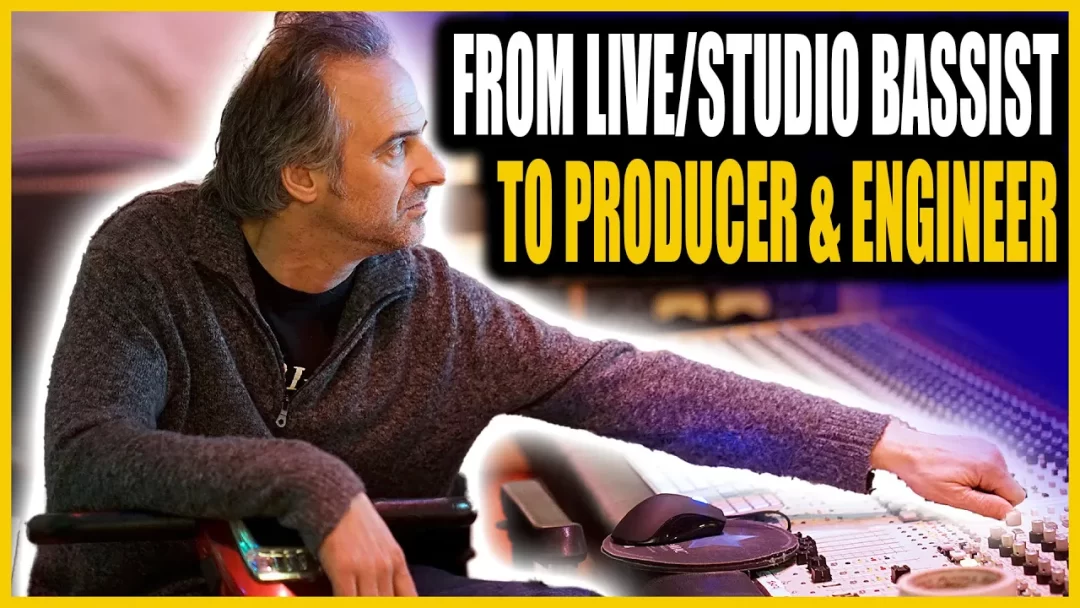

Sheldon Gomberg is a session bassist turned producer/engineer who has worked with an impressive array of artists including Jackson Browne, k.d. lang, Ben Harper, Plain White T’s, and many more. He recently spoke with Warren about his musical journey, his approach to record production, and his inspirational story after having been diagnosed with Multiple Sclerosis (MS).
On Working With Warren Zevon
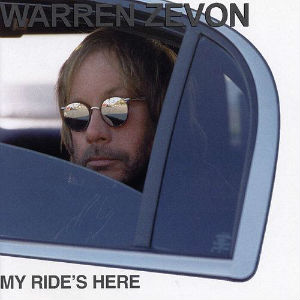
Gomberg played with legendary songwriter Warren Zevon on “My Ride’s Here” which was released only a year before Zevon’s death in 2003. Gomberg was brought in alongside other bassists, who were each to play on a couple songs, but ended up playing on the entire record.
“He (Zevon) called me and said, ‘Everyone loved what you played. Now you have to play on the whole record.’” Gomberg laughs.

The Carriage House
Gomberg built his studio “The Carriage House” in Los Angeles in part to be able to record future records for Zevon, who had been recording in his apartment.
“He was kind of complaining that there wasn’t enough money or whatever, so I was going to build the studio anyway just to have fun producing, but not taking it seriously. Part of the impetus was to have a studio that we could do the next record in.”
The Quad Eight Console
The Carriage House is home to a Quad Eight Pacifica console, which Gomberg acquired, but not before purchasing and then selling a Coronado, a different highly sought after console by Quad Eight.
“You came and played with us at Rob Brill’s place, and he had a Pacifica. That was where I first discovered them. Later, I found a Coronado in Australia with only 24 of the 36 channels. These consoles usually came in 24, 28, 32, or 36 channels, with 36 being the most common. I started rebuilding the 24-channel one, and then Brian Kehew told me about another 36-channel one in Georgia. I bought it and sold the 24-channel one. I’ve had it for years.”
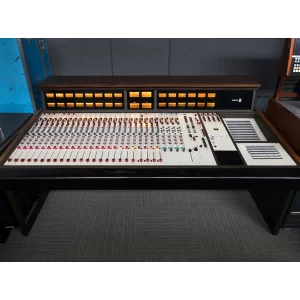

A Quad Eight Pacifica
Gomberg goes on to explain the sonic characteristics of the Pacifica, and how essential it is for his studio.
“I’m a bass player, so I’m not very technical, but they’re really clean—clean but not boring. They’ve got, I don’t know if it’s personality, but they’re just pure and fantastic. I’ve got Neves over here, which we usually use for vocals and sometimes for kick and snare, but I’ve also got some APIs, which I hardly ever use. A friend who made the Ventura by A Designs also made some of his own preamps, the CRS Industries 2412s, I’ve got a bunch of those. But I rarely go to outboard stuff; the console sounds fantastic.”
On Working With MS and Giving Back
Gomberg explains how his diagnosis led to creating records with Sweet Relief, which is a non-profit organization that provides financial assistance to musicians and music industry workers facing illness, disability, or age-related issues.
“I have MS, which is why I don’t play anymore. I started having trouble walking around 2007, and Sweet Relief helped me install an elevator so I could get into my house with a scooter because I couldn’t walk up the stairs anymore. I’m not comfortable with getting gifts, so I offered to repay them. Sweet Relief started in ’93 when Victoria Williams was diagnosed with MS and had to leave the Neil Young tour. Musicians like Pearl Jam, Lucinda Williams, and Lou Reed recorded her songs, and it made more money than she needed, so she decided to start a charity to help others. They also did a Vic Chestnutt record in ’95. In 2008, they helped me, and I suggested doing a record to help pay them back. It was so much fun and felt so good to give back to them and to the music community that supported me all these years. I’ve probably done eight of them now or something like that.”
Vocal Mic Selection and Recording Live
The Carriage House is home to tons of gorgeous music equipment including Fairchild compressors, vintage musical instruments, and classic microphones. Gomberg goes on to describe his preferred vocal mic.
“Depending on the situation, usually a (Neumann) 47. We were just using (an AKG) C12 on a record we were working on, and it sounded fantastic. I mean, obviously, (Telefunken) 251s are fantastic too, but I’m usually going with a 47. If it’s live with the band, quite often I’ll use a 47 or 67. I love ribbon mics, so a (RCA) 77 is a great vocal mic. Sometimes I’ll use (a Shure) SM7 if I need the rejection.”
Warren asks Sheldon about his preferred method of tracking, and if there are situations in which he records everything live including the vocal.
“We’ve done them where you start with the vocal and then build everything around, or the vocal and guitar and then build everything around. My favorite way is if the band’s all playing together. I mean, you can add overdubs on top of that, but if everybody’s playing together, they react to each other, and it’s just greater than each individual part. I don’t know if you’ve noticed this, but you can be tracking live, and then when somebody goes back to replace something, it takes forever to fix it for some reason. Maybe because they’re concentrating on it or nervous. But when everybody’s playing together, even the mistakes—if they’re good mistakes or if the people are good— I’d prefer that.”
On His Assistant, Kevin
As Sheldon’s MS progressed, he became more reliant on studio assistance. He explains meeting his assistant and engineer Kevin, and their specific workflow.
“Sometimes I’ll click on the mouse and my finger won’t let go, so I’ll just drag everything across and mess up the whole session. So Kevin has now become the guy here. When it comes to mixing, we’ll mix together. Kevin will be driving, and I’ll be sitting here listening and making comments.”


Warren recalls how this kind of collaborative mixing has benefitted him in his own career.
“I’ve actually found that I’ve got some of my best results working with Jack Douglas because he would sort of produce the mix. I’d be mixing, pulling up stuff, doing the usual sort of generic EQs—cutting some low mids on the kick, putting a little bit of snap to it, a bit of low end—all the things we all do by rote. Jack would tell me, ‘You need to compress that more, you need to do this, you need to do that.’ Some of my best mixes are from that kind of environment, where you have two sets of ears working together.”
Sheldon continues, “I have a bunch of people that I work with, and they’re all great, but Kevin and I just have this thing together. He’s got great ears, I trust him, and he’s a really nice guy. It was easy to go, ‘Okay, it’s your turn. You do this now; I’m out of here.’ When it comes to mixing, he’s really open to it. It’s hard to sit there and tell people, ‘Do this, do that,’ and I don’t do a whole lot of it.”
Studio Tour
Sheldon and Kevin then provide a tour of the studio, which includes an impressive array of outboard equipment including compressors, equalizers, time based effects, and more.
Here’s a selection of the outboard units mentioned and their uses:
Collins 26 U-1
- Type: Old tube compressor
- Use: Fattening up sounds; used lightly due to its tendency to shut down oddly when hit too hard.
UREI/Universal Audio 1176
- Type: Classic solid-state compressor
- Use: General use; well-known and versatile.
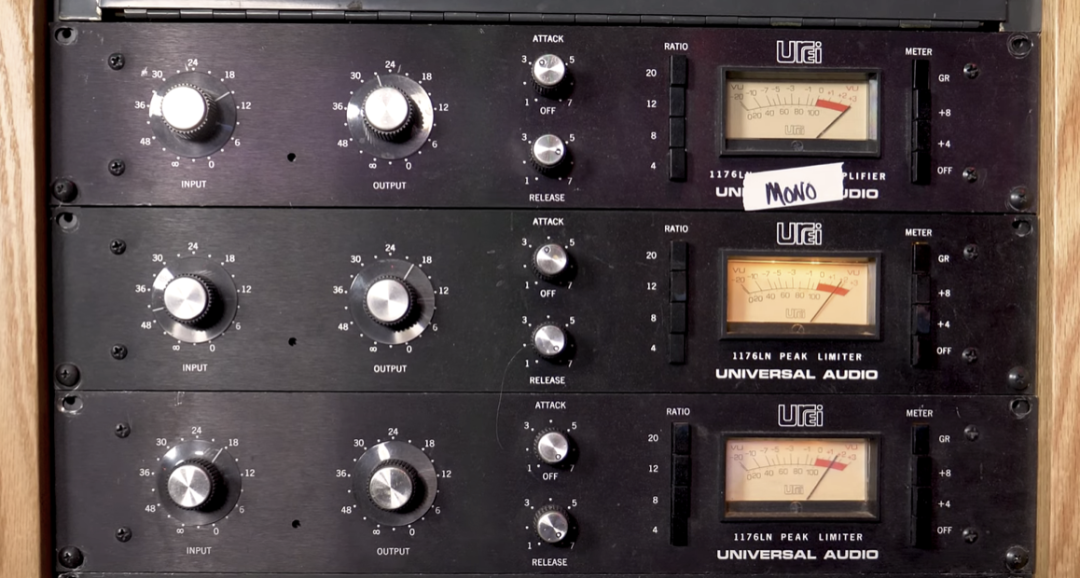

Several racked up 1176 Compressors
Dbx 160 VU
- Type: Solid-state compressor
- Use: Currently used on kick and snare mic; transparent and useful on guitars, acoustic, electric, and kick/snare.
Teletronix LA-2A
- Type: Tube compressor
- Use: Vocal, guitars, and general use; known for its long-standing presence in studios.
RCA BA-6A
- Type: Tube compressor
- Use: Excellent on vocals, bass, guitars, and acoustic guitars; known for its warm tube sound and ability to handle high levels without sounding overly compressed.
- Type: Analog compressor
- Use: Currently used on drum rooms; appreciated for its versatility and fast processing.
- Type: Modular channel Saturator
- Use: Alters sound with options for equalization, compression, drive, and harmonics; great for creating unique sounds and smashing the room.
Eventide H3000
- Type: Harmonizer
- Use: Provides pitch shifting, reverb, and delay effects for versatile sound processing.
- Type: Digital Reverb
- Use: Known for its high-quality reverb sounds, useful in various mixing scenarios.
Lexicon Prime Time (Model 1 and 2)
- Type: Digital Delay
- Use: Provides delay effects; both models are known for their distinctive delay and modulation capabilities.
Cooper Time Cube
- Type: Analog Delay
- Use: Utilizes coiled hoses to create delay effects, providing different delay times (14 and 16 or 14 and 17 milliseconds) for unique sound textures.
Drum Miking Techniques
Sheldon and Kevin then go through describing how they would capture a drum kit. The kick drum usually features either an Electro-Voice 868 or an AKG D12 inside if there’s a hole in the head, sometimes swapping with an ATM 25 from Audio-Technica or a D112. For the current setup, the D12 is positioned outside along with a FET 47, which is typically used for outside kick applications.
On the snare, Shure SM57s are used for both the top and bottom, with the polarity flipped on the bottom mic. The toms are miked with the reliable Sennheiser 421s. For the mono room mic, a Royer R-121 is placed, while the overheads are handled by Coles mics, although AKG 451s have also been used successfully.
A unique aspect of the setup is the “crotch mic,” an American D22 aimed at the drummer’s crotch area, which is heavily compressed through an Altec 436c to add a gritty, filled-in texture to the drum mix. The main room mic is a Royer SF-12, which provides a balanced stereo image of the drum room. On the hi-hat, a Beyerdynamic M160 is used, although the ideal hi-hat mic is still being sought.
For the shell mic, a Royer pointing at the shell runs through an 1176 compressor, serving as a closer-than-room mic to capture additional nuances of the drum shells. Adjustments to the overheads were made to address issues with crash cymbals being too prominent, initially angled straight down and later repositioned to face away from the cymbals and more towards the drums, solving the balance problem without altering the drummer’s playing style.
This setup, combining various dynamic, condenser, and ribbon mics with strategic positioning and compression, ensures a rich, well-rounded capture of the drum kit’s sound.
Additional Instruments and Studio Gear
Finishing up the studio tour, Sheldon and Kevin introduce a handful of impressive amps, guitars, keyboards, and even a “tack piano”.
This beautiful and unique sound is achieved using a Wing and Son piano equipped with five pedals. The far-left pedal creates a marxophone effect, while another pedal produces the tack piano sound, which is slightly tighter. Standard sustain pedals are also present. For miking, they use AKG C414 EB microphones with CK2 capsules, which remain on the piano covered with bags to keep dust out. This unique setup and miking technique produce a distinctive piano sound that many studio visitors appreciate.
Find out more about Sheldon Gomberg here: https://www.sheldongomberg.com