

Would you like to learn more about immersive audio: mixing in surround, Dolby Atmos, what’s happening in the space, and where it’s going?
If so, today is your day because we’ve got a brand-new video covering this topic in detail.
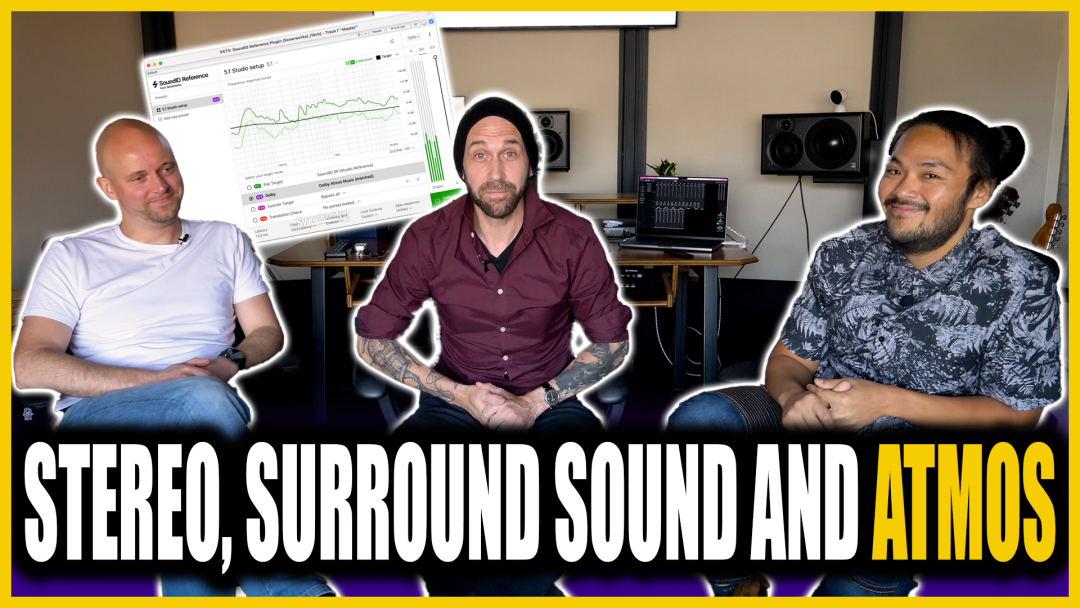
Join Kristian Kohle (Kohle Audio Kult), Alvin Wee (Atmos mixer, producer, and musician), and Martin Popelis (Co-founder of Sonarworks) as they discuss all things “surround”.
Kristian takes the lead on this one, admitting that he’s professionally curious about where one should get their start in mixing for surround, as well as for the audio elephant in the room Dolby Atmos.
Alvin mentions that there are many great resources available on Dolby’s website but, Martin points out that they’re also “creating the information” as they speak. Lucky us!
Alvin, who’s had a lot of experience mixing in surround for film scores, has had the benefit of working in studios treated and outfitted for surround mixing and listening but he also addresses the fact that many engineers are often moving between environments. Thus creating challenge for many mix engineers who often spend time calibrating their own rooms.
“Understanding how to set it up, and how to calibrate speakers in a room is very important.”
He says.
Fortunately, Martin represents Sonarworks, the company that has helped to address this issue with their very own SoundID Reference.
SoundID Reference at a Glance
Calibrating one’s room has always been an essential task for any mix engineer’s “to do” list but, it doesn’t mean that it’s a simple one to tackle, and forget the further complication of calibration for more than two speakers at a time (try 16 speakers, with surround 9.1.6).
SoundID helps you calibrate with ease and now with 16 channel capabilities the software can help do a lot of the manual work for you.
Martin refers to it as a “DIY solution that anyone can use” by allowing you to follow along with SoundID’s step-by-step process, as it maps out frequency responses across your room.
Though he does clarify, “We’re not claiming to be a replacement for room design or room placement” the fact is that many of us can’t afford to hire a vendor to spend day, or more, treating and adjusting our rooms to the desired effects. Alvin agrees.
And for those of us who desire calibration for surround, the latest version allows you to match your configuration up to Dolby 9.1.6 standards!
With 16 channels, Martin says, “There are more channels calibrated, frequency response-wise…more granularity…you can match levels between speakers, time alignment of channels…”
Alvin sites SoundID Reference as “absolutely essential”.
“[it’s] been my go-to, and it’s on my system, every day now.”
And he would know.
Having done mixing for productions for Netflix, and Disney’s Encanto (and a little film called “Top Gun: Maverick”), his resume speaks for itself and the level of expectation and ingenuity of these companies who have fully embraced innovative sound technologies like Atmos.
He speaks to some of the sonic aspects of mixing in this format:
“A huge part of mixing in surround that you’re managing is that there’s a lot more low-end to work with…it opens up a whole new dimension…”
“You want to make sure the listener’s still listening to it in a cohesive environment, and [as an example] you don’t want your vocals to come from the back (or you do)…it’s balancing the technical and creative with those extra speakers.”
But that it gives you great “power and resolution to place any sound anywhere…that opens up a lot of creativity”.
And on his experience working on “Top Gun: Maverick” – score by Han Zimmer, and featuring Lady Gaga:
“It was a massively fun experience! Having to translate single-source audio into surround was also a huge challenge.”
These three audio experts also get into the topic of practicality: surround sound is fun, and most of us who enjoy going to the movies are all familiar enough with it, however, the reality is that we’re not yet at a point where we can truly take advantage of this technology outside of the intended listening environment.
We’re still very much in a “two speaker” world.
The Future of “Immersive” Audio
Headphones, earbuds, and small modular speaker systems still reign supreme in the consumer market. So, how is this being addressed with the advent of immersive audio?
“What’s missing adoption across the consumer market and platforms”,
Martin says.
He explains”Dolby ATMOS is basically a sound translation and encoding standard that enables you to create acoustic sound experiences in three dimensions…it’s based on algorithms.”
Pointing out that, even though there is still a distance to go when it comes to replicating this technology in a physically-limiting (i.e. headphones), there are innovations happening that can replicate the experience.
There are also exciting products in the works. Martin mentions the collaboration between Sonarworks and Wayne Jones Audio where, among other features, an engineer will be able to “upload and store their SoundID Reference room calibration measurement profiles directly to the Jones-Scanlon monitors”.
That’s exciting stuff!
All this and more in the video!
Thanks ever so much for reading and watching!
-Warren