
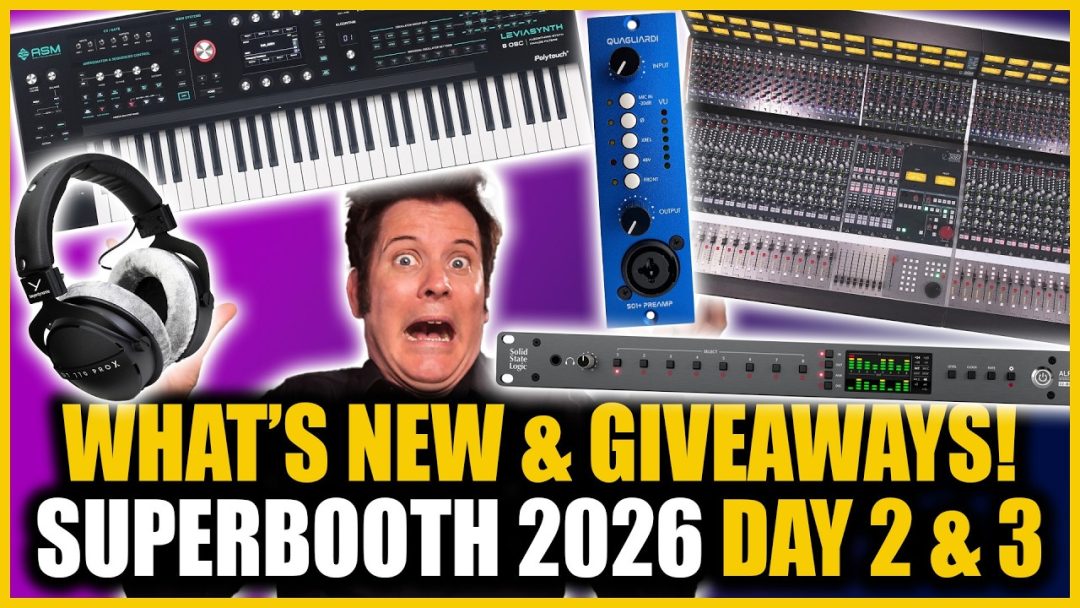

There are very few events in the audio world that genuinely feel different from one another.
NAMM Show has that enormous sense of scale and excitement, where every corner reveals another legendary company, another instrument, another piece of history. It’s the music industry operating at full power.
AES Convention is where some of the deepest technical conversations in professional audio happen. Engineers, designers, educators, and manufacturers all gathering to talk seriously about the craft and future of recording.
Then there’s SuperBooth 2026.
Superbooth Berlin GmbH feels like somebody built an entire electronic music universe inside a forest outside Berlin and invited every synth designer, boutique audio builder, experimental musician, mastering engineer, and gear obsessive on Earth.
By day three, you’re exhausted, drinking too much coffee, wandering through trees looking for modular synth huts, and somehow still discovering another room full of incredible audio gear.
That’s the magic of SuperBooth.


One thing that became obvious this year was just how seriously companies are taking headphones now. Not just for casual listening, but for proper mixing, tracking, immersive work, and critical listening.
At Focal, we compared several models ranging from their affordable Listen Professional all the way up to their flagship headphones.
The Listen Professionals immediately stood out because they actually made sense for musicians. Robust, flattering, good isolation, and at €259 they felt like exceptional value. They had a little extra “smiley face” character to them, which honestly makes perfect sense in a tracking environment. When you’re recording in a live room, you often want headphones that feel exciting and musical, not brutally analytical.
Then we moved up the range.
The higher-end models suddenly revealed tiny vocal inflections and details buried inside familiar records. Listening to “Bohemian Rhapsody” became one of those moments where you hear details in Freddie Mercury’s voice you somehow never noticed before. Wonderful and terrifying at the same time.
That’s the strange thing about truly revealing monitoring. You start rethinking your own mixes.
The lovely people at Focal also gave us a pair of Listen Professionals to give away.
Enter the giveaway here: Focal Listen Professional Giveaway


Over at beyerdynamic, the DT900 Pro X absolutely stole the show for me. Going down the line comparing headphones, those immediately felt the most linear and natural.
There was a familiarity to them.
If you grew up around NS10s, aggressive high mids, and rock records that snap at you a little, these felt incredibly comfortable. Open, detailed, but still musical. At roughly €240, they were shockingly good value.
One of the smartest things Beyerdynamic demonstrated was their factory calibration system. Every individual headphone is measured during manufacturing, and users can enter the serial number into their calibration software to retrieve correction data specific to that exact unit.
That’s an incredibly modern approach to consistency.
And yes, the DT900 Pro X headphones impressed me so much that the wonderful people at Beyerdynamic gave us a pair to give away as well.
Enter the giveaway here: Beyerdynamic DT 900 Pro X Giveaway


Ribbon Mics, Tube Preamps, and Why AEA Keeps Winning
It’s impossible to walk past AEA Ribbon Mics Inc without stopping.
Julie and the team were showing the N28 stereo ribbon mic, a more compact alternative to the legendary R88. The idea was simple: make a smaller stereo ribbon microphone suitable for modern live performance video setups and easier real-world deployment.
And it works brilliantly.
There’s a reason ribbon microphones are having another moment. The old myth that ribbons are “dark” really came from decades of analogue tape generations, acetate copies, and fidelity loss. Engineers once needed bright microphones simply to survive the recording chain.
Digital changed all of that.
Now engineers increasingly want microphones that sound like what they actually hear in the room.
AEA’s guitar amp examples demonstrated this perfectly. On a cranked amp, the microphone simply sounded like a perfectly EQ’d guitar cabinet ready for mixing. No harshness. No battle. Just musicality.
Then things became even more interesting when AEA revealed their upcoming FC2 tube preamp.
A fully balanced hybrid tube/JFET design using Lundahl transformers, Electro-Harmonix tubes, and Toshiba JFETs, it’s designed to combine the openness and linearity of AEA’s incredibly transparent ribbon preamps with a more rounded, tube-forward presentation.
The description that stuck with me was:
“The FC2 blows the RPQ3 out of the water.”
That’s a bold statement from the people who already make some of the best ribbon mic preamps available.


AudioScape and the Joy of “Forgotten” Gear
Talking to AudioScape Engineering Co. always becomes part philosophy discussion, part history lesson.
This year’s booth was filled with recreations of gear that, for years, people ignored or actively dismissed.
Now those same pieces are suddenly prized because they sound different.
Their stereo EQP2A brought classic Pultec-style EQ into a compact stereo chassis. Their recreations of 1178-style compressors, aggressive drum compressors, and vintage-inspired line amps all reinforced one point:
Modern mixing often lacks uniqueness because everybody uses the same tools.
Hardware variance, quirks, and overlooked designs are part of what made older records sound alive.
One of the best discussions all weekend centred around compression. The myth that classic records used “less compression” was thoroughly destroyed.
In reality, engineers like Jack Douglas, Shelly Yakus, and countless others were compressing constantly, during tracking, mixing, tape transfer, console summing, and mastering.
The difference was that analogue systems rounded transients musically instead of producing ugly clipping.
That “larger than life” sound often came from multiple stages of compression happening gently and cumulatively.


SSL, Harrison, and the Hybrid Future
At Solid State Logic and Harrison Audio, the conversation revolved around hybrid workflows.
The modern reality is simple:
People want analogue colour and workflow combined with digital flexibility.
The demo system centred around the SSL Big Six, Fusion, Bus+, and 500-series processors showed how modern engineers are combining in-the-box mixing with analogue summing and hardware bus processing.
The Bus+ in particular demonstrated how far SSL’s classic bus compressor concept has evolved.
The addition of high-pass filtering in the sidechain completely changes how mix bus compression behaves. Suddenly the low end breathes naturally instead of triggering constant pumping.
For anyone who grew up mixing on SSL consoles, this feels like the logical evolution of the format.
The Fusion also continues to prove itself as one of the smartest modern stereo processors available. Transformer saturation, high-frequency compression, stereo imaging, and tonal shaping all packaged in a way that feels musical rather than clinical.


Rupert Neve Designs and the Last Great Console
One of the highlights of the show was spending time with the Rupert Neve Designs 5088 console.
This was Rupert Neve’s final console design, and it represents something increasingly rare in modern audio:
A long-term philosophy.
No subscription. No DSP dependency. No planned obsolescence.
Just transformers, Class A circuitry, massive headroom, and modular analogue architecture designed to still function fifty years from now.
The desk runs on ±45V rails, uses custom transformers on every input and output, and prioritises incredibly low noise and enormous dynamic range.
What struck me most wasn’t just the sound.
It was the simplicity.
One knob per function. No menu diving. No endless screens.
Just listening.
In an era where so much studio equipment becomes obsolete within a few years, the 5088 feels almost rebellious.


Elysia, Eventide, and Modern Dynamics Processing
Elysia showed off their upcoming channel strip, packed with Class A circuitry, dynamic EQ, saturation, recall, routing flexibility, and plugin integration.
Meanwhile, Eventide Audio demonstrated the next generation of immersive processing through the H9000 Gen 2.
Twice the processing power, immersive reverbs, advanced spatial micro-pitch effects, and full surround integration make it clear where high-end effects processing is headed.
And yes, it sounded enormous.


Dangerous Music for Synth Nerds
SuperBooth wouldn’t be SuperBooth without moments of total synth insanity.
The new ASM Levian synthesizer may have been the most ambitious instrument at the show.
Algorithmic synthesis, analogue filters, binaural modulation, poly-aftertouch, ribbon controllers, sequencers, modulation routing, and deep synthesis structures all wrapped into a remarkably approachable interface.
What made it impressive wasn’t just complexity.
It was how immediate it felt.
You could go incredibly deep without constantly fighting the interface.
That balance between experimentation and usability is incredibly difficult to achieve.
And somewhere in the middle of all this, there were still people building strange modular synths inside forest tents, experimental oscillators screaming through giant PA systems, and late-night techno performances happening in hidden woodland stages.
Because of course there were.
The Real Magic of SuperBooth
What makes SuperBooth special isn’t just the gear.
It’s the atmosphere.
You walk from a mastering EQ demo into a forest filled with experimental synth builders. Then into a conversation about Rupert Neve transformers. Then into a tent where somebody is making terrifying spaceship noises through handmade oscillators.
And somehow it all makes sense.
There’s also something deeply encouraging about seeing so many younger engineers and musicians genuinely interested in sound again.
Not presets.
Not algorithms.
Sound.
The actual texture, movement, distortion, harmonics, dynamics, and emotional impact of audio.
That obsession is alive and well in Berlin.
And thankfully, so is SuperBooth.