
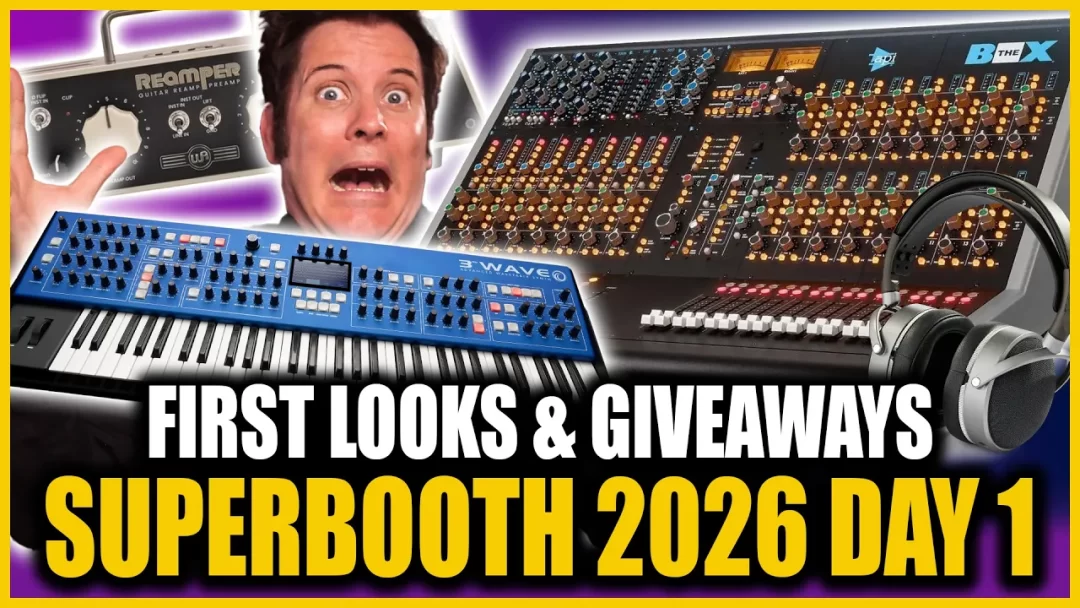

There is something beautifully different about SuperBooth.
The first time I came here was back in 2019, and I had such a marvellous time that I went home and told every gear company I knew, “You have to go to this.” Then, naturally, everyone started coming, and somehow I didn’t make it back for years. So walking up to SuperBooth 2026 felt rather special.
This is not NAMM. This is not a giant corporate trade show full of enormous booths and blinding LED walls. This is Berlin. You wander around and find boutique synth makers, cable companies, legendary pro audio designers, guitar pedal geniuses, headphone specialists, and people quite literally building the future of electronic music on a table in front of you.
That is the magic of it.


One minute you are talking to Warm Audio about a new reamper with Cinemag transformers, silent amp recording up to 50 watts, and clever routing between line level, guitar pedals, amps, and studio gear. The next minute you are looking at stereo DI boxes, 87-style entry-level microphones, fuzz pedals with NOS transistors, and a phaser that makes you immediately want to get one back to the studio.
The Mutation Phasor II particularly stood out. Rich, chewy, vintage modulation with all the movement and musicality you want from a proper analogue phaser.
Enter The Warm Audio Mutation Phasor II Giveaway: Warm Audio Mutation Phasor II Giveaway


Then you turn a corner and there is Audeze.
I have used LCD-X headphones for years, and they have always been one of those tools I can wear for hours without feeling like the top end is taking my head off. However, the new LCD-5S felt like a different kind of serious. Lighter, more open in the midrange, and with that little bit of extra presence around the snare and vocal area that mastering engineers often seem to love. They are not inexpensive at $4,500, however they are also competing with the reality of high-end monitors, room treatment, and the space needed to make all of that work properly.
Audeze also had the LCD-S20, which I have been using as a replacement for the old Sony 7506 type of workflow. Closed back, practical, a little more forward, great for tracking and filming, and much more comfortable sonically than the usual “session headphone that bites your head off” situation. For those of us filming with microphones open in the room, that really matters.
Enter To Win The Audeze LCD S20 Headphones: Audeze LCD S20 Giveaway


One of the big highlights was Chase Bliss and Electronic Audio Experiments. The new Chase Bliss Big Time is a wonderfully mad Automatone delay inspired by 1980s rack delays, complete with motorised sliders, presets, preamp colour, compression, limiting, saturation, stereo widening, diffusion, and some beautifully broken behaviour. The whole concept is brilliant, instead of just copying an Echoplex or another tape delay, it leans into the rack world, Lexicon PCM42 style weirdness, miscalibrated limiters, pumping repeats, crunchy feedback paths, and delays that feel alive under your fingers.
That is always what I love about pedals like this. You play something simple, two notes, maybe a chord, and suddenly it sounds like a record.
Electronic Audio Experiments also had some fantastic pedals of their own. The Halberd was loud, clear, raw, and not trying to be a Tube Screamer, Bluesbreaker, Rat, or anything else obvious. The Prismatic Wall was particularly inspiring, essentially the old studio trick of using a grand piano as a resonant reverb tank, turned into a pedal. Wrong in all the right ways. I love a bit of wrongness.
Enter To Win A Halberd Pedal By Electronic Audio Experiments: Electronic Audio Experiments Halberd Giveaway


API Audio brought the small-format console world into the SuperBooth atmosphere with the BOX console. Eight classic API mic pres, 16 channels of analogue summing, a centre section, compression based around linked 527-style circuits, inserts, talkback, auxes, and 500 series slots. It is a proper API workflow in a smaller footprint.
I have a long history with API. We cut a huge amount of The Fray’s second album on one of the early 1608 consoles, and what always struck me was how logical everything felt. Some consoles make you fight them. API layouts have always made sense to me. Once you understand one channel, you understand the whole thing. That is a big deal when you are moving fast and trying to keep the creative energy in the room.


Then came Groove Synthesis, which was one of those “SuperBooth only” moments where you suddenly find yourself standing in front of something that feels like several instruments at once.
The starting point is the PPG Wave, that glassy, slightly odd, beautifully digital sound that defined so much music. Depeche Mode, Propaganda, those wonderful 80s textures that still feel futuristic. However, Groove Synthesis have taken that concept far beyond nostalgia. Classic analogue waveforms, PPG-style wavetables, modern high-resolution wavetables, sampling, modulation between the different engines, sequencing, effects, multiple outputs, and an MPC-style sequencer.
What I loved was the explanation of why the PPG sounded the way it did. Not just “aliasing” as a catch-all phrase, however the imaging created by the limitations of the original memory and playback system. Beautiful garbage at the top, harmonically related to the note, and absolutely part of the magic.
Groove Synthesis 3rd Wave Wavetable Synth: https://sweetwater.sjv.io/enNK3D
Groove Synthesis 3rd Wave Desktop: https://sweetwater.sjv.io/X4NY04
Groove Synthesis 3rd Wave 8m Synth: https://sweetwater.sjv.io/n4yLro
That is the spirit of SuperBooth. You do not just hear the sound, you get the story behind why the sound exists.


Little Labs were there too, and Jonathan Little was showing something very exciting: a 1970s hi-fi inspired EQ. That immediately hit me because, like so many of us, I grew up with those old receivers, the loudness button pushed in, the tone controls cranked, and records sounding larger than life. Physical Graffiti through a 70s hi-fi with the loudness button on is not the same experience as listening totally flat on a modern system.
Jonathan has taken inspiration from those old Japanese receiver EQ circuits, the Baxandall tone stacks, variable loudness controls, inductor-based midrange, high and low pass filters, and turned it into something for the studio. Proper relay bypass, detailed analogue design, through-hole components where it matters, and the usual Little Labs attention to detail. It is exactly the kind of idea that makes you wonder why more people have not done it already.


There were also wonderfully niche discoveries everywhere. Janko Design Keyboard Project were showing their modern take on the Jankó keyboard layout, where chords and scales retain the same shape in every key, much like moving a barre chord on guitar. As a guitarist, that makes immediate sense. It takes a minute for your brain to adjust visually, however once it clicks, it feels incredibly logical. For music theory, education, and ergonomic playing, it is a fascinating idea.
Then there were the makers behind the makers. Davall Gears, who make knobs and control components for companies like SSL and Allen & Heath. KMK Solutions with low-profile, heavy-duty cables and clever connectors. These are the sorts of companies you might never normally see at a huge trade show, however they are part of the reason our favourite gear feels the way it feels.
Sifam Controls: https://www.sifam.co.uk/
That is what I love about SuperBooth.


It is not just the finished product. It is the ecosystem. The inventors. The small companies. The obsessive details. The people making the knobs, the cables, the connectors, the strange new instruments, the pedals that sound a little broken in exactly the right way.
We also bumped into friends, talked synths, Mellotrons, 808s, old touring nightmares, Berlin, Hansa Studios, David Bowie, Depeche Mode, and the joy of instruments that actually stay in tune. There is something wonderful about hearing people who have lived through all of that history getting excited about new gear that still has a bit of the old madness in it.
SuperBooth 2026 reminded me why I loved it the first time.
It is creative, nerdy, musical, slightly chaotic, and full of people who care deeply about sound. Not just specs. Not just features. Sound.
And that, ultimately, is why we do this.
Have a marvellous time recording and mixing.