

For decades, the SSL 4000 has been one of the most iconic mixing consoles in recording history. From Peter Gabriel’s So and Genesis classics, to the punch of countless ‘80s hits, and even the defining sound of grunge and hip hop in the ‘90s, the SSL 4000 console shaped the way modern records sound. Engineers and producers still speak about the way it glued a mix together, brought vocals forward, and gave drums their legendary snap.
So, what happens when Solid State Logic decides to bottle that magic into a rack unit for today’s studios? Enter the SSL Revival 4000.


Why the 4000 Still Matters
The SSL 4000 is not just another console. It is the most famous desk in recording history. Practically every major mixer has worked on one at some stage, and its sound is woven into the DNA of hit records from the late ‘70s through to the present.
Between 1978 and 1985 especially, the 4000 became the go-to desk for both tracking and mixing. Steve Lillywhite’s early records, Peter Gabriel’s Sledgehammer, and the raw power of countless rock, pop, and R&B albums were all sculpted through its circuitry. The sonic fingerprint of the 4000—punchy dynamics, musical EQ, and unmistakable glue—remains instantly recognisable.


The Birth of the Gated Reverb
One of the most famous SSL 4000 moments came in 1979 at The Townhouse Studios. Engineer Hugh Padgham, working with Phil Collins on Peter Gabriel’s Melt album, accidentally routed the console’s compressed talkback mic into the recording chain. The result was a huge, explosive ambience on the drums.
Gabriel immediately loved it and asked Collins to play a stripped-down part with no cymbals, building the entire track “Intruder” around this sound. It was the first bold use of what became known as gated reverb. While the technique had been used more subtly before, this was the first time it became the centrepiece of a song.
That SSL accident didn’t just create a hit track. It revolutionised drum production, paving the way for its dominance throughout the 1980s on classics like Collins’ “In the Air Tonight” and Bowie’s “Let’s Dance.”


The Revival 4000: Best of the B and E Series
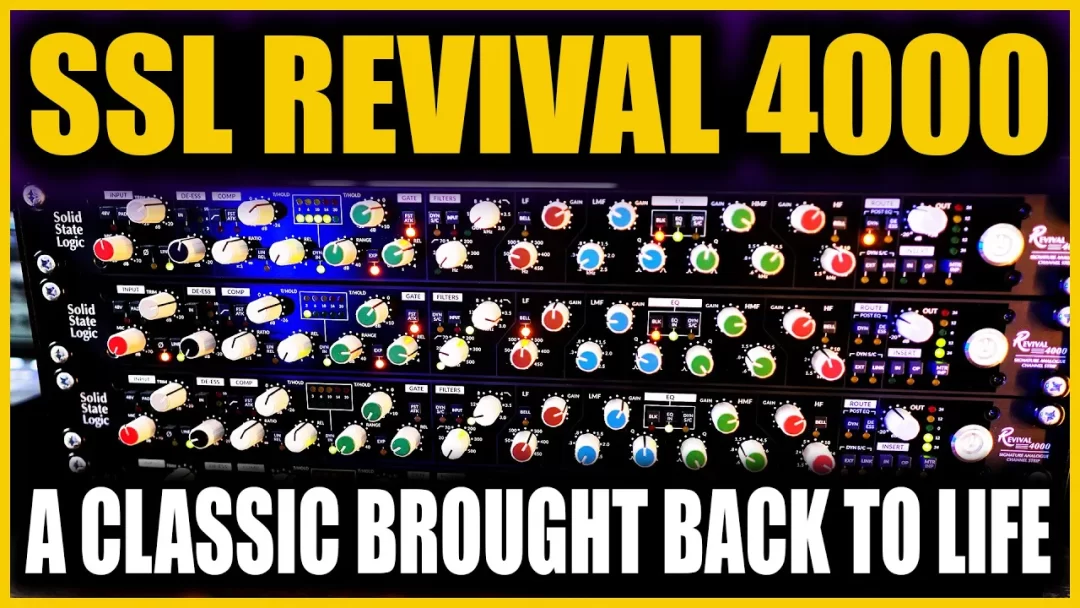
The Revival 4000 is a single-channel rack unit designed to capture the very essence of the early 4000 consoles. SSL describes it as “the best of the 4000E, with a sprinkling of the 4000B.”
- Mic Preamp: Transformer-balanced using the original Jensen J115, delivering that touch of harmonic grit engineers love when the red light flickers.
- De-Esser: Taken directly from the 4000B, this simple but musical DS circuit is fixed at 7kHz and works independently from the compressor—subtle, natural, and perfect for vocals.
- Dynamics Section: A faithful recreation of the 4000E VCA circuit, with options for soft or hard knee, fast attack, and both linear and logarithmic release modes.
- Expander/Gate: Classic SSL control, equally at home cleaning up toms, taming snare bleed, or adding articulation to bass.
- EQ: Switchable between “Brown” (original 4000) and “Black” (later 4000 with extended gain and steeper filters), offering that instantly recognisable SSL tone-shaping.
- Routing Flexibility: Filters can be moved pre-input, EQ can be routed into the compressor, and both EQ and filters can be placed in the dynamics sidechain.
- Stereo Linking & Inserts: Units can be linked for overheads or stereo busses, and the balanced insert point adds modular flexibility.
In short: this is not just a clone. It’s a “greatest hits” of SSL 4000 design choices, all housed in a rack-ready unit with modern refinements.
Key Features


- Classic SSL 4000 E Jensen transformer-balanced mic preamp
- Musical one-knob 4000 B De-Esser section
- Ultimate 4000 E Series Dynamics section
- Discrete Class A VCA compressor
- Soft or Hard Knee modes
- Fast Attack on/off
- Logarithmic or Linear Release modes
- Classic Gate/Expander section
- Fast Attack on/off
- External sidechain (key) input
- Sidechain link for stereo pairing
- Classic 4-band SSL EQ
- Fully parametric mid-bands
- Switchable Brown Knob 02 and Black Knob 242 EQ circuits
- High and Low Pass Filters
- Brown 02 mode: 12 dB/octave HPF & LPF
- Black 242 mode: 18 dB/octave HPF & 12 dB/octave LPF
- Balanced Insert point for integrating external devices
- Extensive ‘to sidechain’ functionality
- Filters to Dynamics sidechain
- EQ to Dynamics sidechain
- Flexible process-order routing
- Filters to input
- Dynamics and De-Ess post-EQ options
- Insert to output
- Line Output Trim
- Switchable input/output metering
Pricing and Positioning
Priced at £1,249 + VAT in the UK (around $1,999 USD), the Revival 4000 is intentionally competitive. It actually costs less than many racked original console channels, while offering greater flexibility, warranty, and reliability.
That price point makes it accessible not only for professional studios but also for serious home and project studios. It’s easy to imagine producers building their own modular SSL consoles: a pair for guitars, a pair for drum overheads, a few on busses, and one for vocals—summing into an Origin or other DAW setup.
Why It’s More Than Nostalgia
The Revival 4000 isn’t just a vintage reissue. It embodies why SSL became a benchmark: musical tools that guide you toward decisions quickly. Instead of endless parameters, SSL gave engineers limited but powerful choices—and those choices defined the sound of modern records.
Features like EQ into compression, the legendary gate/expander, and that unmistakable SSL EQ curve aren’t just about colour. They’re about workflow, inspiration, and immediacy. As Andy Jackson of SSL put it, “Less choice is often better—if the choices are good.”
A Modern Classic in the Making
For years, engineers have been buying old SSL channels, reracking them, and paying a fortune for modules that often lack reliability or warranty. The Revival 4000 provides a purpose-built, modern solution that doesn’t compromise on authenticity.
It’s easy to imagine this unit becoming a studio essential, whether you’re tracking through it for vocals, shaping drums, or slamming a bass into the expander for articulation. With its flexibility, modular potential, and undeniable heritage, the SSL Revival 4000 might just become the new standard for anyone chasing that iconic sound.
SSL didn’t just revive the 4000. They reimagined it for the next generation.