
A Real-World Drum Test With Blair Sinta
Hi everybody, hope you’re doing marvellously well.
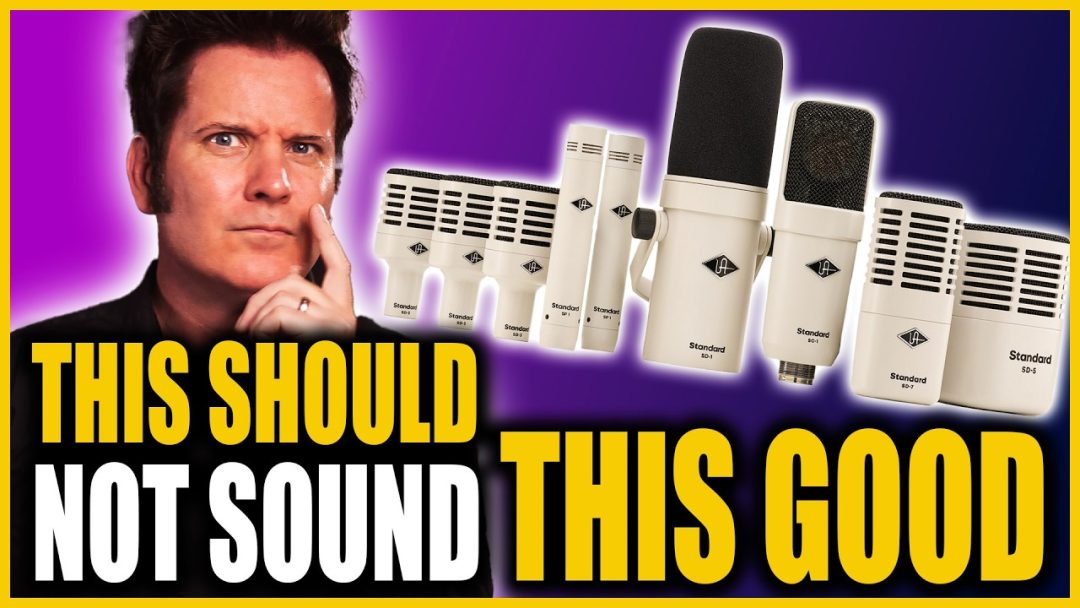
In this video, we’re putting the Universal Audio Standard Modelling Microphones through a proper real-world test. A few years ago, I tested the original Sphere microphone system, which was originally made by Townsend Labs before Universal Audio acquired the company. Since then, UA has expanded the idea into what they now call the Standard Modelling Microphones, using Hemisphere modelling software.
The range includes several different mics, including the SD-1 dynamic, SP-1 pencil condensers, SC-1 condenser, SD3, SD5, SD7, and more. The idea is pretty exciting: capture with the mic, then choose different microphone models later.
Kind of insane, however also kind of awesome.
Download The Multitracks: https://producelikeapro.lpages.co/ua-standard-series-mics-chase-k-gone-form/


A Little Background on the UA Standard Series
The UA Standard Series was designed as a more accessible range of microphones for home studios, content creators, podcasters, and serious production spaces.
Two of the core designs are:
- The SD-1 Dynamic Mic, aimed at vocals, broadcast, and podcasting
- The SP-1 Pencil Condenser pair, designed for stereo recording of instruments and live performances
The modelling side connects directly to UA’s 2021 acquisition of Townsend Labs, bringing Chris Townsend’s Sphere modelling technology into the Universal Audio world. UA also designed these mics to work neatly with Apollo interfaces, with presets intended to get you towards album-ready and broadcast-ready sounds quickly.
So this isn’t just a collection of inexpensive microphones. It’s part of a much bigger ecosystem.
Why We Wanted To Test Them
The reason I got interested was because we visited the rather wonderful Rabea Massaad in Brighton a few months ago. He had been recording drums using these mics, and I asked him, “How do they sound?”
His answer was very simple:
“Really good.”
And of course, he had just made an album with them, and it sounded fantastic. So I thought, alright, let’s put them through their paces.


Enter Blair Sinta
For this test, we asked the amazing Blair Sinta to record drums for us. I’ve worked with Blair for about 25 years, and if you follow the channel, you’ll have seen him many times over the last decade or so.
Blair does a lot of remote drum recording from his own room, and he gets fantastic results. He has a serious setup: Chandler mic pres, BAE/Brent Averill gear, API pres, and a kit he knows inside out.
So this was not a “can these mics rescue a bad drum sound?” test.
This was:
Can these mics stand up against a great drummer, in a familiar room, with a properly dialled-in traditional setup?


The Test
Blair recorded the drums two ways:
First, using his normal microphone setup.
Then, using the UA modelling mics.
We weren’t trying to cheat anything. No samples. No heavy processing. No “fix it in the mix” nonsense. The idea was to get the best drum sound we could from the UA mics and see how they compared.
We used 11 mics, including kick, snare top and bottom, toms, overheads, hi-hat, mono room, rear mic, and even a mono overhead for fun. Some decisions were made right there in the room, which is honestly how sessions go. We had to choose between a kick out mic and a mono room, and we chose the room because I wanted some ambience.
First Listen: No Modelling
Before opening up the fancy plugin, I wanted to hear the mics flat.
And honestly, that was one of the biggest surprises.
With no modelling, no EQ, no compression, the mics already sounded good. The kick had attack and weight. The snare had snap. The toms had plenty of body. The overall sound was modern, clear, and usable.
That matters, because modelling is only exciting if the source capture is good in the first place.


The SD5 on kick was really impressive. With no modelling, it already had great attack and a very modern punch.
Once we started using the Hemisphere plugin, the DN52 model gave us that familiar big dynamic kick mic weight. It had low end, it had punch, and it felt immediately useful.
Then we tried something fun: duplicating the kick track and using a sub-style model on the duplicate. Because it’s the exact same performance and exact same mic capture, it stays perfectly in phase. Suddenly we had a huge, perfectly aligned low-end layer.
That could be worth its weight in gold in a mix.


This was probably my favourite discovery.
I thought we’d end up using a 57-style model on snare, because that’s the obvious move. And yes, the 57 model sounded like a 57. It did the thing.
However, I kept coming back to the SD3 with no modelling on it.
It had this lovely transient, this “spank” on the front of the snare that just worked. It sounded modern, open, and exciting. I did a little EQ, the kind of EQ I’d normally do anyway, however the raw mic was really giving me something I liked.
So in the final drum sound, we used modelling on most of the kit, however left the SD3 raw on the snare top.
That’s the beauty of it. You’re not forced to use the modelling. You can choose.
Toms, Rooms, and Overheads
On toms, the modelling helped control some of the ring and focus the sound. The 409-style model was particularly useful. It brought the toms forward, tightened the transient, and helped reduce some of that “cardboard box” low-mid area that often needs cutting anyway.
For the mono room, I ended up liking a 414-style model. It gave the room a slightly more finished quality, not drastic, just a nice bit of polish.
The overheads also benefited from modelling in a subtle way. It felt like the transients were being smeared ever so slightly, in a tasteful, classy way. That’s something we often associate with analogue gear. Not less detail, just a little less harshness.


The hi-hat was another hidden gem.
Using the proximity/filter controls in Hemisphere, we were able to reduce low-frequency bleed from the kick and some of the snare. That’s incredibly useful.
On a normal hi-hat mic, you’re usually reaching for EQ or gates or just living with the bleed. Here, the modelling tools gave us another way to shape the capture.
Very cool.
The Bigger Realisation
What I found myself doing was going back and forth constantly:
Do I prefer the model? Do I prefer the mic raw? Do I want a blend? Should I duplicate it and use two different models?
That’s where this system gets really interesting.
It’s not just “does this sound exactly like that famous mic?”
That’s useful, of course, however the bigger question is:
Does this give me more creative options in the mix?
And the answer is yes.


Against Blair’s Normal Setup
Blair’s own drum setup sounded great. It has more of what you’d expect from a traditional, carefully chosen mic chain: body, low mids, and familiar character.
The UA setup sounded a little more modern and open. In some cases, it was brighter. In some cases, it needed less work. In others, Blair’s traditional mics had a bit more weight.
The biggest difference for me was the room setup. Blair’s normal setup had stereo rooms, whereas we only used a mono room with the UA mics. That naturally changes the overall size of the kit.
However, even with that limitation, the UA mics held up really well.
Final Thoughts
This was incredibly revealing.
The big takeaway for me is that the UA mics sound good before you even touch the modelling. That’s huge.
Then, once you add Hemisphere, you get a whole new level of flexibility. You can model a kick mic, change the snare character, tighten toms, smooth overheads, shape hi-hat bleed, or duplicate a track and create a perfectly phase-aligned second mic sound.
For me, the standouts were:
- SD5 on kick, strong, modern, punchy
- SD3 on snare, especially raw, with no modelling
- 409-style models on toms, focused and controlled
- 414-style mono room, polished and useful
- Proximity control on hi-hat, genuinely practical
I like the mics. I like the modelling. And maybe most importantly, I like that I don’t have to use the modelling if the raw mic is already doing the job.
That’s the real win.
Try It Yourself
Download the multitracks and make your own decision: https://producelikeapro.lpages.co/ua-standard-series-mics-chase-k-gone-form/
Don’t just take my word for it. Mix the drums, EQ them, compress them, compare the two setups, and let us know what you prefer.
Because the proof of the pudding is always in the track.
Have a marvellous time recording and mixing.