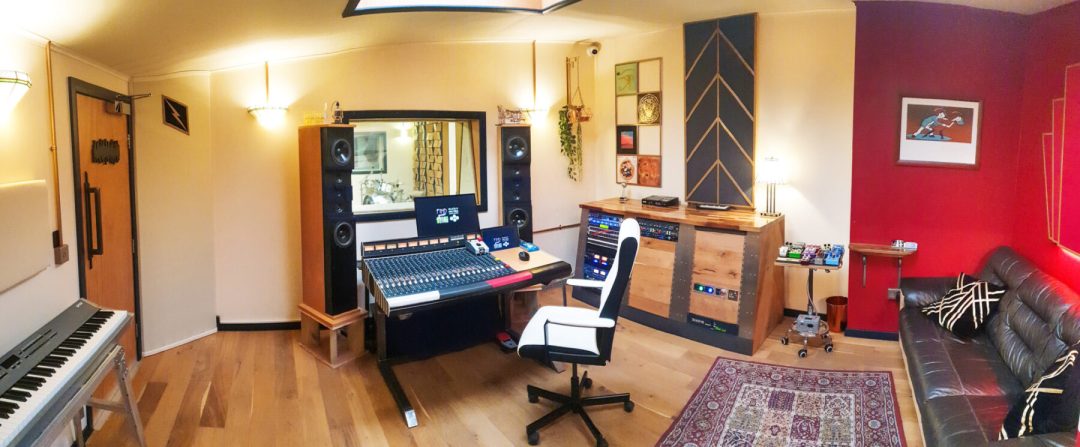
When you walk into The Puzzle Factory, Dax Liniere’s London studio, you can feel immediately that nothing here is accidental. The burgundy retro fridge that secretly houses microphones, the hand-built racks and stands, the carefully crafted acoustic treatment, the layout that somehow manages to feel both homely and relentlessly professional, it all points to a mind that lives at the intersection of music, engineering and invention.
That intersection has defined Dax’s entire life.
A three-year-old in a radio station
Dax grew up in Australia in a deeply musical household where, intriguingly, nobody played an instrument. His grandfather was a radio DJ, so records and radio were always on, shaping his ears long before he ever touched a fader.
The turning point came when his parents took him, at the age of three, to visit a radio station. Faced with banks of gear, lights, dials and faders, he was instantly obsessed. The staff apparently had to keep pulling him away from the console because he wanted to push every button in sight. He went home, flipped a chair upside down to make a “desk”, grabbed a paint roller and used it as a microphone. The image tells you everything: the gear, the performance, and the complete lack of separation between imagination and making something real.
DJ Dax and the art of making do
Dax did not come from a wealthy background. There was no “here you go son, have a studio” moment. If he wanted something, he had to build it, hack it, or patiently save until he could buy it.
By the age of ten he was DJing school discos, running the sound for primary school dances, and before long he was DJing weddings and 40th birthday parties that came through his father’s catering work. At eleven years old he was “DJ Dax”, running proper events, learning on the job how music works on a crowd and how sound systems behave in the real world.
At thirteen or so, he found a job in a second-hand shop. It was the perfect environment for someone like him. Gear came through the door every week, and he got first pick of whatever he could afford. He started piecing together a primitive recording setup: some battered SM58s, a tiny two-channel mic preamp he built himself, and whatever he could get his hands on.
He also picked up drums around this age, joined bands and, almost inevitably, started recording his friends’ projects. Mic by mic, cable by cable, he was quietly becoming an engineer.

Half a garage, a console and a path forward
When his parents realised he was genuinely serious, they did something that changed the trajectory of his life. They gave him half the garage.
A builder friend came in, lined the room, and effectively helped create his first proper studio and rehearsal space. Dax watched every step of that build, fascinated by the carpentry and construction. That experience is written all over The Puzzle Factory now. He was absorbing not just sound, but the physical craft of building a studio from bare walls.
Through his teens he carried on recording local bands while finishing school. After high school he worked in a Maplin/Radio Shack type electronics store, the sort that sold components as well as consumer gear. When those kinds of shops were still around, they were universities for the self-taught engineer, and Dax soaked it up.
He was later poached by a company building large-scale video advertising screens for supermarkets, shopping centres and train stations. It was a respectable job, but not a fulfilling one. Around the year 2000, after one particularly bad day, he asked himself a simple question: what if I just give this studio thing a proper go?
By then he had saved for a basic two-channel audio interface from, then upgraded to an eight-channel unit. He’d found a used SECK console with direct outs, patiently paid it off on lay-by, and now had enough infrastructure to take recording seriously.
So he did. That decision, to walk away from a “sensible” tech job and bet on audio, is the quiet hinge point in his story.
From “just the engineer” to producer, mixer and mastering engineer
In the early 2000s in Australia, Dax found himself working with a wide spread of artists. A lot of it was rock and metal, as you would expect from that era, however he also took on jazz, hip-hop, electronic music and anything else that came through the door. That stylistic breadth would become one of his strengths.
At first he thought of himself simply as “the engineer”, but, as so often happens, he was doing far more than mic placement and gain staging. He was suggesting parts, helping bands restructure songs, solving performance problems and guiding sessions in a way that went well beyond technical work. It took a while before he realised there was a name for that role. He had been quietly producing records for years.
The same thing happened with mastering. Like many of us, he started mastering his own mixes out of necessity, because bands often did not have the budget to hire a dedicated mastering engineer. For years he prefaced conversations with “I’m not a mastering engineer but…”. At some point around 2007, he stopped saying that; the work stood up, the clients were happy. His ears and results were strong enough that downplaying it simply did not make sense any more.
By 2009, he had moved from Sydney to Canberra, where he ran a series of studios: some in rented commercial premises, some in houses where a spare bedroom became a dedicated mix and mastering room. Australian real estate was more forgiving at the time, so he could afford to ring-fence a space purely for audio.
He also launched a service he called “Mix Direction” around 2010. Clients would send him their mixes for mastering and he found himself writing back with detailed notes on how they could improve balance, tone and impact before the mastering stage. Rather than keep doing that informally, he structured it as a proper add-on service. It sits neatly alongside his broader ethos: empowering artists and engineers to make better records, not just running their audio through a chain and sending an invoice.
Engineering, inventing and the degree that did not exist
For a while Dax tried to straddle academia and the studio. He moved to Canberra partly to study systems engineering at the Australian National University, focusing on mechanical systems and the integration of multiple engineering disciplines.
He did a year of full-time study while running the studio full-time, then dropped the course to part-time in his second year so he could stay full-time in audio. Even then, it became clear that something had to give. He was simply too busy in the studio to commit properly to the degree.
More importantly, the degree was not really what he wanted. What he actually craved was something that does not formally exist, a degree in inventing. He has always been fascinated by designing things, understanding how systems work, and then bending them to solve creative problems. That mindset, rather than the qualification, is what stayed with him.
A Churchill Fellow in the control room
In 2012 Dax’s work was formally recognised in a big way. He was awarded Producer of the Year in two separate competitions, one in Sydney and one in Canberra. In the same year he received a Winston Churchill Fellowship for his audio work and research.
The Churchill Fellowships are designed to send people out into the world to learn, then bring that knowledge back and share it. Dax’s project centred on understanding how analogue gear shapes audio signals, and how those characteristics could be understood, analysed and recreated in the digital domain.
The fellowship took him to Europe and the UK to study, observe and learn from some of the world’s most respected engineers and producers. He spent a week with Michael Brauer in the south of France, then 16 days travelling between studios, sitting in on sessions and talking with engineers. He then came back down for a session with Joe Chiccarelli, followed by two weeks in London at Assault & Battery with Alan Moulder and Flood while they were working on Foals’ Holy Fire.
For any engineer that would be a dream itinerary. For Dax, it was also an engineering problem to solve.
Partway through the Foals sessions, Alan complained about his existing work desk for the DAW and screens. The assistant mentioned that no carpenters ever got back to him because he did not have technical drawings. Dax, with his mechanical engineering background, immediately offered to design and draw a custom desk. He measured, sketched, drafted proper plans, organised fabrication of the steelwork, the powder-coating and the timber, then assembled the whole thing in the studio.
Alan walked back in, saw the finished piece and famously said, “Mate, that looks de-effing-luxe!” The name stuck. Dax later sent a small brass plaque emblazoned “The Deluxe” and had it fitted. You can still see it there today, a literal piece of furniture that symbolises his hybrid identity: producer, engineer, maker.
From thesis to column: understanding analogue in the box
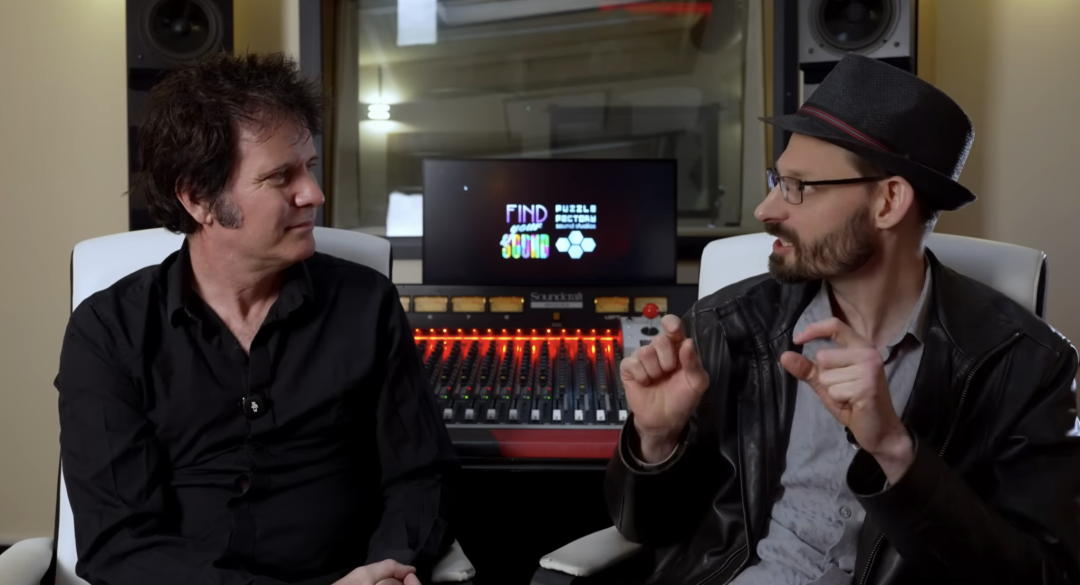
As part of the fellowship, Dax had to write a report, nominally around 2,000 words. He ended up writing roughly 7,000. His mentor on the project was Greg Simmons, a respected engineer and educator who was also the founding editor of Audio Technology magazine in Australia.
Greg read the report, encouraged Dax to submit it to the magazine, and that led to an ongoing column. The central question of both the thesis and the articles was simple but deep: what really happens to our signals when they pass through analogue equipment, and how can we understand and emulate the parts we like inside the box?
He broke it down into the desirable traits, saturation, subtle compression, harmonic enhancement, pleasing randomness, and the less desirable: noise, crosstalk and other limitations. His writing helped many engineers think more clearly about why they love analogue, and how to chase those qualities with intention rather than vague nostalgia, especially when mixing and mastering digitally.
“A few years” becomes now: moving to London
With European parents, Dax had always said he would move to Europe “in a few years”. Like tomorrow, “a few years” is a phrase that can stretch on forever. In 2015 he decided to stop saying it and set a date. He committed to moving in 2016.
In April 2016 he packed his life and studio into a shipping container, sent it to the other side of the world, and began the search for a warehouse space in London that was the right size, in the right place, and not impossibly expensive. Eventually he found what would become The Puzzle Factory and set about hand-building it into the studio you see in the tour.
It was, in his own words, an effort of blood, sweat and tears with no exaggeration. There were huge highs, when things finally clicked, and very low lows, when it felt like everything that could go wrong did. What carried him through was simple perseverance and a clear vision of what he wanted the space to be.
A studio that reflects the person
The Puzzle Factory is not a generic studio. It is a reflection of Dax himself: comfortable, professional, inspiring, and quietly inventive. The colour palette, the retro fridge full of microphones, the custom stands and racks, the lighting, the workflow, it all serves the same purpose. It is designed to make artists feel at ease while also making the technical side invisible, so the creativity can flow.
He has little patience for “we do it this way because that is how we have always done it” thinking. Tradition has its place, however for Dax, convention only matters if it is genuinely useful. Otherwise you design something better.
Today he continues to work as a producer, mixer and mastering engineer, often helping clients shape their projects from the ground up, and still writing, teaching and answering questions from viewers and artists who discover him through studio tours and mix breakdowns.
From a three-year-old pressing forbidden buttons in a radio station to a Churchill Fellow designing desks for Alan Moulder and building one of London’s most distinctive studios, Dax Liniere’s journey is really about one core idea: if the thing you want does not exist yet, learn how it works and build it.