Hi everybody, hope you’re doing marvellously well.
There are some studios that impress you the moment you walk in because of the gear. There are others that get you because of the room, the light, the atmosphere, the history, the feeling that music belongs there.
Salvation Studios in Brighton has all of that.
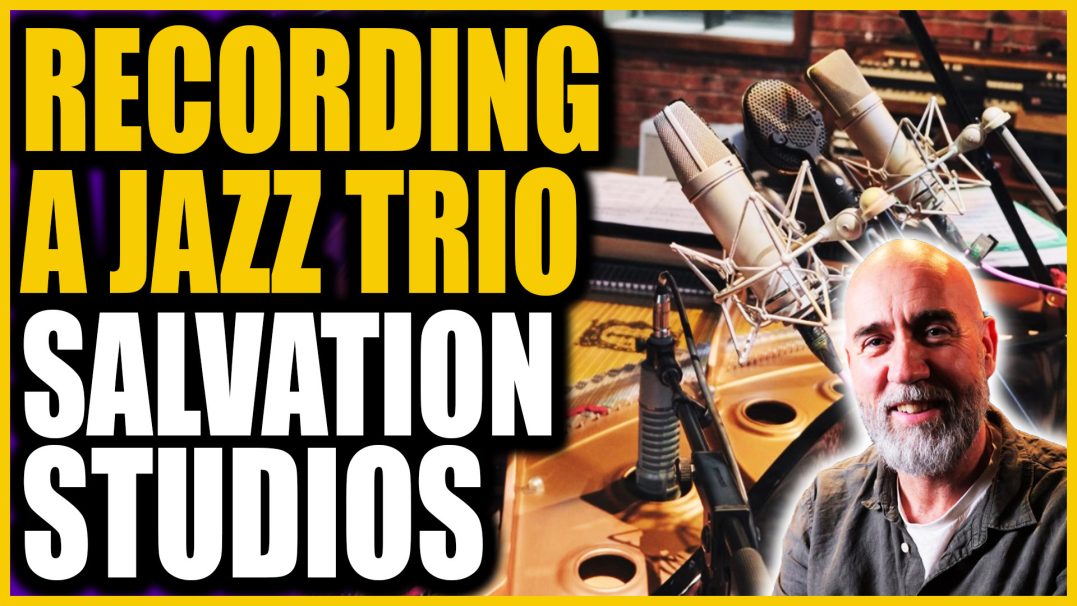
In this studio tour, we visit Salvation Studios in Brighton, a stunning recording space built inside a former Salvation Army Hall dating back to 1910.
The name is not a clever branding exercise. The building really was a Salvation Army Hall, built in 1910, and for more than a century it had music in its walls. The Salvation Army band would have played in the hall, the audience would have gathered in the main room, and the ceiling that still soars above the live space today is the original one.
That is the first thing that struck me. This was not a soulless industrial unit turned into a studio. It was a building with a musical purpose long before microphones, patchbays, ATCs, tape machines and Neve consoles arrived. The wonderful thing is that Russell, the owner, did not just buy the building and turn it into something else. He saved it.
When Russell bought it at auction, the building already had planning permission to be knocked down and turned into live-work units. Instead, he and his team spent four years bringing it back to life as a recording studio, a process made even more complicated by Covid landing right in the middle of the build. The studio finally opened around two years ago, and the result is something very special indeed.

Saving The Building, Keeping The Music
One of the loveliest parts of the story is that the Salvation Army themselves have recognised what Russell has done. A major from the Salvation Army came by, knocked on the door, and said how pleased they were that the building had been kept for music rather than demolished.
That really says it all.
There is something deeply right about taking a hall that once hosted brass bands, community gatherings and music, then turning it into a world-class recording studio. It is not nostalgia for the sake of it. It is continuity. The building is still doing what it was meant to do, just with a lot more microphones and a truly wonderful amount of vintage gear.

A Live Room With Height, Soul And Real Isolation
The main live room is immediately impressive. High, vaulted ceilings, loads of volume, and the original hall still clearly visible in the shape of the room. Russell mentioned the ceiling being around 40 feet high, and you really feel that space when you walk in.
However, this is not just a pretty old room. It has been properly built as a recording environment. The floor is floated, which is a serious investment, however it makes a huge difference. Salvation Studios sits near a fairly busy intersection in Brighton, and yet inside the room you do not hear the traffic. That is not by accident.
Part of that comes from the modern studio build, however part of it comes from the original construction. Russell explained that the original building had two external walls with an air gap between them. You would almost never build that way now because it would be like building two houses, however for sound isolation it is fantastic. You cannot beat air space.
That combination of old construction and modern acoustic work gives the live room a very reassuring quality. It feels open and inspiring, however controlled. It is not splashing around uncontrollably. It has character, however it does not feel like it is going to fight you.
Drum Booths, Room Sounds And Options
Inside the live room there are separate drum spaces that give you different flavours. One booth gives you that tighter, deader 1970s drum sound, where the acoustic changes the moment you walk in. Another area has brick and tile, giving a completely different feel.
That is incredibly useful because it means you can make real decisions at source. You can put the kit in a drier space and keep it tight, or open things up into the larger room and capture those big, natural room sounds we all love. You are not relying on a plugin later to invent a room. You have the room.
Russell has also made sure the in-house drum options are serious. There is a Ludwig kit, a Tama Classic, a C&C kit, and loads of snares. He said this came from years of people turning up with terrible drum kits that simply did not sound good. Haha, we have all been there. A great drummer on a bad kit is still fighting the kit. So he built the studio around the idea that artists could walk in and immediately have access to instruments that sound right.
Tama clearly agree, because they are now using the studio several times a year for social media content, bringing great players in because they love the drum sounds.

A Dangerous Place For Guitar Players
Now, I have to say, if you are a guitar player, Salvation Studios is dangerous.
Russell describes himself as “a bit of an ampaholic,” and that might be underselling it. The studio is absolutely packed with vintage amplifiers, cabinets and guitars. There is a JMP with original Celestions and a cabinet signed inside by Jim Marshall. There is an original Hiwatt DR103 with Fane Crescendos. There is a 1964 Vox AC30 with blue Bulldogs. There is a 1965 Pro Reverb, old Selmers, a Dumble Overdrive Special clone, a 1958 Gibson GA-20, a Watkins suitcase amp, an Ampeg 8×10, and plenty more.
The wonderful thing is that these are not just museum pieces. They are there to be used.
We talked about how, when we were kids, Selmer amps were almost ignored. You could pick them up for next to nothing. Now, of course, everyone has realised they sound fantastic. That is the funny thing about gear. Sometimes the stuff nobody wanted becomes the thing everyone is chasing because it does something different.
And that matters. Today, everyone has access to the same plugins, the same amp sims, the same sample packs. There is nothing wrong with that, however one of the joys of a studio like this is that you can plug into a real amp, in a real room, with real speakers moving air, and create something that is yours.
Wet Leg’s producer Dan Carey apparently used 19 of the studio’s amps on a record, which tells you everything. There is even a tiled toilet that can be miked up for slapback, reamping guitars, or getting strange vocal ambience. That is exactly the kind of thing I love. A studio should invite experimentation.

The Bunker: Production, Toplines And Synth Heaven
Downstairs is the subterranean area, known as The Bunker. Russell said digging it out was an absolute nightmare, and I believe him. However, the result is a fantastic production room and chill-out space that still feels connected to the studio’s identity.
This is where a lot of toplines, production and pre-production happen. It is full of synths, keyboards, monitors, outboard, and comfortable working space. There are Tannoys, Focals, Genelecs, Neve channels, a Wurlitzer, a piano, Coles and Gefell mics, and all sorts of toys that can be moved around the building depending on the session.
Russell made a point that I completely agree with. Two things are often overlooked in studios: lighting and art.
The lighting system at Salvation is computerised and can change the colour and feel of the rooms. That might sound like a luxury, however it affects performance. Artists do not perform in a vacuum. They respond to the environment. If the lighting makes them feel comfortable, inspired, moody, energised, or relaxed, that can end up on the record.
The art is also a huge part of the vibe. The studio features incredible photography by Danny Clifford, including shots of Keith Moon, Lou Reed and others. These are not random decorations. They remind you that you are in a place that takes music seriously, while still having fun with it.
And yes, there is a fantastic Lemmy piece by local artist The Postman. Russell is a huge Lemmy fan, and really, who can argue with that? Lemmy is simply cool.

The Main Control Room: Neve 8068 At The Centre
The main control room is built around a beautiful Neve 8068 console. Russell had owned it before Salvation, using it in his previous studio at home, where he made a lot of records, including work with Ren and Chinchilla.
At Salvation, the console now sits in a proper world-class control room, with excellent line of sight into the live area and an extremely well-thought-out patching system. Jake, one of the house engineers, walked us through the outboard, and it is exactly the kind of setup that makes sense for a working recording studio.
There are Cadac mic pres, a Space Echo, Lexicon PCM80, Bricasti M7, Eventide Orville, Thermionic Culture pieces, Culture Vulture, Distressors, Crane Song STC-8, ADL LA-2A-style compressors, DBX 160s, API 2500, Smart C1, 1176s, a Tube-Tech CL 1B, Pultecs, Manley EQ, Thermionic Culture Swift EQ, tape machine, API 312s, Rupert Neve 543, V72s, Ross modules, and more.
That sounds like a list, however the important thing is that it does not feel random. Jake made the point that they are not light on outboard, however everything they do have is something you actually reach for.
That is the ideal studio rack. Not just gear for the sake of showing off, gear that solves problems and creates sounds.
Tracking First, Mixing When Needed
One thing I really liked hearing from Jake is that the studio’s bread and butter is band tracking. That makes perfect sense. The live room is built for it. The sightlines are right. The booths are flexible. The amp options are brilliant. The console is exactly what you want in front of you when a band is playing.
The Crane Song STC-8, for instance, gets used on vocals, bass and piano. The Tube-Tech CL 1B is there because artists know it and expect it, however also because it genuinely does something special on vocals. The Ross modules give them a different colour from the Neve, faster transient detail with a bit of that transformer body. Jake described it almost like API and Neve having a child, which is a pretty good way of putting it.
That is the beauty of a well-equipped room. You can put most of the drums through the Neve, then use the Ross modules for a front-of-kit or overhead pair and get another flavour. It is not about one “best” thing. It is about having complementary colours.

ATCs, Translation And A Properly Designed Room
The control room uses ATCs, which Jake loves, however he rightly pointed out that speakers are only part of the equation. The room has to work.
This room was designed by John Flynn, who joined us later in the tour and gave a wonderful insight into the design process. John has had an extraordinary career. His first major studio project was Maison Rouge for Ian Anderson of Jethro Tull. From there, through a brilliant chain of connections, he ended up working on Genesis’ studio, The Farm, at Fisher Lane. That project led to a long collaboration with Sam Toyoshima, and together they worked on major rooms including Abbey Road Studio 3.
John explained that the control room follows Sam Toyoshima’s approach, where the front wall is a strong baffle wall for the speakers, while the side walls and ceiling become progressively more absorbent towards the rear. Behind the fabric are slatted reflective elements with absorption behind them, decreasing as you move back through the room.
The idea is that the room supports accurate monitoring without becoming dead in an unnatural way. The speakers are mounted in the wall, which John confirmed is pretty much the ideal from an acoustic design perspective. You get improved bass output because the energy that would go backwards from a freestanding speaker is instead effectively redirected into the room.
And, just as importantly, the room feels good. John made a point that I really appreciated. Because he comes from an architectural background, he cares deeply about how a space looks and feels, not just how it measures. A studio is a creative environment. People spend long hours in it. You do not want a purely functional box that drains the life out of you.
That is something Salvation gets very right. It sounds serious, however it does not feel clinical.

Microphones, Guitars And The Joy Of Real Instruments
The mic collection is also excellent. There are all the expected workhorse mics, 57s, 421s, D112s and so on, however Jake showed us some of the special pieces.
One of the stars is a Gefell CMV 563 with interchangeable capsules, including the M15 cardioid and M8 figure-eight. I love those mics. They look unusual, particularly with the gooseneck, however once people hear them on vocals, piano, rooms or overheads, they immediately understand.
There is also a Beyer M69, which Jake likes on snare instead of a 57 because it gives more low-mid weight. There is a Flea 47, an AEA R88, and a Sony C-800G in its Men in Black-style case. The C-800G is one of those microphones that can be utterly magical on the right singer and completely wrong on another, however when it works, it really does something unique.
The guitar collection is equally fun. There is a 1966 Telecaster, a Manson custom, an 80s Kramer, a 70s SG, a Duesenberg, a Jazzmaster, a Custom Shop Strat, an Epiphone bass, a Les Paul, a Duo-Sonic, a Sandberg California bass, a 12-string Martin that apparently belonged to Trevor Horn, a J-200, a Noel Gallagher prototype, an 80s 335, a Rickenbacker and more.
Again, the theme is the same: artists can arrive with nothing and still make a record.
That is an incredibly powerful thing for a studio to offer. Not just a room and an engineer, but a creative world.

John Flynn On Live Rooms As Instruments
John’s comments about the live room were particularly interesting. He described the difference between a control room and a performance space very simply. In the control room, you only want to hear what comes from the speakers. In the live room, the room itself contributes to the music. It becomes a musical instrument.
That is exactly what you feel at Salvation.
The live room has steel, wood, height, irregular shapes, a mezzanine, booths, and different acoustic pockets. The gallery can even be used for musicians, perhaps a brass section, while also serving practical purposes for the air conditioning system. The original ceiling remains, however the building needed new structural support to carry the additional weight of the soundproofing.
There are so many little details that show how much thought went into it. The roof shapes over the booths. The way the office spaces are treated. The way wood elements curve around rather than just stopping bluntly. The lighting. The stained-glass-style Brighton-themed feature. The balance of old and new.
Nothing feels accidental.
A Studio With Personality
What I love about Salvation Studios is that it has personality without becoming gimmicky.
It is not just vintage for vintage’s sake. It is not modern for modern’s sake. It is not a sterile “luxury” room that looks impressive online but makes musicians feel nervous. It is a proper working studio, built by people who clearly care about records, musicians, tones, performances and atmosphere.
Russell saved a 1910 Salvation Army Hall from demolition and gave it a new life. Jake and Lewis have a room and a collection of equipment that allows them to track real bands properly. John Flynn and the design team created a studio that works acoustically while still feeling inspiring.
That combination is rare.
In a time when so much music is made in bedrooms, laptops and headphones, places like Salvation Studios remind us why great rooms still matter. There is still something incredibly powerful about getting musicians into a space together, putting beautiful microphones in front of great instruments, using amps that move air, and capturing performances in a room that has its own story.
Salvation Studios is not just a clever name.
It is a building that was saved for music, and you can feel that the moment you walk through the door.
If you want to see the full tour, hear the stories, check out the live room, the Neve 8068, the amp collection, the microphones, the guitars, and John Flynn’s amazing insight into the acoustic design, watch the full Salvation Studios video here: