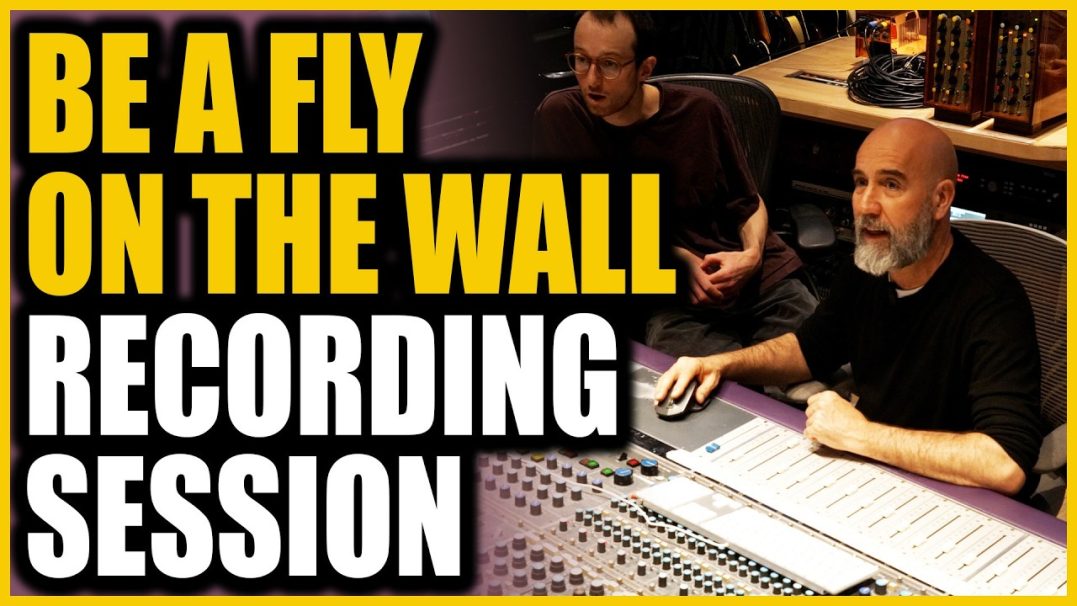
When I walked into Puzzle Factory Sound Studios for the first time I knew immediately this wasn’t just another recording space. It felt like stepping inside the brain of an inventor — equal parts engineer, artist and craftsman. Everywhere I looked there were details that spoke of care and precision: hand-welded fixtures, art deco styling, beautifully treated rooms and gear racks built with an obsessive level of thought.
At the centre of it all stood Dax Liniere — producer, mixer, mastering engineer, builder and in many ways a creative scientist. This studio which he literally built with his own hands reflects everything about who he is.

A Life in a Shipping Container
Dax’s journey to Puzzle Factory perfectly sums up his dedication. In 2016 after a successful career in Australia he packed his entire life into a shipping container and sent it halfway across the world to London to build a new world-class recording complex from scratch. It took him around a year and a half of six and seven-day weeks to complete. Every wall, cable and panel was planned, designed and fitted by him.
He explained to me that he wanted “natural light in every room” and a creative space that felt alive not another dark windowless box pretending to have vibe. The result is stunning. Every room has character, warmth and an unmistakable sense of purpose.
The acoustic design by Jeff Hedback is executed with the same precision. Floating floors, deeply treated ceilings, reversible gobos that switch from absorption to diffusion and velvet drapes to control decay. It’s one of those spaces where you can tell every acoustic decision has been measured, listened to and lived with.

The Control Room: A BBC Heart with Modern Muscle
The first thing that catches your eye in Control Room 2 is a custom-built BBC console refurbished by its original designer Graham Blyth. It’s a piece of British engineering history that Dax has paired with a formidable selection of boutique preamps Chandler TG2 Abbey Road Edition, Atlas Juggernaut Twin, Pendulum Audio MDP-1, Great River MP-2NV and Daking Mic-Pre IV.
He doesn’t use outboard compression or EQ on the way in which surprised me at first. But as Dax explained
“My ethos is to capture everything as cleanly as possible. The sound is in the instrument, the mic choice, the placement and the player.”
And it’s true. Every signal path in this studio is immaculate. He captures clarity and then shapes emotion later.

Lockdown Projects Turned Studio Fixtures
When most of us were learning to bake sourdough during lockdown Dax was engineering entire systems. He built a battery-powered pedal power supply to eliminate hum, a sequential power switcher to safely bring up his racks in the correct order and a retro refrigerator mic locker to store microphones vertically (ideal for ribbons). Inside are gems from Audio-Technica, DPA, AKG and a few quirky vintage pieces like a Film Industries M8 that literally arrived packed in straw.
It’s all so very “Dax” — inventive, elegant and slightly mad in the best possible way.

The RoboMic and The Auditioner
One of the standout inventions in the studio is the RoboMic. Dax designed and built it from scratch — a robotic microphone mover with joystick control from the desk. If you’ve ever walked back and forth between a guitar cabinet and control room trying to find the sweet spot you’ll immediately understand how brilliant this is.
Then there’s The Auditioner, a custom switching system that routes one guitar to up to five amplifiers and two cabinets with a “random” blind-test mode that removes brand bias. As Dax put it “Sometimes the Fender wins. Sometimes it doesn’t. But this way you really listen.”
Recording Philosophy: The Human Element
Dax approaches recording with a refreshing lack of dogma.
“Recording should never be about one rigid way of doing things,” he told me. “Every project has its own demands and motives. There’s only one rule — it has to sound great.”
But as he pointed out “good sound is only part of the picture.” At Puzzle Factory the environment itself is part of the creative process. It’s comfortable, inspiring and quietly efficient. Whether you’re a seasoned session player or tracking your very first single Dax has a way of making the session flow. He listens carefully, makes thoughtful suggestions and ensures that the energy of the music always comes first.
Watching him work reminded me of the best producers I’ve met — people who blend musicality, empathy and a meticulous ear for detail.

The Live Rooms: Space Meets Imagination
Live Room A is a thing of beauty — spacious, flexible and full of character. The walls are lined with reversible acoustic panels and hidden PZM microphones capture the natural ambience of the space. A rare Brady fibreglass kit sits proudly in the centre alongside rows of modified amps and clever two-by-twelve cabinets loaded with mixed speaker types.
He even demonstrated how he can hang a pair of PZMs from the ceiling to capture huge cinematic drum room sounds while keeping the floor clear for musicians. Every inch of this place has been thought through.
Live Room B and Control Room 1 are equally impressive. Control Room 1 Dax’s main mixing and mastering suite is built around a pair of Duntech Princess monitors powered by Hypex Class-D monoblocks. When he played back a mix the clarity and imaging were jaw-dropping. The room itself designed again by Hedback is tuned to within millimetres and treated with hand-painted red quadratic diffusers. It’s precise but welcoming, the mark of a room built by someone who actually makes records not just measures them.

The Man Behind the Machines
It’s easy to get caught up in the gear and Dax certainly has world-class equipment but what really makes him stand out is his background and outlook.
His work across diverse genres and his ability to deliver at a world-class level earned him a Winston Churchill Memorial Trust Fellowship in 2012. A year later he was named Producer of the Year in two different Australian awards. Then in 2016 he took the leap to London and built the studio we’re standing in today.
Dax’s career has been marked by both achievement and curiosity. He’s written for AudioTechnology Magazine and studied under heavyweights like Alan Moulder, Michael Brauer, Joe Chiccarelli and Flood. Over the years he’s also contributed to the development of countless plugins from companies including FabFilter, Eventide, SoundToys, Celemony, Sonnox, u-he and Tokyo Dawn Labs.
That mix of creativity and technical fluency explains why he’s so comfortable moving between producing, mixing and mastering or designing a robot to move a microphone.
“Nothing makes me happier than a great sounding record,” he told me. “I’ll always match the passion an artist brings to their music.”
And that passion is evident in every part of this place.
The Spirit of Puzzle Factory
What struck me most about Puzzle Factory is that it doesn’t just look like a professional studio it feels like a creative home. Dax’s approach is deeply human. He understands that a perfect recording isn’t about perfection it’s about emotion, honesty and connection.
He told me something that really resonated.
“I’d rather hear a great performance recorded imperfectly than a perfect recording of a bad performance.”
That sums up everything about the Puzzle Factory ethos — music first, always.

Why Artists Keep Coming Back
- A studio designed by a producer who solves problems at the source so sessions run smoothly and creatively
- Two adaptable live rooms that morph to suit the sound and mood of the music
- A mix and mastering chain that translates everywhere
- A producer with proven awards, fellowship recognition and decades of hands-on experience
Whether you are recording your debut single, tracking a full band or finishing a mix Dax Liniere will bring the same precision, creativity and enthusiasm to your project as he brings to his own.
If you want to experience a studio built with heart, brain and both hands I can say from experience Puzzle Factory Sound Studios is one of the most inspiring places you’ll ever record in.