An Elegant, Bulletproof Workhorse for Modern Studios
By Warren Huart
When I first laid hands on the Radial Nuance Select, it was immediately clear: this isn’t a flashy toy, it’s a precision tool. It’s solid, straightforward, and unapologetically purposeful—an elegant, bulletproof workhorse built to serve modern studios with zero fuss and maximum fidelity.
Although it’s been quietly available for about a year, this desktop monitor controller from Radial deserves a bit more noise. Why? Because it might just be one of the cleanest, smartest, and most durable monitor controllers I’ve used in years.
First Impressions: Radial Ruggedness
Like every Radial product, the Nuance Select is built like an industrial tank. Enclosed in 14-gauge steel and weighing nearly 2.7 kg (5.88 lb), it radiates durability. It’s the sort of gear you instinctively trust, the kind you know will still be working flawlessly 20 years from now—probably after a few drops and dings.
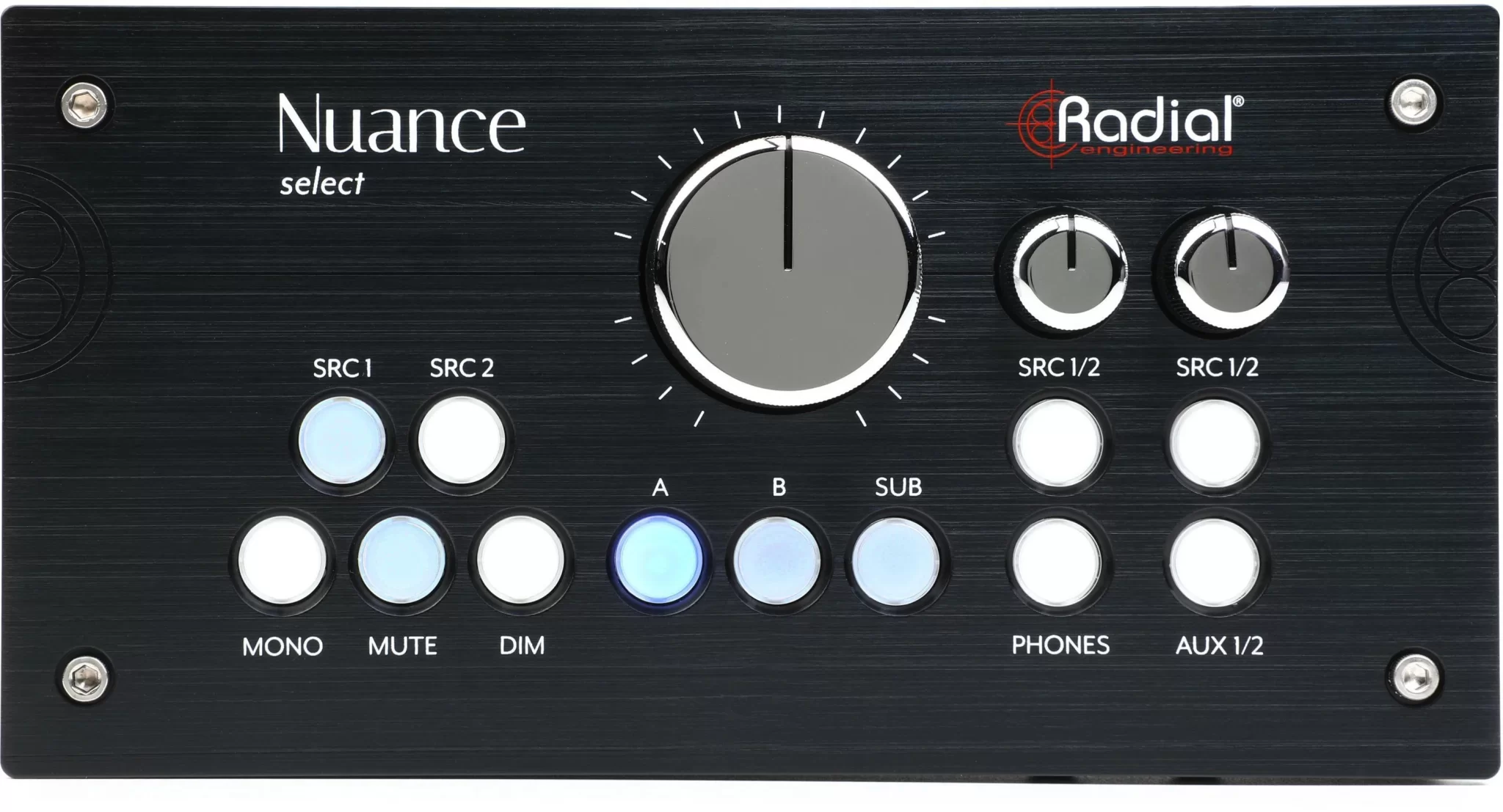
The layout is refreshingly minimalist: clean lines, clearly labelled buttons, and a smooth-turning rotary volume controlthat feels reassuringly mechanical. Every switch is tactile, with no wobbles or soft clicks—just that solid, confident snapthat screams quality.
Specs That Matter
It’s not just about build. The Nuance Select is also one of the most sonically transparent monitor controllers on the market today. Here’s what’s under the hood:
-
Total Harmonic Distortion (THD+N): 0.00001%
-
Frequency Response: ±0.05 dB, 20 Hz to 20 kHz
-
Signal-to-Noise Ratio: >115 dB
-
Crosstalk: Better than -120 dB
-
Input Impedance: 47 kΩ
-
Output Impedance: 100 Ω
That’s studio-grade precision. In real-world terms, it means the Nuance Select doesn’t add or subtract anything from your sound. It doesn’t colour your signal, shift the stereo image, or soften your transients. It gets out of the way—completely.
A Thoughtfully Designed Feature Set
The Nuance Select offers exactly what a modern workflow demands—no more, no less:
Front Panel Controls
-
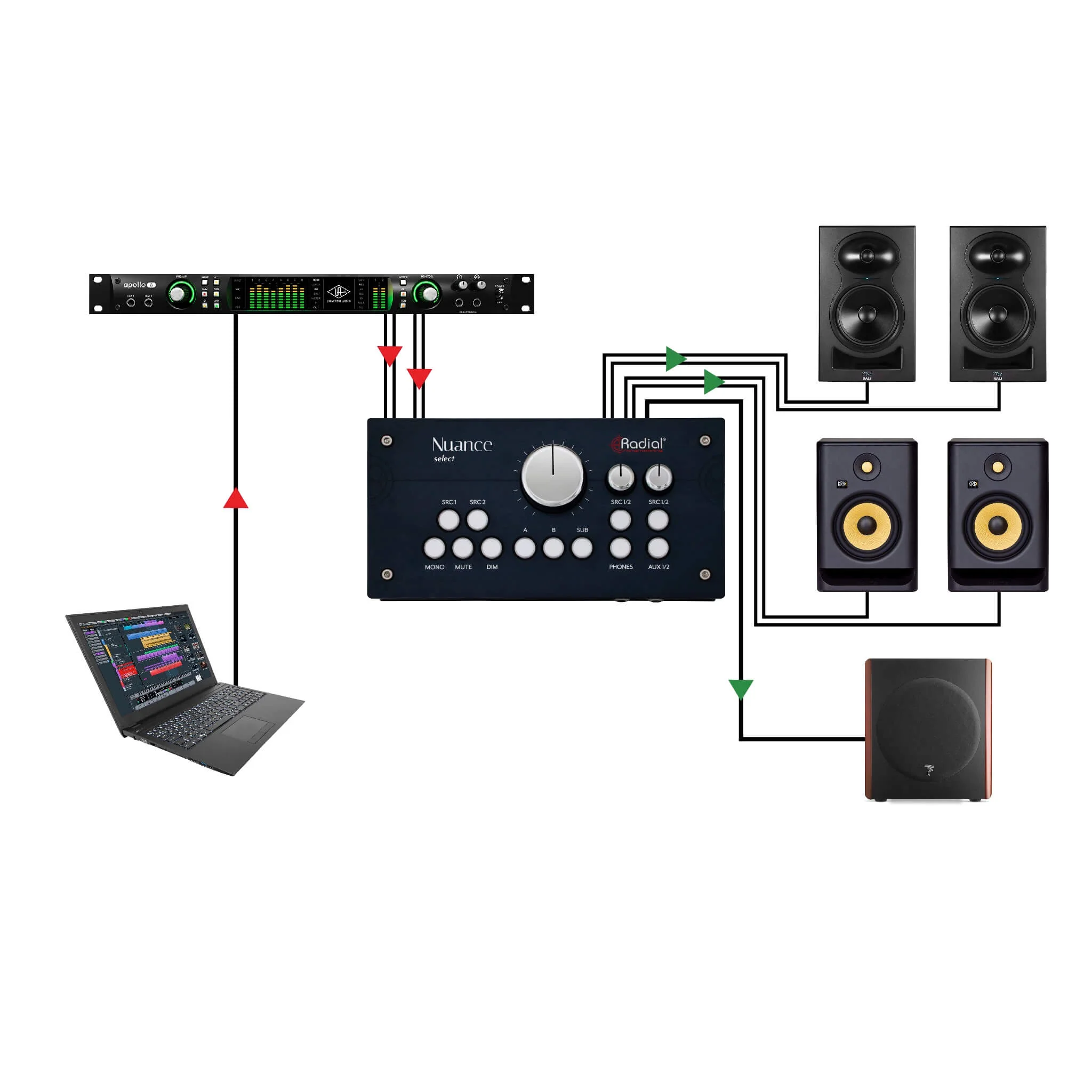
Source Select: Switch between two stereo sources (e.g. DAW and streaming platform)
-
Speaker Select: Toggle between two sets of monitors
-
Subwoofer On/Off
-
Mute, Dim, and Mono buttons
-
Two Headphone Outputs with independent source selection
Rear Panel Connectivity
-
2x Stereo Inputs (¼” TRS balanced)
-
2x Stereo Monitor Outputs
-
Dedicated Subwoofer Output
-
Aux 1 & 2 Outputs (ideal for recording or streaming feeds)
-
15V External Power Supply
The standout feature here is the dual headphone outputs, each with its own source toggle. This is perfect if you’re recording a vocalist while referencing a mix—one set of headphones can be listening to Pro Tools, while the other monitors a Spotify reference.
The Aux outputs are also a smart addition, giving you a fixed-level feed to send to a camera, Zoom recorder, or streaming setup. You rarely see this on monitor controllers at this price point, and it adds considerable flexibility for modern hybrid studios and creators.
In Session: Hearing the Difference
We tested the Nuance Select through ATC SCM25As and Yamaha NS-10s, toggling between a Pro Tools session and system playback via Apple Music. The clarity was instantly noticeable—transients were crisp, stereo imaging was wide and stable, and the low end remained tight and uncoloured.
Even more telling was the mono summing. Many cheaper monitor controllers struggle with this, often collapsing the stereo field unevenly or causing a volume drop. Not here. Pressing the Mono button gave us a dead-centre, consistent sound—exactly what you want when checking your mix for phase issues or mono compatibility.
The listening experience was revealing. I could hear subtle air on the floor tom, natural reverb decay, and the kind of spatial depth that often gets smeared when gear introduces harmonic distortion. This controller doesn’t.
Everyday Workflow Wins
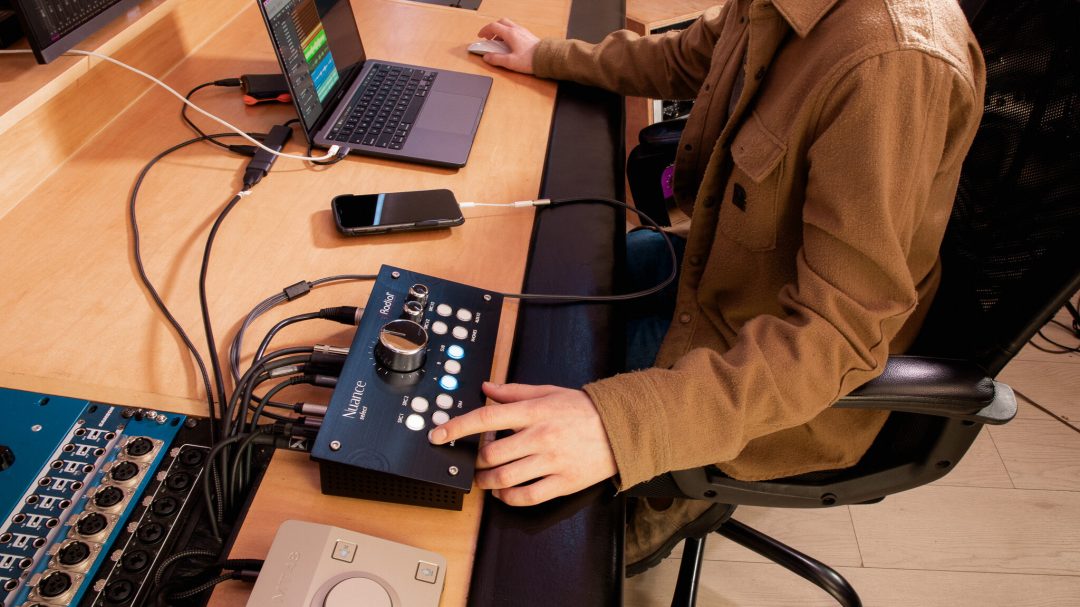
In practice, the Nuance Select helped us move quickly and with confidence. A/B-ing between speaker pairs, switching sub on and off, flicking over to a streaming reference—everything was immediate and intuitive. No menu diving, no software config, no delays.
If you’re mixing in the box and want to maintain pristine audio fidelity through every stage, this controller makes absolute sense. And because the headphone section is so thoughtfully implemented, you’re not limited to just what your interface provides.
Who It’s For
-
Mixing & Mastering Engineers needing ultra-clean, accurate monitoring
-
Home and Project Studio Owners wanting speaker/sub control without sonic compromise
-
Content Creators & Podcasters who need a fixed-level stereo feed for cameras or recorders
-
Studio Collaborators working with vocalists, producers, or clients needing individual headphone feeds
This unit also makes sense in high-end professional environments. Even in studios with consoles like SSL Duality or Neve Genesys, we’ve seen engineers bypass the built-in monitor section in favour of ultra-transparent outboard controllers like this—just to ensure the most accurate signal path.
Price & Value
At $699 USD (approx. £550–£600 in the UK), the Nuance Select isn’t the cheapest controller around, but it punches well above its weight. You’re getting world-class transparency, excellent routing flexibility, dual headphone feeds, and build quality that will outlive your studio desk.
And of course, it’s Radial. These are the folks who make DI boxes so rugged you could throw one off a roof and it’d still pass signal.
Final Verdict: A Future Classic
The Radial Nuance Select hits that rare sweet spot: professional-grade clarity, purpose-driven features, and unbreakable reliability. Whether you’re mixing platinum records, crafting indie releases, or building content in a bedroom setup, this unit offers pure, unfiltered confidence in what you’re hearing.
It’s not fancy. It’s not digital. And it doesn’t try to do a hundred things. It just does the right things, really, really well.
Two thumbs up. A new studio staple.
For full specs and more details, visit the official page:
👉 https://www.radialeng.com/product/nuance-select