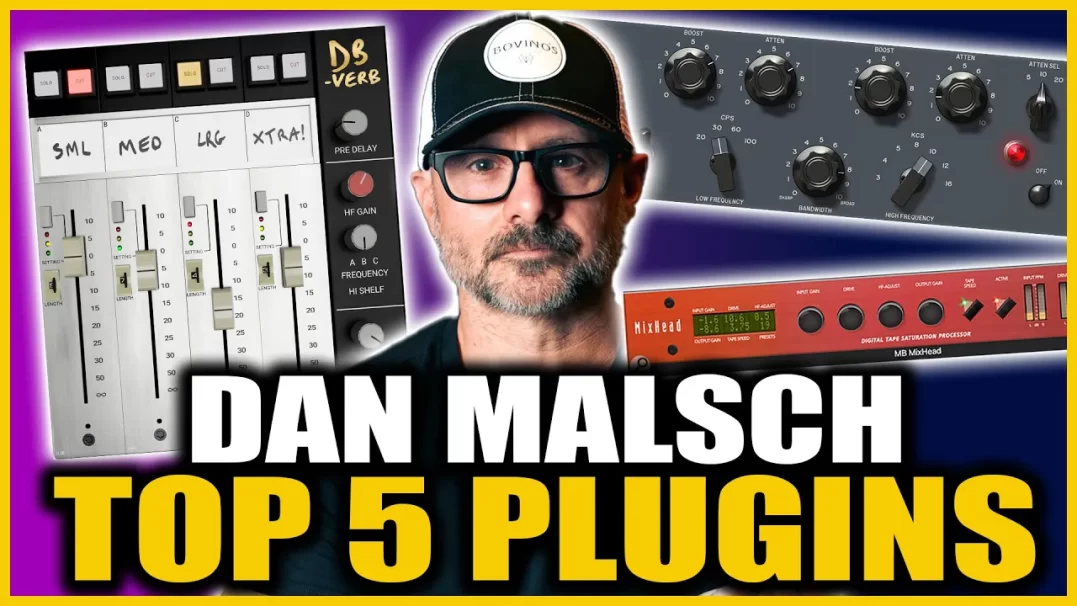
When Dan Malsch talks about mixing, it is worth listening.
This is a mixer and engineer whose work sits right at the intersection of modern rock power, classic analogue workflow and serious major label credibility. Dan has worked with artists including Ghost, Avenged Sevenfold, Gojira and Bowling For Soup, and has built a reputation for mixes that are punchy, aggressive, polished and deeply musical. His work with Ghost alone places him in rare company, including mixing on Skeletá, the band’s chart topping 2025 album, as well as working across their catalogue in Dolby Atmos.
What makes Dan particularly interesting is that his plug in choices are not abstract preferences. They come directly from the way he works every day at Soundmine Recording in Pennsylvania, where his Studio A is centred around a vintage SSL 4000 E/G+ console. In other words, when Dan reaches for a channel strip, compressor, reverb, saturation tool or EQ, he is not simply looking for something that looks good on screen. He is looking for tools that behave like the real world equipment he knows intimately.
In this breakdown, Dan walks through five plug ins that live in his sessions. These are not flavour of the month choices. They are the kind of reliable, mix shaping tools that earn their place by being useful every single day.
If you want to see Dan take this exact kind of thinking into a full modern rock mix, check out his Pro Mix Academy course, Mixing Monolith’s “Mother Martyr.” Dan opens up the complete session, featuring Mike Mangini on drums, and walks through the real decisions behind the drums, bass, guitars, vocals, mix bus and overall impact. You also get the multitracks, so you can follow along, study his moves and mix the song yourself: https://promixacademy.com/course/dan-malsch-mixing-monoliths-mother-martyr/
1. SSL 4K Channel Strip
Dan’s first choice is the SSL 4K Channel Strip, and it is easy to understand why. He mixes on an actual SSL 4000 console, so the sound, layout and behaviour of this style of channel strip is second nature to him.
The SSL 4K lives across his sessions. It is on buses, individual channels, drum tracks, snares, kicks, sub kicks and anywhere else he might want instant access to that familiar SSL sound.
Using Bowling For Soup’s “Holding On To That Hate” as an example, Dan shows the SSL 4K on his drum buses and individual drum tracks. On the snare bus, he adds top end at around 8k and another lift around 5k, bringing out that familiar SSL bite and presence. When he bypasses the EQ, the difference is clear. With the EQ engaged, the snare has more snap, more forward motion and more of that recognisable SSL zing.
Get the SSL 4k channel strip here: https://sweetwater.sjv.io/4ayNqr
However, for Dan, the real magic of an SSL channel strip is not just the EQ. It is the combination of EQ and compression.
On the snare track itself, he leans into the compressor, using a ratio around 3.5:1 with a medium release and only a few dB of gain reduction. It is not about smashing the track beyond recognition. It is about shaping the transient, controlling the energy and making the drum feel more finished.
That says a lot about Dan’s approach. He is not using an SSL style plug in because it is trendy. He is using it because the SSL workflow is part of his musical language. For a mixer who spends his life working on powerful rock records, that immediacy matters.
2. UAD 1176 Blackface
Dan’s second choice is the UAD 1176 Blackface. Again, this is not a theoretical choice. He owns vintage Blackface 1176s in his studio and knows exactly what the hardware does when it is being pushed.
In the session, he shows a Universal Audio 1176 on a vocal, although he makes it clear that he loves 1176s in general. His settings are classic Dan, 4:1 ratio, medium attack, fastest release.
Get the UAD 1176: https://sweetwater.sjv.io/eneWMj
That fastest release setting is important. For Dan, it is part of how the 1176 creates urgency and excitement. On the vocal, he is hitting the compressor hard. It is clamping the performance down, keeping it tight and present, however it is not killing the life of the vocal. In fact, it adds attitude.
That is the beauty of a good 1176. It does not just reduce dynamic range. It adds energy. The Blackface version in particular has a forward, aggressive character that works beautifully on rock vocals. It keeps the singer right in your face without making the performance feel flat.
Dan describes it as adding excitement, and that is exactly what you hear. The vocal becomes more controlled, more confident and more urgent.
For mixers working on rock, punk, metal or any vocal that needs to stand up against dense guitars and heavy drums, this is a crucial lesson. Compression is not just about control. In the right hands, it is part of the performance.
3. DBVerb by David Bendeth, Metric Halo and Make Believe Studios
Dan’s third choice is DBVerb, the David Bendeth reverb from Metric Halo and Make Believe Studios.
This one has become a constant in his sessions. Once he got it, it stayed. That says a lot, because reverbs are deeply personal. Most mixers have dozens of them, however only a few become part of the default template.
DBVerb is built around a very practical idea. It gives you a set of reverbs that feel like the kind of effects an experienced mixer would have ready on a console, especially in an SSL based workflow. Small, medium and large spaces are immediately available, and each has a thick, musical quality.
Dan demonstrates it on snare, moving between the small, medium and large settings. The small and medium verbs are the ones he tends to use most, especially together. They add body, space and density without pulling the drum away from the track.
One interesting part of Dan’s approach is that he does not always run the reverb completely wet, even when using it on a return. He often keeps some of the dry signal coming through because he likes the way it interacts with the reverb. That is a very mixerly move. It is not about following rules. It is about listening to what makes the sound feel better.
The large reverb is more dramatic, almost a whole world of ambience on its own, however Dan uses it more sparingly. The small and medium settings give him the thickness and depth he wants while keeping the track focused.
For drums, and especially snares, DBVerb gives Dan a way to add space without losing punch. That is a big part of modern rock mixing. The drums need to feel huge, however they still need to hit you in the chest.
4. MixHead by Make Believe Studios and Metric Halo
Dan’s fourth choice is MixHead from Make Believe Studios and Metric Halo.
This plug in sits in a very important position in his workflow. It is the first plug in on his mix bus after his analogue mix bus chain comes back into the digital world.
Dan’s analogue mix bus includes serious hardware, including a DW Fearn, SSL Bus+, and BetterMaker EQ. Once the mix returns to the digital side on his print track, MixHead is there as a digital tape saturation processor.
What does it do? In Dan’s words, it smooths out the edges. It adds excitement without making the mix harsh. When he bypasses and re engages it, the sides feel wider, the mix feels a little more alive, and the overall presentation has more polish.
That is exactly the kind of thing a great mix bus processor should do. It should not suddenly change the identity of the mix. It should make everything feel a little more expensive, a little more glued, a little more finished.
Dan uses Rick Carson’s preset as a starting point and keeps the drive fairly controlled. He likes the 30 ips tape speed setting because it gives him a more hi fi sound. The 15 ips option gives more bottom end, however 30 ips suits the polished, open sound he is chasing.
This choice also says a lot about Dan’s taste. He is not using tape saturation to make the mix obviously distorted or vintage. He is using it to create width, smoothness and excitement. It is subtle, however it matters.
In a world where many mixers overdo saturation, Dan’s use of MixHead is a great example of restraint. It is about tone, not novelty.
5. Universal Audio Pultec
Dan’s fifth choice is the Universal Audio Pultec.
This is another choice grounded in real hardware experience. Dan owned a stereo pair of vintage Pultecs, however like many vintage units, they were not perfectly matched left to right. That made them difficult to use across a stereo mix bus. Eventually, he opened up the plug in version and found that it gave him the musical character he wanted with the consistency he needed.
Get the UAD Pultec Bundle here: https://sweetwater.sjv.io/E0ON1K
In the example, he is using a subtle boost around 60 Hz, only about a dB, with no attenuation. The result is not just more low end. It is that classic Pultec sense of weight, roundness and tube character.
Dan points out that even just inserting the EQ can make the track sound better. That is one of the things people love about Pultec style EQs. They are not purely corrective tools. They have a tone. Even before you start boosting or cutting, the circuit itself can add something musical.
For Dan, the UAD Pultec does the “tubey” thing very well, and he finds it very close to the hardware. Sometimes he will not even add bottom end. He will simply insert the EQ because he likes what it does to the signal.
That is the mark of a true colour piece. It is not always about dramatic EQ moves. Sometimes the sound of the box is the move.
Why These Five Plug Ins Matter
What stands out about Dan Malsch’s top five plug ins is how practical they are.
There is no attempt here to impress anyone with obscure tools or complicated chains. These are workhorse processors, chosen because they get results quickly and consistently.
The SSL 4K gives him the console workflow and tone he knows inside out.
The 1176 Blackface gives him aggressive, exciting compression, especially on vocals.
DBVerb gives him thick, musical ambience that works beautifully in rock mixes.
MixHead gives his mix bus polish, width and smooth saturation.
The UAD Pultec gives him tube style weight and tone with the reliability of a plug in.
Together, they reveal a lot about Dan’s mixing philosophy. He is a modern mixer with deep analogue roots. He understands the sound of classic equipment, however he is not precious about using plug ins when they get the job done. His choices are all about speed, familiarity, tone and musical impact.
That makes perfect sense when you look at his credits. Whether he is working with Ghost, Bowling For Soup, Gojira, Avenged Sevenfold or breaking down a Monolith mix for Pro Mix Academy, Dan’s mixes have to deliver power, clarity and excitement. These five plug ins help him get there.
They are not magic bullets. They are trusted tools in the hands of someone who knows exactly what he wants to hear.
And that is the real lesson. Great mixers do not just collect plug ins. They build a language with them.
To go deeper with Dan’s workflow, watch his full Pro Mix Academy course, Mixing Monolith’s “Mother Martyr.” It is a rare chance to sit inside a full Dan Malsch mix session, hear how he builds size, punch and excitement from the ground up, and then apply those ideas yourself with the included multitracks: https://promixacademy.com/course/dan-malsch-mixing-monoliths-mother-martyr/
Have a marvellous time recording and mixing!
Warren